Minbar
1468-1496 (made)
| Artist/Maker | |
| Place of origin |
A minbar, or pulpit, stands to the right of the mihrab niche in major mosques. It is used for the sermons delivered during the midday prayer on Friday, the main service of the week.
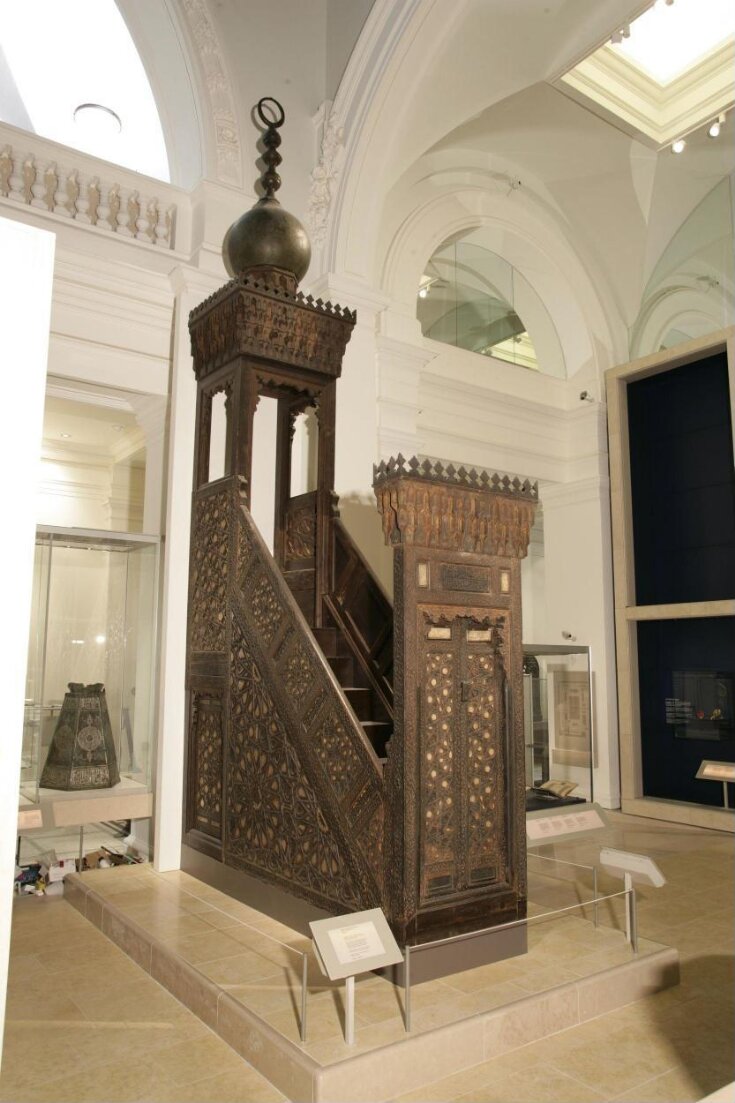
Several woodworking techniques were used to decorate the structure, as here. Most striking are the panels assembled from hundreds of small, carefully shaped pieces of wood. Many, including this one, are set with carved ivory elements, which highlight the complex geometric designs.
The decoration often included carved inscriptions. Here they include the name of Sultan Qa'itbay, who ruled Egypt and Syria from 1468 to 1496. During this time, he earned a reputation for piety. He founded and restored many religious buildings and supplied them with minbars (mosque pulpits).
Several woodworking techniques were used to decorate the structure, as here. Most striking are the panels assembled from hundreds of small, carefully shaped pieces of wood. Many, including this one, are set with carved ivory elements, which highlight the complex geometric designs.
The decoration often included carved inscriptions. Here they include the name of Sultan Qa'itbay, who ruled Egypt and Syria from 1468 to 1496. During this time, he earned a reputation for piety. He founded and restored many religious buildings and supplied them with minbars (mosque pulpits).
Object details
| Categories | |
| Object type | |
| Parts | This object consists of 2 parts. (Some alternative part names are also shown below)
|
| Materials and techniques | Carved wood, inlaid with ivory |
| Brief description | Minbar (Islamic pulpit) made for Sultan Qa'itbay, Cairo, Egypt, 1468-1496 |
| Physical description | Islamic pulpit, of carved wood, inlaid with ivory. |
| Dimensions |
|
| Style | |
| Marks and inscriptions |
|
| Gallery label |
|
| Object history | Purchased in Paris as part of "Dr Meymar's Collection", a group of historic objects sent to France by the Egyptian government, for display at the international exhibition of 1867. In 1869, following discussions at a parliamentary Select Committee in London, the South Kensington Museum (today the V&A) was authorised to buy this collection, with British government funds. "Dr Meymar" was Husayn Fahmi (c.1827-1891), also called Husayn Pasha al-Mi`mar or al-Mi`mari (transliterated as "Meymar", meaning architect), a senior official in the Egyptian administration. He was (in 1864) the chief architect of the Majlis al-Tanzim wa'l-Urnatu, a committee in charge of public works in Cairo, and later (1882-5) a member of the Comite de conservation des monuments de l'Art arabe, which oversaw Cairo's historic heritage. Throughout his career, he was responsible for salvage and removal of historic architectural fittings, and for the construction of modern monuments and streets in the Egyptian capital. Reporting on the 1867 Paris exhibition, Adalbert de Beaumont noted that "Dr Meymarie" had recovered decorative woodwork fragments from the mosque of Ibn Tulun in Cairo, damaged during renovations to the mihrab area. |
| Historical context | Sultan Qa'itbay sponsored a great revival of the arts in Egypt and Syria during his long reign, especially the production of objects used to adorn mosques. This minbar (pulpit), a masterpiece of Islamic woodwork, was part of that program and bears inscriptions with Qa'itbay's name and titles. The decorative scheme is a time-honoured one consisting of central stars which "radiate" intersecting polygons. The design has been carefully assembled like a mosaic from precisely cut strips of wood, then ornamented with materials of subtly contrasting colors, such as ivory and ebony, to create a beautifully integrated ensemble. |
| Production | Dating is based on the attribution to Qaitbay's reign . |
| Subjects depicted | |
| Associations | |
| Summary | A minbar, or pulpit, stands to the right of the mihrab niche in major mosques. It is used for the sermons delivered during the midday prayer on Friday, the main service of the week. Several woodworking techniques were used to decorate the structure, as here. Most striking are the panels assembled from hundreds of small, carefully shaped pieces of wood. Many, including this one, are set with carved ivory elements, which highlight the complex geometric designs. The decoration often included carved inscriptions. Here they include the name of Sultan Qa'itbay, who ruled Egypt and Syria from 1468 to 1496. During this time, he earned a reputation for piety. He founded and restored many religious buildings and supplied them with minbars (mosque pulpits). |
| Associated object | TN.492-2011 (Part) |
| Bibliographic reference | Tim Stanley (ed.), with Mariam Rosser-Owen and Stephen Vernoit, Palace and Mosque: Islamic Art from the Middle East, London, V&A Publications, 2004
pp.24, 28, 37, 100 |
| Collection | |
| Accession number | 1050:1 to 2-1869 |
About this object record
Explore the Collections contains over a million catalogue records, and over half a million images. It is a working database that includes information compiled over the life of the museum. Some of our records may contain offensive and discriminatory language, or reflect outdated ideas, practice and analysis. We are committed to addressing these issues, and to review and update our records accordingly.
You can write to us to suggest improvements to the record.
Suggest feedback
You can write to us to suggest improvements to the record.
Suggest feedback
| Record created | October 6, 2000 |
| Record URL |
Download as: JSONIIIF Manifest
