Mill-Glass
ca. 1570 (made)
| Artist/Maker | |
| Place of origin |
In the 16th century, drinking games were popular in many European countries including the Netherlands. There, special objects were made to encourage alcohol consumption in a social and playful manner.
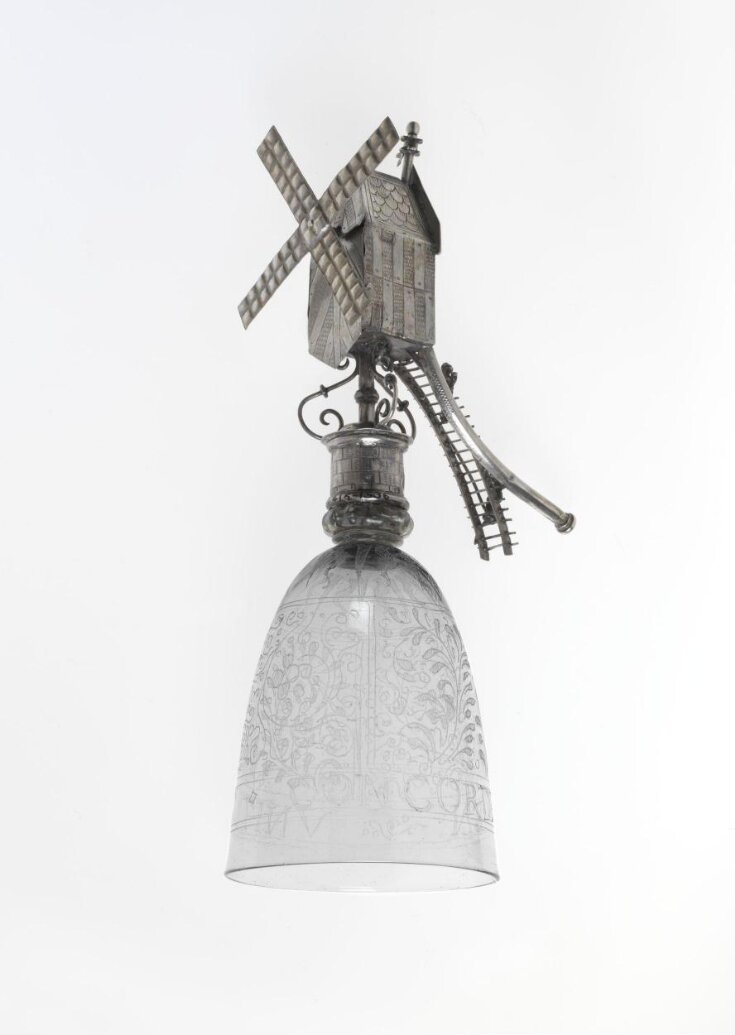
This goblet was specially crafted for such use. When the whistle is blown, both the windmill and the hands of the clock start turning. The drinker would have had to empty the entire contents of the glass before the windmill stopped turning. The price of failure would have been to drain the glass again, as many times as indicated by the clock.
The windmill mount of the goblet probably dates from around 1800 and must be a replacement for an earlier mount. Sometimes a goblet that had lost its foot was subsequently mounted in this manner. However, the engraving on the glass is stylistically contemporary with the glass itself and, since it is written so it can be read only when the glass is turned upside down, it appears that the glass was always intended to be fitted with a mount.
This goblet was specially crafted for such use. When the whistle is blown, both the windmill and the hands of the clock start turning. The drinker would have had to empty the entire contents of the glass before the windmill stopped turning. The price of failure would have been to drain the glass again, as many times as indicated by the clock.
The windmill mount of the goblet probably dates from around 1800 and must be a replacement for an earlier mount. Sometimes a goblet that had lost its foot was subsequently mounted in this manner. However, the engraving on the glass is stylistically contemporary with the glass itself and, since it is written so it can be read only when the glass is turned upside down, it appears that the glass was always intended to be fitted with a mount.
Object details
| Categories | |
| Object type | |
| Materials and techniques | Blown glass, diamond-point engraved and with silver mount |
| Brief description | Mill-glass with silver mount, Netherlands, Antwerp, ca. 1570 |
| Physical description | Glass bowl on a ribbed knop to which is attached a silver mount, bearing the hallmark for Dordrecht. The glass is engraved with a diamond point with scrolls and the inscription: 'CONCORDE EN UNITE'. |
| Dimensions |
|
| Styles | |
| Marks and inscriptions |
|
| Credit line | Wilfred Buckley Collection |
| Object history | The mount probably dates from around 1800 and must be a replacement for an earlier mount. The engraving on the glass is stylistically comtemporary with the glass itself and, as it is written so it can be read only when the glass is turned up side down, it appears that the glass was always intended to be fitted with a mount. |
| Historical context | This goblet was used for a popular drinking game. When the whistle is blown, both the windmill and the hands of the clock start turning. The user would have to drink the entire contents of the glass before the windmill stops turning. If he does not succeed, he will have to drain the glass again, as many times as is indicated by the clock on the windmill. As a result, most contestants will sooner or later end up completely drunk. |
| Production | Tony North 16-12-1992: mount prob. c19th, around 1800; Cf. glass dated 1570 of similar shape and decoration, but with original glass finial, in the Museum für Kunsthandwerk, Frankfurt am Main. ( M. Bauer 1975 = C. und M. Pfoh-stiftung, p. 24, cat. 32 and also Buckley, Diamond engraved glasses..., London 1929 pl. 14-15). The ribbed hollow knob is similar, as are distinctive features of the engraved decoration. The inscription on the Frankfurt glass is: "AMOR VINCIT OMNYA Ao 1570" (see: F.G.A.M. Smit, Line-engraved glass, Peterborough 1994, nrs 67. |
| Summary | In the 16th century, drinking games were popular in many European countries including the Netherlands. There, special objects were made to encourage alcohol consumption in a social and playful manner. This goblet was specially crafted for such use. When the whistle is blown, both the windmill and the hands of the clock start turning. The drinker would have had to empty the entire contents of the glass before the windmill stopped turning. The price of failure would have been to drain the glass again, as many times as indicated by the clock. The windmill mount of the goblet probably dates from around 1800 and must be a replacement for an earlier mount. Sometimes a goblet that had lost its foot was subsequently mounted in this manner. However, the engraving on the glass is stylistically contemporary with the glass itself and, since it is written so it can be read only when the glass is turned upside down, it appears that the glass was always intended to be fitted with a mount. |
| Bibliographic references |
|
| Collection | |
| Accession number | C.416-1936 |
About this object record
Explore the Collections contains over a million catalogue records, and over half a million images. It is a working database that includes information compiled over the life of the museum. Some of our records may contain offensive and discriminatory language, or reflect outdated ideas, practice and analysis. We are committed to addressing these issues, and to review and update our records accordingly.
You can write to us to suggest improvements to the record.
Suggest feedback
You can write to us to suggest improvements to the record.
Suggest feedback
| Record created | December 13, 1997 |
| Record URL |
Download as: JSONIIIF Manifest
