
Coat
Coat
ca. 1900 (made)
ca. 1900 (made)
| Artist/Maker | |
| Place of origin |
When acquired by the Museum in 1905, this woman's marriage coat was described as a Gilyak coat from the lower Amur River near Vladivostok in Eastern Siberia, and a note added that 'The tribe who make this work is said to be dying out.'
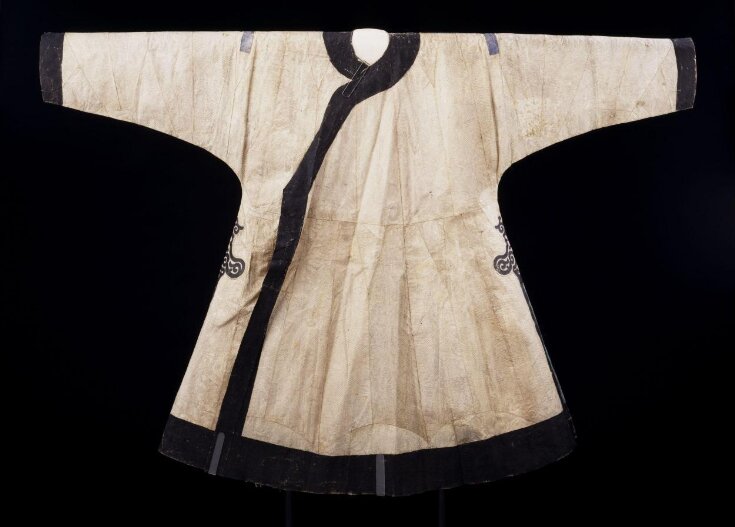
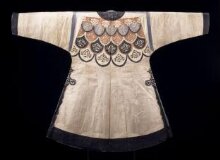
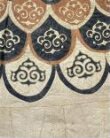
Sixty Pacific salmon, each weighing between 6.8 and 9kg (15 to 20 pounds), were used to make this coat. Their skins have been sewn together with sinew, using the natural shape of the fish to create a subtle decorative pattern of seams. The front of the coat is plain but the upper back is made from a patchwork of overlapping, scale-like panels each decorated with applied skin. The smooth inner side of the salmon skin has been used for the applique and has been painted red, black or blue and been stitched in place using coloured silk. The coat is unlined and has no fastenings, suggesting that it was unused when acquired by the Museum. Similar garments in other collections often have three metal buttons which fasten into leather loops and sometimes they are lined with cotton.
The skins of animals and fish make effective wind- and rain-proof garments which can be vital to human beings who live in dangerously cold environments. They are also an effective and inventive use of natural resources.
Sixty Pacific salmon, each weighing between 6.8 and 9kg (15 to 20 pounds), were used to make this coat. Their skins have been sewn together with sinew, using the natural shape of the fish to create a subtle decorative pattern of seams. The front of the coat is plain but the upper back is made from a patchwork of overlapping, scale-like panels each decorated with applied skin. The smooth inner side of the salmon skin has been used for the applique and has been painted red, black or blue and been stitched in place using coloured silk. The coat is unlined and has no fastenings, suggesting that it was unused when acquired by the Museum. Similar garments in other collections often have three metal buttons which fasten into leather loops and sometimes they are lined with cotton.
The skins of animals and fish make effective wind- and rain-proof garments which can be vital to human beings who live in dangerously cold environments. They are also an effective and inventive use of natural resources.
Object details
| Categories | |
| Object type | |
| Title | Coat |
| Materials and techniques | Sewn salmon skin |
| Brief description | Coat, salmon skin, silk, Siberia, ca.1900 |
| Physical description | A woman's marriage coat of Pacific salmon skin. It was made from the skins of about 60 salmon (each estimated to have weighed between 15 and 20 pounds) sewn together with sinew using the natural shape of the fish as a decorative element. The upper part of the back is decorated by painting (blue, red or black) the inner side of the fish skin (fish-scale shaped pieces) and sewing these small panels down with coloured silk (orange-red, grey-green, dark blue and green). The applied motifs may represent animals faces. The silk was also used to give embroidered outlines to the applied decorative motifs on the lowest set of scale shapes. From the hem upwards on each side of the garment is a black applied and painted wavy panel with a central stripe picked out in a green-blue colour. This panel ends with a finial ornament of a scrolling design with beast faces. The blue bands applied across the shoulders and from shoulder to underarm have two hard, raised ridges which form part of the decoration. A black painted border edges the neck, front overlap panel, hem and sleeves. The outer front panel overlaps the under one from left to right. The coat is unlined and has no fastenings but similar garments in collections in Eastern Europe frequently have cotton linings and three copper or brass buttons, round or flat in shape and possibly of Chinese origin, which fasten into leather loops. (Information provided by personal communications with Natalia Kalashnikova of the Russian Ethnographic Collection in St Petersburg, Vera Kobko of the Pacific Institute in Vladivostok and Christine Hemmet of the Musee de L'Homme, Paris in 1998). This coat may have been unfinished and unused when acquired. The underneath panel is finished with a turned in and stuck hem. The neck edge is turned in and stitched. The hem, sleeve ends and edge of the outer fron panel are finished with a cut edge. Pigment analysis (1998): the blue pigment is probably indigo; the orange-red pigment is a natural earth pigment or ochre; the black is probably a carbon black; the green-blue is probably indigo mixed with another pigment, possibly Dyers Knotgrass. Dye analysis (1998): orange-red is likely to be safflower (Carthamus tinctorius L); grey-green is likely to be knotgrass (Polygonum tinctorum L); dark blue is likely to be knotgrass (P. tinctorum); strong green is likely to be knotgrass (P. tinctorum) plus a natural yellow mordant dye. |
| Dimensions |
|
| Gallery label | WOMAN'S MARRIAGE COAT
Around 1900
Sixty Pacific salmon were used to make this coat. Their skins have been sewn together with sinew, using the natural shape of the fish to create a subtle decorative pattern of seams. The front of the coat is plain but the upper back is made from a patchwork of overlapping panels, each decorated with applied skin. The applique uses the smooth inner side of the salmon skin, painted and stitched in place using coloured silk. The coat is unlined and has no fastenings, suggesting that it was unused when acquired nby the Museum in 1905. Some similar garments in other collections are lined with cotton and have three metal buttons which fasten into leather loops.
Salmon skin, stitched with sinew and silk, and painted.
Eastern Siberia.
Museum no. 626-1905 |
| Historical context | The Fischleder Projekt (Fish Leather Project) at the Amur Art Museum is devoted to this craft |
| Production | When acquired it was described as a Gilyak coat from the lower Amur River near Vladivostok in Eastern Siberia. Note from the file: 'The tribe who make this work is said to be dying out.' The Amur basin is close to the island of Sakhalin, the northernmost region of Japan which was inhabited by the Ainu people. Decorative elements on the coat have much in common with decorative motifs used by the Ainu. |
| Summary | When acquired by the Museum in 1905, this woman's marriage coat was described as a Gilyak coat from the lower Amur River near Vladivostok in Eastern Siberia, and a note added that 'The tribe who make this work is said to be dying out.' Sixty Pacific salmon, each weighing between 6.8 and 9kg (15 to 20 pounds), were used to make this coat. Their skins have been sewn together with sinew, using the natural shape of the fish to create a subtle decorative pattern of seams. The front of the coat is plain but the upper back is made from a patchwork of overlapping, scale-like panels each decorated with applied skin. The smooth inner side of the salmon skin has been used for the applique and has been painted red, black or blue and been stitched in place using coloured silk. The coat is unlined and has no fastenings, suggesting that it was unused when acquired by the Museum. Similar garments in other collections often have three metal buttons which fasten into leather loops and sometimes they are lined with cotton. The skins of animals and fish make effective wind- and rain-proof garments which can be vital to human beings who live in dangerously cold environments. They are also an effective and inventive use of natural resources. |
| Bibliographic reference | Crill, Rosemary, Jennifer Wearden and Verity Wilson. Dress in Detail from Around the World. London: V&A Publications, 2002. 224 p., ill. ISBN 09781851773787. p. 128 |
| Collection | |
| Accession number | 626-1905 |
About this object record
Explore the Collections contains over a million catalogue records, and over half a million images. It is a working database that includes information compiled over the life of the museum. Some of our records may contain offensive and discriminatory language, or reflect outdated ideas, practice and analysis. We are committed to addressing these issues, and to review and update our records accordingly.
You can write to us to suggest improvements to the record.
Suggest feedback
You can write to us to suggest improvements to the record.
Suggest feedback
| Record created | August 10, 2000 |
| Record URL |
Download as: JSONIIIF Manifest
