Flask
1500 - 1550 (made)
| Place of origin |
Venetian enamelled and gilt glass was a luxury product exported all over Italy and beyond. The glassmakers of Venice had an excellent and wide spread reputation for high-quality colourless glass and fine workmanship in gilding and enamelling.
Account books and inventories of the time sometimes mention small numbers of 'worked' or 'gilded' glass and often this is stated to have come from Venice or Murano, the Venetian island on which the glass industry was concentrated. The value of such items was often many times as great as that of ordinary glasses and bottles which were used in much greater quantities.
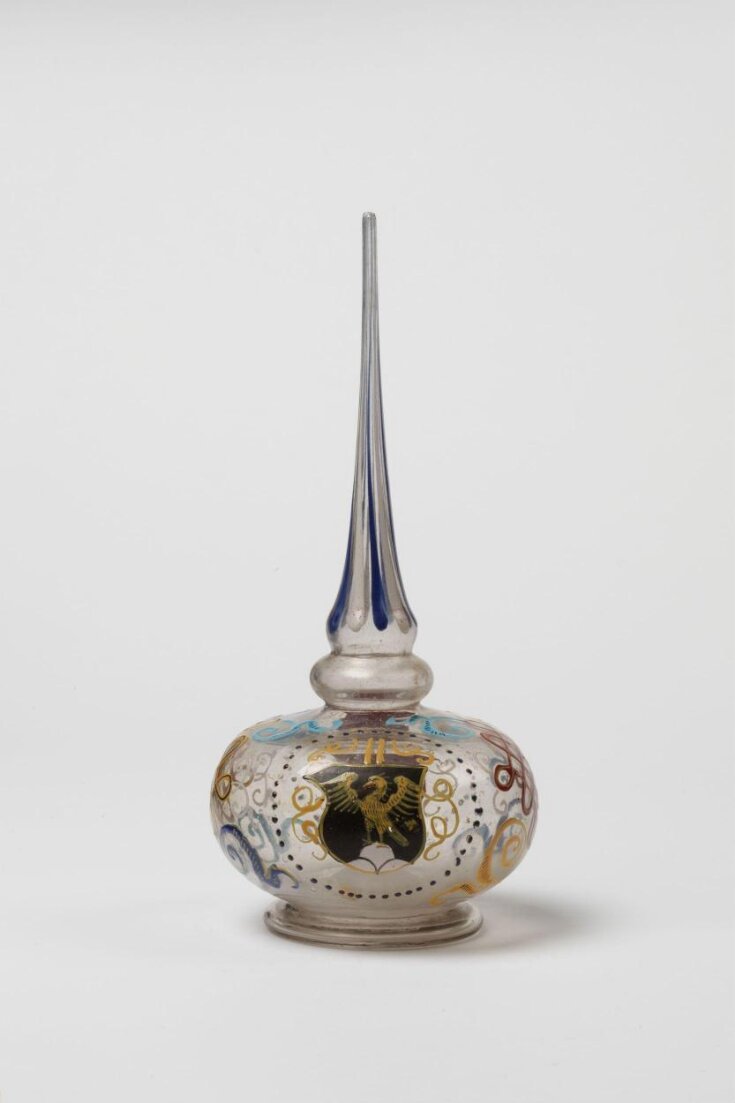
The shape of this sprinkler is derived from silver objects more commonly found in the Middle East, where they were widely used to sprinkle scented water. Some metal sprinklers were made in the Middle East especially for the Italian market, which indicates that this practice must have spread to the West. Our sprinkler was made in Venice and its unidentified European coat of arms, suggests which indicates that it was made as a special commission for an important patron.
Account books and inventories of the time sometimes mention small numbers of 'worked' or 'gilded' glass and often this is stated to have come from Venice or Murano, the Venetian island on which the glass industry was concentrated. The value of such items was often many times as great as that of ordinary glasses and bottles which were used in much greater quantities.
The shape of this sprinkler is derived from silver objects more commonly found in the Middle East, where they were widely used to sprinkle scented water. Some metal sprinklers were made in the Middle East especially for the Italian market, which indicates that this practice must have spread to the West. Our sprinkler was made in Venice and its unidentified European coat of arms, suggests which indicates that it was made as a special commission for an important patron.
Object details
| Category | |
| Object type | |
| Materials and techniques | blown glass, enamelled |
| Brief description | Flask, glass with enamelled decoration, Italy (Venice) 1500-1550 |
| Physical description | Glass sprinkler bottle with long and very narrow neck, enamelled with two coats of arms. |
| Dimensions |
|
| Style | |
| Marks and inscriptions |
|
| Object history | Bought from the Bernal Collection. |
| Historical context | Venetian enamelled and gilt glass was a luxury product exported all over Italy and beyond. The glassmakers of Venice had an excellent and wide spread reputation for high-quality colourless glass and fine workmanship in gilding and enamelling. Account books and inventories of the time sometimes mention small numbers of 'worked' or 'gilded' glass and often this is stated to have come from Venice or Murano, the Venetian island on which the glass industry was concentrated. The value of such items was often many times as great as that of ordinary glasses and bottles which were used in much greater quantities. The shape of this sprinkler is derived from silver objects more commonly found in the Middle East, where they were widely used to sprinkle scented water. Some metal sprinklers were made in the Middle East especially for the Italian market, which indicates that this practice must have spread to the West. Our sprinkler, however, was made in Venice. |
| Summary | Venetian enamelled and gilt glass was a luxury product exported all over Italy and beyond. The glassmakers of Venice had an excellent and wide spread reputation for high-quality colourless glass and fine workmanship in gilding and enamelling. Account books and inventories of the time sometimes mention small numbers of 'worked' or 'gilded' glass and often this is stated to have come from Venice or Murano, the Venetian island on which the glass industry was concentrated. The value of such items was often many times as great as that of ordinary glasses and bottles which were used in much greater quantities. The shape of this sprinkler is derived from silver objects more commonly found in the Middle East, where they were widely used to sprinkle scented water. Some metal sprinklers were made in the Middle East especially for the Italian market, which indicates that this practice must have spread to the West. Our sprinkler was made in Venice and its unidentified European coat of arms, suggests which indicates that it was made as a special commission for an important patron. |
| Bibliographic references |
|
| Other number | 8353 - Glass gallery number |
| Collection | |
| Accession number | 1851-1855 |
About this object record
Explore the Collections contains over a million catalogue records, and over half a million images. It is a working database that includes information compiled over the life of the museum. Some of our records may contain offensive and discriminatory language, or reflect outdated ideas, practice and analysis. We are committed to addressing these issues, and to review and update our records accordingly.
You can write to us to suggest improvements to the record.
Suggest feedback
You can write to us to suggest improvements to the record.
Suggest feedback
| Record created | December 13, 1997 |
| Record URL |
Download as: JSONIIIF Manifest
