
Hanging
late 19th century (made)
| Artist/Maker | |
| Place of origin |
This fine kalaga (pictorial textile hanging) was obtained by a British officer, while stationed in Burma in the latter part of the 19th century.
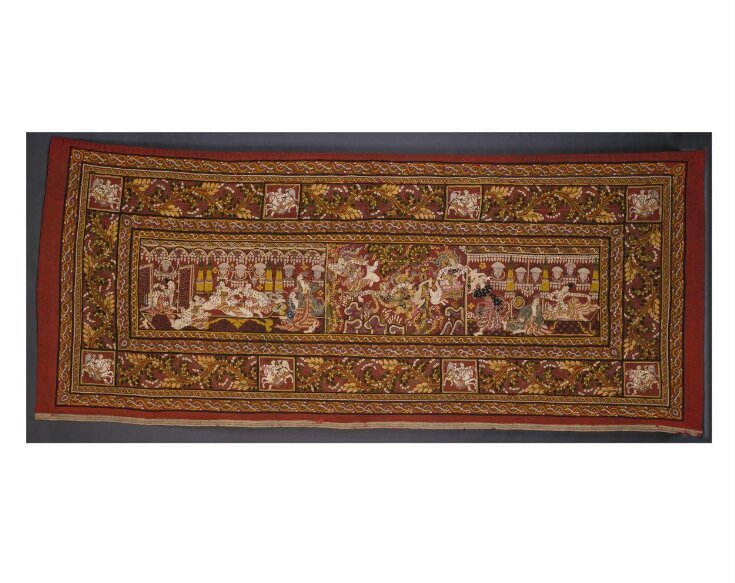
Kalagas were used by the Burmese either as decorative wall hangings, to partition a room or, on festive occasions, to form a screen outside. They grew in popularity from the middle of the 19th century in Burma. This kalaga of red woollen cloth, with an applique design of shaped coloured fabrics (partly painted) and silver sequins, illustrates episodes from the popular Manohari legend. The ornate costumes of the figures are depicted in the stylised tradition of Burmese theatre, themselves relating to those of the Mandalay Court of around 1880.
Britain took control of Burma stage by stage during the 19th century until in 1885 the entire kingdom came under British rule. By this period the extravagantly decorated design of these hangings appealed to Burmese and Europeans alike.
Kalagas were used by the Burmese either as decorative wall hangings, to partition a room or, on festive occasions, to form a screen outside. They grew in popularity from the middle of the 19th century in Burma. This kalaga of red woollen cloth, with an applique design of shaped coloured fabrics (partly painted) and silver sequins, illustrates episodes from the popular Manohari legend. The ornate costumes of the figures are depicted in the stylised tradition of Burmese theatre, themselves relating to those of the Mandalay Court of around 1880.
Britain took control of Burma stage by stage during the 19th century until in 1885 the entire kingdom came under British rule. By this period the extravagantly decorated design of these hangings appealed to Burmese and Europeans alike.
Object details
| Categories | |
| Object type | |
| Materials and techniques | Embroidered wool edged with satin, appliquéd with cotton, velvet and sequins, painted in Indian ink and watercolours |
| Brief description | Embroidered hanging (Kalaga) of dyed woollen cloth, Mandalay, late 19th century. |
| Physical description | Embroidered hanging (Kalaga) of madder-dyed woollen cloth, edged at the top with green satin. The appliqué ornament is executed in shaped pieces of prepared cottons of various tints, coloured woollen fabrics, green velvet, white cotton and silver sequins. The supplementary details are painted in Indian ink and watercolours. Two unrelated scenes from different stories are depicted in the central panel. To the left is a Naga-King with his Queen and two ministers. Another courtly pair are shown before him. In the middle and the end sections are scenes from Manohari or Manohara. The action begins on the right, in which Prince Thudanu, the husband of Dway Mai Naw (Manohari), is in conversation with his minister. Behind them another minister hold the heroine's child up to her as she prepares to fly back to her fairy kingdom called Ngwe Taung (Silver Country) to escape being offered up as a sacrificial victim. In the centre, she flies over mountains and is threatened by a belu-kinnara (demon half-human and half bird-like creature). The borders of this kalaga are decorated with undulating foliate patterns, small panels containing equestrian figures, and a rich variety of acheik motifs. The figures are dressed in the elaborate costumes of the Konbaung Dynasty. |
| Dimensions |
|
| Style | |
| Credit line | Given by Major Sir Bartle C. Frere, Bt, DSO |
| Object history | Manohari or Manohara are from a series of plays based on the Panji legends and cycles of plays of Malaysia and Indonesia. This Kalaga, and IM48 1925 were bequeathed to the donor by the late general Deedes. D.S.O. Rifle Brigade who was his Colonel in the Regiment when in Upper Burmah 1886-1888. Inf. supplied by Noel F. Singer June 2002 |
| Historical context | Kalagas with religious themes were used in the Buddhist Temples of Burma on high festivals and on account of their rarity were lent to the different Temples as required. |
| Production | This was probably made in the same workshop and the designs created by the same artist as IS 297-1890. (Inf. supplied by Noel F. Singer June 2002) |
| Literary reference | Manohari or Manohara are from a series of plays based on the Panji legends and cycles of plays of Malaysia and Indonesia. |
| Summary | This fine kalaga (pictorial textile hanging) was obtained by a British officer, while stationed in Burma in the latter part of the 19th century. Kalagas were used by the Burmese either as decorative wall hangings, to partition a room or, on festive occasions, to form a screen outside. They grew in popularity from the middle of the 19th century in Burma. This kalaga of red woollen cloth, with an applique design of shaped coloured fabrics (partly painted) and silver sequins, illustrates episodes from the popular Manohari legend. The ornate costumes of the figures are depicted in the stylised tradition of Burmese theatre, themselves relating to those of the Mandalay Court of around 1880. Britain took control of Burma stage by stage during the 19th century until in 1885 the entire kingdom came under British rule. By this period the extravagantly decorated design of these hangings appealed to Burmese and Europeans alike. |
| Collection | |
| Accession number | IM.48-1925 |
About this object record
Explore the Collections contains over a million catalogue records, and over half a million images. It is a working database that includes information compiled over the life of the museum. Some of our records may contain offensive and discriminatory language, or reflect outdated ideas, practice and analysis. We are committed to addressing these issues, and to review and update our records accordingly.
You can write to us to suggest improvements to the record.
Suggest feedback
You can write to us to suggest improvements to the record.
Suggest feedback
| Record created | June 27, 2000 |
| Record URL |
Download as: JSONIIIF Manifest
