
Hanging
second half 19th century (made)
| Artist/Maker | |
| Place of origin |
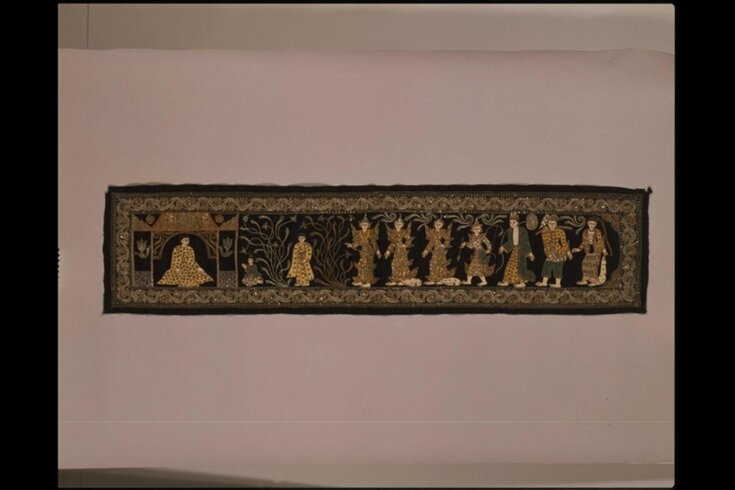
This long kalaga, or pictorial textile hanging, was used to decorate the upper walls of a room. Kalagas were also used to partition a room or, by the Burmese, to form a screen outside on festive occasions. The hanging, of black woollen cloth with an appliqué design of shaped coloured fabrics, sequins and tinsel, shows a scene from a mythological pwe (play) representing a royal procession approaching a Buddhist temple. The costumes of the figures are depicted in the stylised tradition of Burmese theatre and relate to those of the Mandalay Court of around 1880.
This example was obtained by the donor, a British officer, while stationed in Burma in the latter part of the 19th century. Britain had annexed Burma stage by stage through the 19th century until in 1885 the entire kingdom came under British rule. These textiles grew in popularity in Burma from the middle of the 19th century. By the end of the century they were being acquired by both Burmese and Europeans alike.
This example was obtained by the donor, a British officer, while stationed in Burma in the latter part of the 19th century. Britain had annexed Burma stage by stage through the 19th century until in 1885 the entire kingdom came under British rule. These textiles grew in popularity in Burma from the middle of the 19th century. By the end of the century they were being acquired by both Burmese and Europeans alike.
Object details
| Categories | |
| Object type | |
| Materials and techniques | Black woollen cloth, with appliqué work of satin, woollen and cotton material, outlined and embroidered with gold and silver cord and sequins |
| Brief description | Embroidered Burmese kalaga (hanging). Black woollen cloth with an appliqué design, showing a royal procession approaching a Buddhist temple, of coloured cloth, sequins and tinsel. Late 19th century. |
| Physical description | Shows a scene, taken from a mythological play (pwe'), representing a royal procession approaching a Buddhist temple. The border is a floral scroll repeat. |
| Dimensions |
|
| Style | |
| Credit line | Presented by Sydney Vacher Esq, 35 Wellington Street, Strand in the name of the late Lieut. Col. C. L. Barett, 43 Gurkha rifles |
| Object history | Used for decorative purposes at festivals. |
| Production | Attribution note: Used for decorative purposes at festivals. |
| Subject depicted | |
| Summary | This long kalaga, or pictorial textile hanging, was used to decorate the upper walls of a room. Kalagas were also used to partition a room or, by the Burmese, to form a screen outside on festive occasions. The hanging, of black woollen cloth with an appliqué design of shaped coloured fabrics, sequins and tinsel, shows a scene from a mythological pwe (play) representing a royal procession approaching a Buddhist temple. The costumes of the figures are depicted in the stylised tradition of Burmese theatre and relate to those of the Mandalay Court of around 1880. This example was obtained by the donor, a British officer, while stationed in Burma in the latter part of the 19th century. Britain had annexed Burma stage by stage through the 19th century until in 1885 the entire kingdom came under British rule. These textiles grew in popularity in Burma from the middle of the 19th century. By the end of the century they were being acquired by both Burmese and Europeans alike. |
| Collection | |
| Accession number | IS.5-1900 |
About this object record
Explore the Collections contains over a million catalogue records, and over half a million images. It is a working database that includes information compiled over the life of the museum. Some of our records may contain offensive and discriminatory language, or reflect outdated ideas, practice and analysis. We are committed to addressing these issues, and to review and update our records accordingly.
You can write to us to suggest improvements to the record.
Suggest feedback
You can write to us to suggest improvements to the record.
Suggest feedback
| Record created | June 7, 2000 |
| Record URL |
Download as: JSONIIIF Manifest
