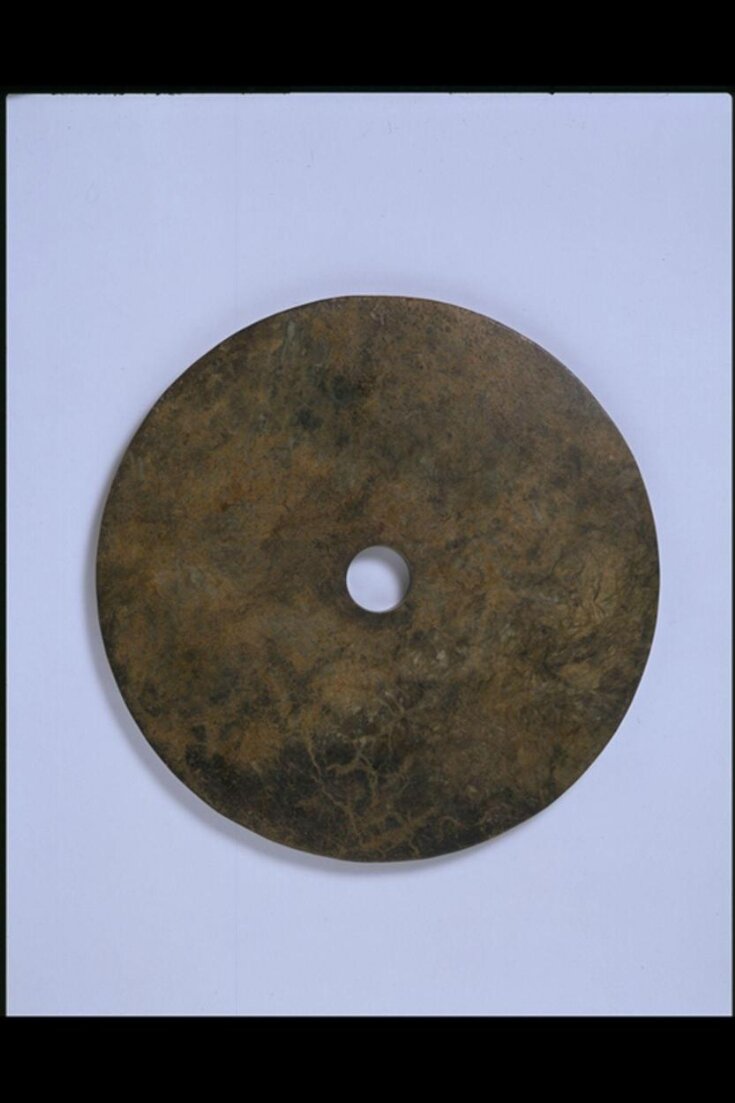
Disc (Bi)
ca. 2500 BC (made)
| Artist/Maker | |
| Place of origin |
A ‘bi’ is a flat circular slab of jade with a central hole. An ancient Chinese text entitled the ‘Zhouli’ (‘Rituals of Zhou’) describes the ‘bi’ as a ceremonial object to sacrifice to Heaven. However the ‘bi’ was made at least a thousand years before the ‘Zhouli’ was written. Its function in prehistoric times remains unknown.
Object details
| Categories | |
| Object type | |
| Materials and techniques | Nephrite jade, carved |
| Brief description | Liangzhu disc (bi) with bird pattern, Nephrite jade, circa 2500 BC |
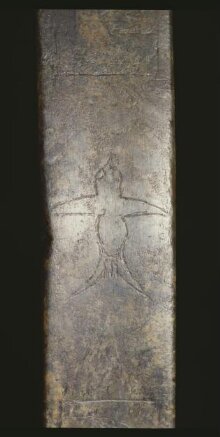
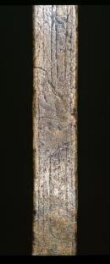
| Physical description | Variegated dark green and brown. Pattern consists of four groups of spirals, four in each group. Between every alternate group of spirals is a small bird with spread wings and short bifurcated tail flying in clockwise direction. One of the birds is clearly discernible but the other one is obscured by encrustations on the stone. Each spiral measures a regular 5cm, and the space between each group is evenly laid out - an indication that the pattern was very carefully executed. No ridge in the hole. An important piece for its size and pattern. It is slightly larger than the bi in the Freer Gallery with similar pattern (nr.17.79) which measures 31.8cm. The pattern is found along the slightly concave outer rims, made up of short, repeated incised lines. |
| Dimensions |
|
| Style | |
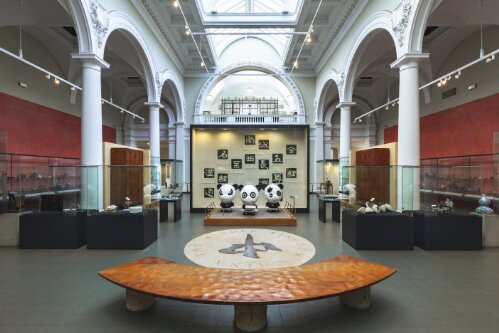
| Gallery label | Disc (bi)
Stone Age
About 2500 BC
Round discs with a central hole are found in many graves. Their significance in prehistorical China is not clear but they may have been ritual objects.
Carved nephrite jade
Liangzhu culture, south China
Museum no. A.42-1936(2007) |
| Credit line | Purchased with Art Fund support, the Vallentin Bequest, Sir Percival David and the Universities China Committee |
| Production | Liangzhu culture |
| Summary | A ‘bi’ is a flat circular slab of jade with a central hole. An ancient Chinese text entitled the ‘Zhouli’ (‘Rituals of Zhou’) describes the ‘bi’ as a ceremonial object to sacrifice to Heaven. However the ‘bi’ was made at least a thousand years before the ‘Zhouli’ was written. Its function in prehistoric times remains unknown. |
| Bibliographic references |
|
| Collection | |
| Accession number | A.42-1936 |
About this object record
Explore the Collections contains over a million catalogue records, and over half a million images. It is a working database that includes information compiled over the life of the museum. Some of our records may contain offensive and discriminatory language, or reflect outdated ideas, practice and analysis. We are committed to addressing these issues, and to review and update our records accordingly.
You can write to us to suggest improvements to the record.
Suggest feedback
You can write to us to suggest improvements to the record.
Suggest feedback
| Record created | May 8, 2000 |
| Record URL |
Download as: JSONIIIF Manifest
