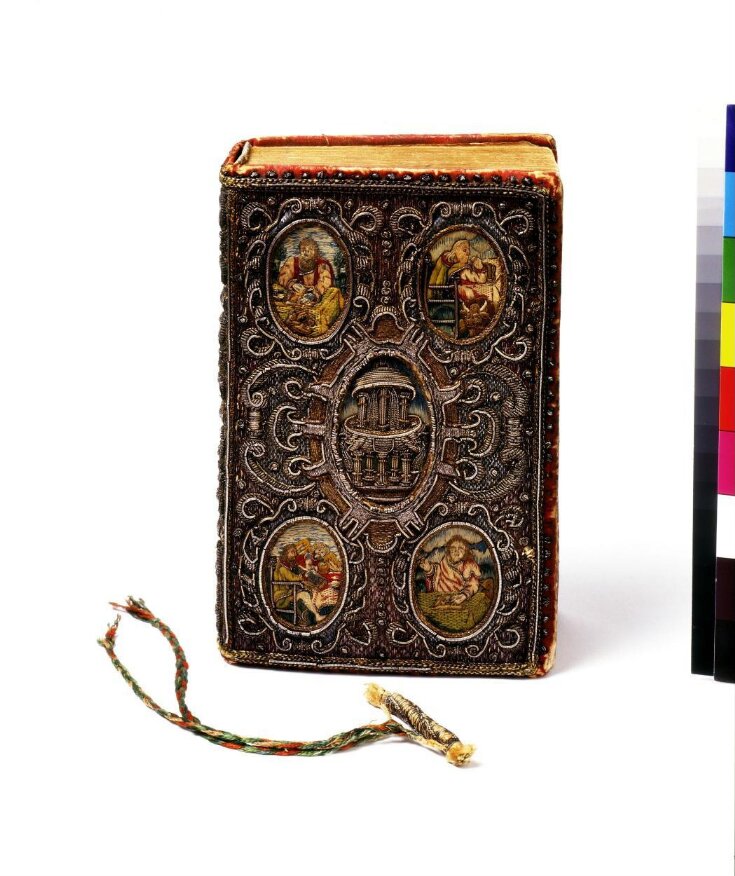
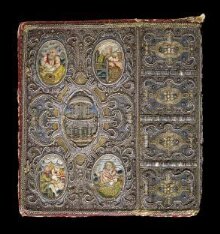

Book Cover and Book Mark
ca. 1634 (made)
| Artist/Maker | |
| Place of origin |
Object Type
Embroidery was much used for the bindings of religious books or presentation copies in England in the 16th and early 17th century. Although new covers might sometimes be made for precious books of an earlier date, the embroidery here is likely to be contemporary with the books.
Materials & Making
Bookbindings were sometimes worked by skilled amateur embroiderers. The best known examples are a series of books with embroidered bindings made by the future Queen Elizabeth I as New Year gifts for her father, Henry VIII, and his last wife, Katherine Parr. However, the materials that have been used here - metal thread, strip and purl - are difficult to use. When applied in embroidery of this quality, they almost always indicate professional work.
People
This binding was almost certainly carried out by a member of the Broderers' Company in London. The company was granted its charter for the organisation of professional work in 1561 and regulated the quality of embroideries sold to the public.
Embroidery was much used for the bindings of religious books or presentation copies in England in the 16th and early 17th century. Although new covers might sometimes be made for precious books of an earlier date, the embroidery here is likely to be contemporary with the books.
Materials & Making
Bookbindings were sometimes worked by skilled amateur embroiderers. The best known examples are a series of books with embroidered bindings made by the future Queen Elizabeth I as New Year gifts for her father, Henry VIII, and his last wife, Katherine Parr. However, the materials that have been used here - metal thread, strip and purl - are difficult to use. When applied in embroidery of this quality, they almost always indicate professional work.
People
This binding was almost certainly carried out by a member of the Broderers' Company in London. The company was granted its charter for the organisation of professional work in 1561 and regulated the quality of embroideries sold to the public.
Object details
| Categories | |
| Object type | |
| Parts | This object consists of 2 parts.
|
| Materials and techniques | Satin covered board, embroidered with silver, silver-gilt-thread, purl and coil, and coloured silks, and plaited threads |
| Brief description | Embroidered binding for 'The Book of Common Prayer' and bookmark, possibly by Broderers Company, embroidered in London, ca. 1634 |
| Physical description | Embroidered binding for 'The Book of Common Prayer' and bookmark. |
| Dimensions | Dimensions checked: Measured; 01/09/1999 by NH |
| Gallery label | British Galleries:
Embroidery was often used for the bindings of precious books. It was supplied by professional embroiderers, members of the Broderers' Company. This binding has an elaborate strapwork design with the Fountain of life in the central cartouche, and smaller pictures of the four Evangelists, Matthew, Mark, Luke and John.(27/03/2003) |
| Credit line | Given by the American and International Friends of the Victoria and Albert Museum, Inc. |
| Object history | Registered File number 1987/707. |
| Production | About 1634, for 'The Booke of Common Prayer', 1633, published by Robert Barker, London; 'The Whole Book of Psalmes', 1634 |
| Subjects depicted | |
| Summary | Object Type Embroidery was much used for the bindings of religious books or presentation copies in England in the 16th and early 17th century. Although new covers might sometimes be made for precious books of an earlier date, the embroidery here is likely to be contemporary with the books. Materials & Making Bookbindings were sometimes worked by skilled amateur embroiderers. The best known examples are a series of books with embroidered bindings made by the future Queen Elizabeth I as New Year gifts for her father, Henry VIII, and his last wife, Katherine Parr. However, the materials that have been used here - metal thread, strip and purl - are difficult to use. When applied in embroidery of this quality, they almost always indicate professional work. People This binding was almost certainly carried out by a member of the Broderers' Company in London. The company was granted its charter for the organisation of professional work in 1561 and regulated the quality of embroideries sold to the public. |
| Bibliographic reference | Official catalogue of the Scottish National Needlework Exhibition, Edinburgh, 1934.
no.4 |
| Collection | |
| Accession number | T.6-1988 |
About this object record
Explore the Collections contains over a million catalogue records, and over half a million images. It is a working database that includes information compiled over the life of the museum. Some of our records may contain offensive and discriminatory language, or reflect outdated ideas, practice and analysis. We are committed to addressing these issues, and to review and update our records accordingly.
You can write to us to suggest improvements to the record.
Suggest feedback
You can write to us to suggest improvements to the record.
Suggest feedback
| Record created | May 4, 2000 |
| Record URL |
Download as: JSONIIIF Manifest
