
Monstrance
1575-1600
| Artist/Maker | |
| Place of origin |
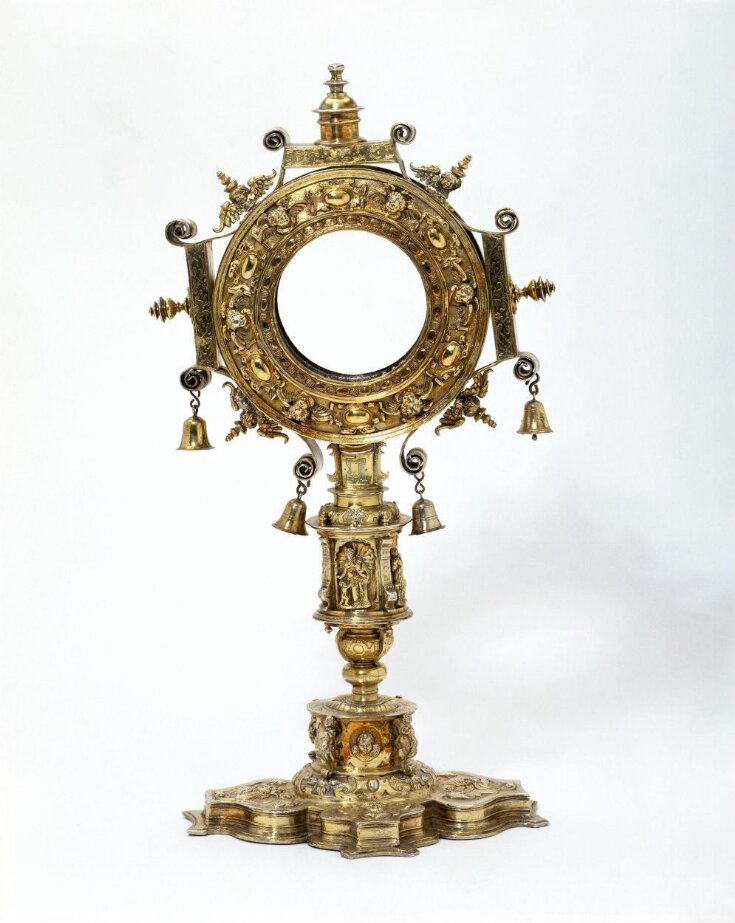
A monstrance is an open or transparent vessel in which the Host (the bread consecrated in the Eucharist) may be displayed, either on an altar or in processions. It is usually made of gold or silver.
Object details
| Categories | |
| Object type | |
| Materials and techniques | Silver gilt; embossing, engraving and casting. |
| Brief description | Silver gilt, Spain (possibly Toledo), last quarter of the 16th century. |
| Physical description | Round monstrance embossed with cherubs and cartouches and framed with engraved panels and cast cherubs. Cylindrical knop with four shell-topped niches filled with cast figures of the Cardinal Virtues and Temperance. Shaped oblong foot embossed with strapwork, cherubs and busts of bearded heads. |
| Dimensions |
|
| Style | |
| Marks and inscriptions | ELISEO
DAVIT (Eliseus was a prophet of Israel -- see Old Testament 1 Kings 19:8-21.
David was the second King of Israel. For his life see the Old Testament, 1 Samuel 16; 1 Kings 2; 1 Chronicles 2, 3, 10-29; Ruth 4:18-22.)
|
| Credit line | Dr W.L. Hildburgh Bequest |
| Object history | Acquired by Leo Hildburgh from the sale of the Baron von Stumm Collection, Berlin, 4th October 1932, Lot 329. |
| Historical context | A monstrance is an open or transparent vessel in which the Host (the bread consecrated in the Eucharist) may be displayed, either on an altar or in processions. It is usually made of gold or silver. |
| Subjects depicted | |
| Summary | A monstrance is an open or transparent vessel in which the Host (the bread consecrated in the Eucharist) may be displayed, either on an altar or in processions. It is usually made of gold or silver. |
| Bibliographic references |
|
| Collection | |
| Accession number | M.384-1956 |
About this object record
Explore the Collections contains over a million catalogue records, and over half a million images. It is a working database that includes information compiled over the life of the museum. Some of our records may contain offensive and discriminatory language, or reflect outdated ideas, practice and analysis. We are committed to addressing these issues, and to review and update our records accordingly.
You can write to us to suggest improvements to the record.
Suggest feedback
You can write to us to suggest improvements to the record.
Suggest feedback
| Record created | June 24, 2009 |
| Record URL |
Download as: JSONIIIF Manifest
