
Delphos
Delphos Dress
ca. 1920 (designed and made)
ca. 1920 (designed and made)
| Artist/Maker | |
| Place of origin |
The ‘Delphos’
‘Delphos’ dresses were produced in Venice, Italy from 1907 until well into the twentieth century, and were sold in Mariano Fortuny shops in various European capitals. Mariano Fortuny garments also became available, in Paris, France, through Vitaldi Babani, who was born into an Istanbul (Turkey) Jewish family and set up the Parisian shop Babani in 1894, and the French fashion designer Paul Poiret. 'Delphos' dresses are made from finely pleated silk, often in one block colour. They typically feature beads made of Venetian glass, used for decoration and weighting and/or as fixings.
For decades these gowns were thought to have been designed by Mariano Fortuny (Mariano Fortuny y Madrazo, Marià Fortuny i de Madrazo, 1871-1949), a Spanish designer based in Venice. More recently evidence has emerged that suggests that Henriette Nigrin (or Negrin, 1877-1965)—a French inventor and designer who was living and working with Fortuny in Venice—was largely if not wholly responsible for the creation of the ‘Delphos’. Comments Fortuny made on a copy of a patent application for the dress’s pleating system acknowledge Nigrin (here referred to as Madame Henrietta Brassart, Brassart being Nigrin’s mother’s surname) as the inventor of this system, which was patented in 1909. The way in which Nigrin described her relationship with ‘Delphos’ dresses suggests that her involvement went beyond the invention of the permanent pleating method, that she was wholly or at least largely responsible for the design.
The pleating method was innovative, but the ‘Delphos’ also looked to the past, in particular early Greece, which had inspired earlier artistic dress reformers in places including Britain and the United States. The dress was modelled on chitons and named after ‘The Charioteer of Delphi’, a bronze statue of a charioteer wearing a chiton produced in Early Classical Greece. The ‘Delphos’ is striking for its chiton-inspired column-like shape, achieved by hand-sewing narrow widths of pleated silk together to form a tube. The chiton’s folds were conducive to free movement, while the ‘Delphos’’s pleats made these dresses elastic, clinging but non-restrictive. The pleats can also be seen to simulate the chiton’s draped quality. Chitons were held in place by fibulae (brooches) at the shoulders and belts at the waist. Comparably, ‘Delphos’ often feature Venetian glass beads around the shoulders and elsewhere, sometimes as fixings, belts, usually of stencilled silk or cord and beads, and concealed drawstrings.
In the early twentieth century in places including Italy, France, and the United States, ‘Delphos’ dresses were considered daring and/or desirable due to their relative informality and clinging yet fluid nature. French stage actor Sarah Bernhardt and Isadora Duncan, a dancer from the United States, were among the first to wear the ‘Delphos’. Other women who could afford these expensive garments began to adopt them as informal tea gowns, but later the ‘Delphos’ became more acceptable for evening wear outside the home. They remained in fashion until around the 1930s, but continued to be produced beyond this time.
This ‘Delphos’
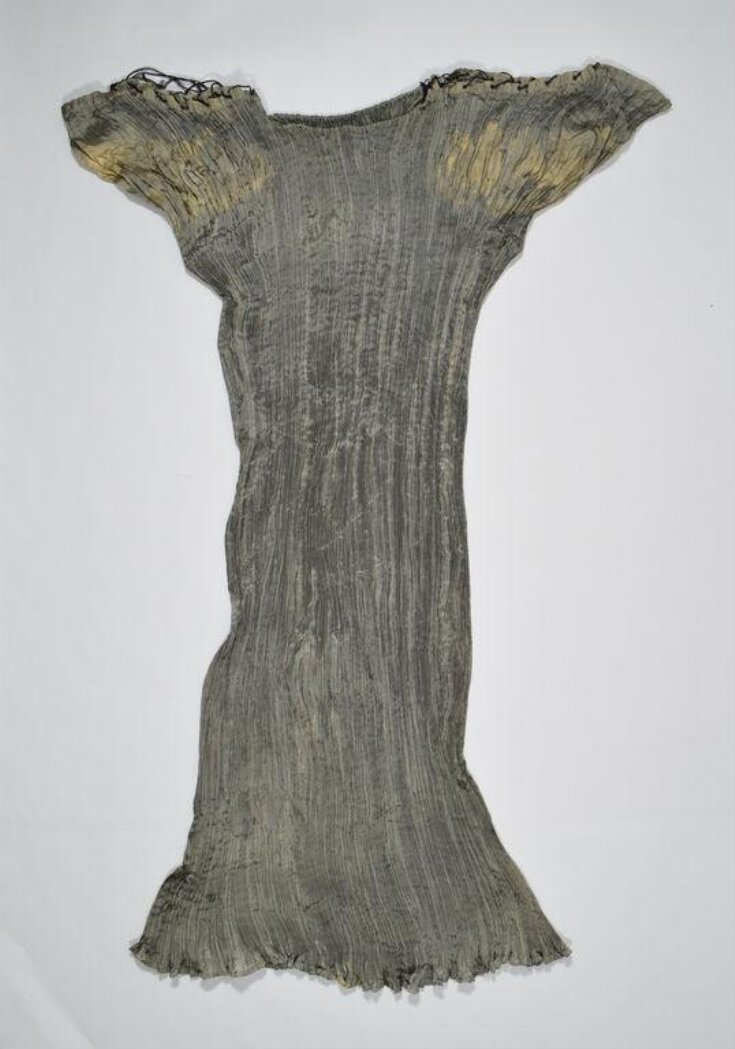
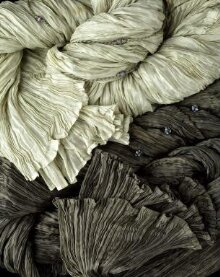
This dress is made dark green silk and features black silk cord with spherical black beads with white spots and blue satin ties.
It was purchased from Babani, situated at 98 Boulevard Haussman. As well as selling Mariano Fortuny pieces, this shop, run by a designer-importer, stocked Liberty textiles and its own fabrics and garments that were markedly influenced by both of these successful brands.
This particular ‘Delphos’ belonged to the famous Italian performer Eleonora Duse, a great friend of Fortuny. Duse is also known for her association with the Italian poet and playwright Gabriele d'Annunzio, and for wearing very little make-up on stage at a time when this was unusual. Duse was the first woman to appear on the cover of Time magazine in July 1923.
Henriette Nigrin (1877-1965) and Mariano Fortuny (1871-1949)
Henriette Nigrin (or Negrin) was born in Fontainebleau, Paris, France in 1877. She was named Adèle Henriette Elisabeth but went by Henriette. Nigrin married her first husband, Jean Eusèbe León Bellorgeot, in Fontainebleau in 1897. She also lived in Marlotte (now Bourron-Marlotte) and is said to have been an artist’s model in Paris. Nigrin’s first marriage was terminated in 1902, the year Nigrin moved to Venice, Italy to be with Mariano Fortuny (Mariano Fortuny y Madrazo, Marià Fortuny i de Madrazo). The couple, who got married in Paris in 1924, would be romantic and creative partners until Fortuny’s death in 1949. Fortuny was born in Granada, Spain in 1871 and studied to be a painter in Paris. He moved to Venice in 1889 and lived there for the rest of his life, while maintaining his Spanish nationality. As well as being a painter, the multi-talented Fortuny was, amongst other things, a lighting engineer and set designer, but he remains best known as a textiles and fashion designer, whose garments were popular with wealthy avant-garde women in places including Italy, France, and the United States from around 1910 to the 1930s. Clients included French stage actor Sarah Bernhardt and Isadora Duncan, a dancer from the United States. Nigrin is increasingly recognised to have played an important part in designing these textiles and garments, the ‘Delphos’ in particular.
Note: In October 2021 the catalogue records for the ‘Delphos’ dresses in the V&A collection were updated to incorporate recent research on Henriette Nigrin. Prior to this, the ‘Delphos’ dresses in the collection were catalogued as designed by Mariano Fortuny.
‘Delphos’ dresses were produced in Venice, Italy from 1907 until well into the twentieth century, and were sold in Mariano Fortuny shops in various European capitals. Mariano Fortuny garments also became available, in Paris, France, through Vitaldi Babani, who was born into an Istanbul (Turkey) Jewish family and set up the Parisian shop Babani in 1894, and the French fashion designer Paul Poiret. 'Delphos' dresses are made from finely pleated silk, often in one block colour. They typically feature beads made of Venetian glass, used for decoration and weighting and/or as fixings.
For decades these gowns were thought to have been designed by Mariano Fortuny (Mariano Fortuny y Madrazo, Marià Fortuny i de Madrazo, 1871-1949), a Spanish designer based in Venice. More recently evidence has emerged that suggests that Henriette Nigrin (or Negrin, 1877-1965)—a French inventor and designer who was living and working with Fortuny in Venice—was largely if not wholly responsible for the creation of the ‘Delphos’. Comments Fortuny made on a copy of a patent application for the dress’s pleating system acknowledge Nigrin (here referred to as Madame Henrietta Brassart, Brassart being Nigrin’s mother’s surname) as the inventor of this system, which was patented in 1909. The way in which Nigrin described her relationship with ‘Delphos’ dresses suggests that her involvement went beyond the invention of the permanent pleating method, that she was wholly or at least largely responsible for the design.
The pleating method was innovative, but the ‘Delphos’ also looked to the past, in particular early Greece, which had inspired earlier artistic dress reformers in places including Britain and the United States. The dress was modelled on chitons and named after ‘The Charioteer of Delphi’, a bronze statue of a charioteer wearing a chiton produced in Early Classical Greece. The ‘Delphos’ is striking for its chiton-inspired column-like shape, achieved by hand-sewing narrow widths of pleated silk together to form a tube. The chiton’s folds were conducive to free movement, while the ‘Delphos’’s pleats made these dresses elastic, clinging but non-restrictive. The pleats can also be seen to simulate the chiton’s draped quality. Chitons were held in place by fibulae (brooches) at the shoulders and belts at the waist. Comparably, ‘Delphos’ often feature Venetian glass beads around the shoulders and elsewhere, sometimes as fixings, belts, usually of stencilled silk or cord and beads, and concealed drawstrings.
In the early twentieth century in places including Italy, France, and the United States, ‘Delphos’ dresses were considered daring and/or desirable due to their relative informality and clinging yet fluid nature. French stage actor Sarah Bernhardt and Isadora Duncan, a dancer from the United States, were among the first to wear the ‘Delphos’. Other women who could afford these expensive garments began to adopt them as informal tea gowns, but later the ‘Delphos’ became more acceptable for evening wear outside the home. They remained in fashion until around the 1930s, but continued to be produced beyond this time.
This ‘Delphos’
This dress is made dark green silk and features black silk cord with spherical black beads with white spots and blue satin ties.
It was purchased from Babani, situated at 98 Boulevard Haussman. As well as selling Mariano Fortuny pieces, this shop, run by a designer-importer, stocked Liberty textiles and its own fabrics and garments that were markedly influenced by both of these successful brands.
This particular ‘Delphos’ belonged to the famous Italian performer Eleonora Duse, a great friend of Fortuny. Duse is also known for her association with the Italian poet and playwright Gabriele d'Annunzio, and for wearing very little make-up on stage at a time when this was unusual. Duse was the first woman to appear on the cover of Time magazine in July 1923.
Henriette Nigrin (1877-1965) and Mariano Fortuny (1871-1949)
Henriette Nigrin (or Negrin) was born in Fontainebleau, Paris, France in 1877. She was named Adèle Henriette Elisabeth but went by Henriette. Nigrin married her first husband, Jean Eusèbe León Bellorgeot, in Fontainebleau in 1897. She also lived in Marlotte (now Bourron-Marlotte) and is said to have been an artist’s model in Paris. Nigrin’s first marriage was terminated in 1902, the year Nigrin moved to Venice, Italy to be with Mariano Fortuny (Mariano Fortuny y Madrazo, Marià Fortuny i de Madrazo). The couple, who got married in Paris in 1924, would be romantic and creative partners until Fortuny’s death in 1949. Fortuny was born in Granada, Spain in 1871 and studied to be a painter in Paris. He moved to Venice in 1889 and lived there for the rest of his life, while maintaining his Spanish nationality. As well as being a painter, the multi-talented Fortuny was, amongst other things, a lighting engineer and set designer, but he remains best known as a textiles and fashion designer, whose garments were popular with wealthy avant-garde women in places including Italy, France, and the United States from around 1910 to the 1930s. Clients included French stage actor Sarah Bernhardt and Isadora Duncan, a dancer from the United States. Nigrin is increasingly recognised to have played an important part in designing these textiles and garments, the ‘Delphos’ in particular.
Note: In October 2021 the catalogue records for the ‘Delphos’ dresses in the V&A collection were updated to incorporate recent research on Henriette Nigrin. Prior to this, the ‘Delphos’ dresses in the collection were catalogued as designed by Mariano Fortuny.
Object details
| Categories | |
| Object type | |
| Title | Delphos (assigned by artist) |
| Materials and techniques | Pleated silk, silk cord with beads |
| Brief description | ‘Delphos’, dress, permanently pleated silk, designed by Henriette Nigrin, possibly with Mariano Fortuny, for Mariano Fortuny, Venice, Italy, retailed by Babani in Paris, France, ca. 1920, dark green pleated silk dress, black silk cord with spherical black beads with white spots, blue satin ties, belonged to Eleonora Duse |
| Physical description | Dress of dark green pleated silk. It is laced at the shoulders with black silk cord and spherical black beads with white spots. It has blue satin ties under the bust to adjust the fit. |
| Dimensions |
|
| Credit line | Given by Fr. Sebastian Bullough |
| Summary | The ‘Delphos’ ‘Delphos’ dresses were produced in Venice, Italy from 1907 until well into the twentieth century, and were sold in Mariano Fortuny shops in various European capitals. Mariano Fortuny garments also became available, in Paris, France, through Vitaldi Babani, who was born into an Istanbul (Turkey) Jewish family and set up the Parisian shop Babani in 1894, and the French fashion designer Paul Poiret. 'Delphos' dresses are made from finely pleated silk, often in one block colour. They typically feature beads made of Venetian glass, used for decoration and weighting and/or as fixings. For decades these gowns were thought to have been designed by Mariano Fortuny (Mariano Fortuny y Madrazo, Marià Fortuny i de Madrazo, 1871-1949), a Spanish designer based in Venice. More recently evidence has emerged that suggests that Henriette Nigrin (or Negrin, 1877-1965)—a French inventor and designer who was living and working with Fortuny in Venice—was largely if not wholly responsible for the creation of the ‘Delphos’. Comments Fortuny made on a copy of a patent application for the dress’s pleating system acknowledge Nigrin (here referred to as Madame Henrietta Brassart, Brassart being Nigrin’s mother’s surname) as the inventor of this system, which was patented in 1909. The way in which Nigrin described her relationship with ‘Delphos’ dresses suggests that her involvement went beyond the invention of the permanent pleating method, that she was wholly or at least largely responsible for the design. The pleating method was innovative, but the ‘Delphos’ also looked to the past, in particular early Greece, which had inspired earlier artistic dress reformers in places including Britain and the United States. The dress was modelled on chitons and named after ‘The Charioteer of Delphi’, a bronze statue of a charioteer wearing a chiton produced in Early Classical Greece. The ‘Delphos’ is striking for its chiton-inspired column-like shape, achieved by hand-sewing narrow widths of pleated silk together to form a tube. The chiton’s folds were conducive to free movement, while the ‘Delphos’’s pleats made these dresses elastic, clinging but non-restrictive. The pleats can also be seen to simulate the chiton’s draped quality. Chitons were held in place by fibulae (brooches) at the shoulders and belts at the waist. Comparably, ‘Delphos’ often feature Venetian glass beads around the shoulders and elsewhere, sometimes as fixings, belts, usually of stencilled silk or cord and beads, and concealed drawstrings. In the early twentieth century in places including Italy, France, and the United States, ‘Delphos’ dresses were considered daring and/or desirable due to their relative informality and clinging yet fluid nature. French stage actor Sarah Bernhardt and Isadora Duncan, a dancer from the United States, were among the first to wear the ‘Delphos’. Other women who could afford these expensive garments began to adopt them as informal tea gowns, but later the ‘Delphos’ became more acceptable for evening wear outside the home. They remained in fashion until around the 1930s, but continued to be produced beyond this time. This ‘Delphos’ This dress is made dark green silk and features black silk cord with spherical black beads with white spots and blue satin ties. It was purchased from Babani, situated at 98 Boulevard Haussman. As well as selling Mariano Fortuny pieces, this shop, run by a designer-importer, stocked Liberty textiles and its own fabrics and garments that were markedly influenced by both of these successful brands. This particular ‘Delphos’ belonged to the famous Italian performer Eleonora Duse, a great friend of Fortuny. Duse is also known for her association with the Italian poet and playwright Gabriele d'Annunzio, and for wearing very little make-up on stage at a time when this was unusual. Duse was the first woman to appear on the cover of Time magazine in July 1923. Henriette Nigrin (1877-1965) and Mariano Fortuny (1871-1949) Henriette Nigrin (or Negrin) was born in Fontainebleau, Paris, France in 1877. She was named Adèle Henriette Elisabeth but went by Henriette. Nigrin married her first husband, Jean Eusèbe León Bellorgeot, in Fontainebleau in 1897. She also lived in Marlotte (now Bourron-Marlotte) and is said to have been an artist’s model in Paris. Nigrin’s first marriage was terminated in 1902, the year Nigrin moved to Venice, Italy to be with Mariano Fortuny (Mariano Fortuny y Madrazo, Marià Fortuny i de Madrazo). The couple, who got married in Paris in 1924, would be romantic and creative partners until Fortuny’s death in 1949. Fortuny was born in Granada, Spain in 1871 and studied to be a painter in Paris. He moved to Venice in 1889 and lived there for the rest of his life, while maintaining his Spanish nationality. As well as being a painter, the multi-talented Fortuny was, amongst other things, a lighting engineer and set designer, but he remains best known as a textiles and fashion designer, whose garments were popular with wealthy avant-garde women in places including Italy, France, and the United States from around 1910 to the 1930s. Clients included French stage actor Sarah Bernhardt and Isadora Duncan, a dancer from the United States. Nigrin is increasingly recognised to have played an important part in designing these textiles and garments, the ‘Delphos’ in particular. Note: In October 2021 the catalogue records for the ‘Delphos’ dresses in the V&A collection were updated to incorporate recent research on Henriette Nigrin. Prior to this, the ‘Delphos’ dresses in the collection were catalogued as designed by Mariano Fortuny. |
| Bibliographic references |
|
| Collection | |
| Accession number | T.740-1972 |
About this object record
Explore the Collections contains over a million catalogue records, and over half a million images. It is a working database that includes information compiled over the life of the museum. Some of our records may contain offensive and discriminatory language, or reflect outdated ideas, practice and analysis. We are committed to addressing these issues, and to review and update our records accordingly.
You can write to us to suggest improvements to the record.
Suggest feedback
You can write to us to suggest improvements to the record.
Suggest feedback
| Record created | June 24, 2009 |
| Record URL |
Download as: JSON
