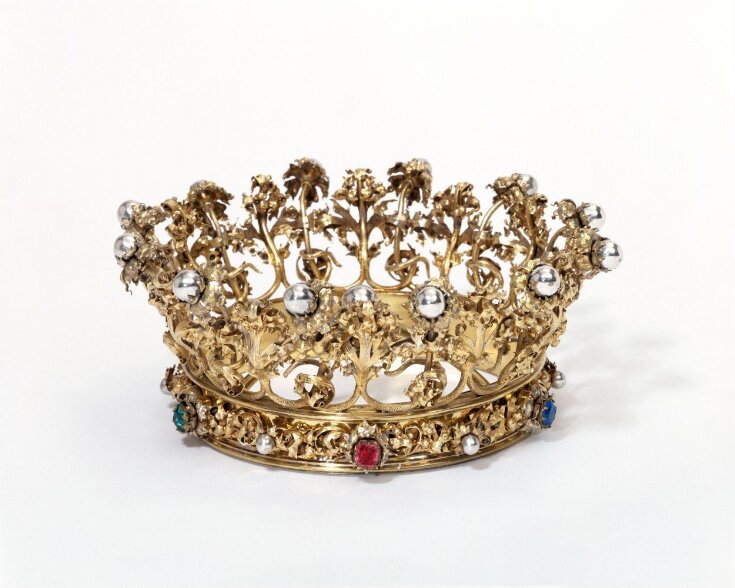
Crown
ca. 1863 (made)
| Artist/Maker | |
| Place of origin |
The crown is a symbol of virtue and martyrdom as well as an emblem of sovereignty. This crown was made for a statue of the Virgin Mary, to remind worshipers of her coronation by Jesus Christ and her high status as ‘Queen of Heaven’.
Object details
| Categories | |
| Object type | |
| Materials and techniques | Silver, parcel gilt, gilt metal set with paste gems |
| Brief description | Gilt metal crown set with paste gems; Germany, ca. 1863. |
| Physical description | Crown for a statue of the Virgin. Silver, parcel-gilt, gilt metal, set with paste gems. |
| Dimensions |
|
| Gallery label |
|
| Object history | This crown was bought for the Museum for £12 12s in 1863. The crown is an emblem of sovereignty as well as a symbol of virtue and martyrdom. Statues of the Virgin Mary were crowned to remind worshipers of her coronation by Jesus Christ and her high status as "Queen of Heaven". |
| Historical context | The Gothic Revival In the Victorian period a dramatic and profound change took place in religious life. Centred on a renewed interest in the Middle Ages, it affected the appearance of churches and how services were conducted. The influential architect A.W.N. Pugin promoted the Gothic as the true Christian style. Although Pugin was Catholic, his theory appealed to Anglicans of the Oxford Movement - radicals who hoped to restore pre-Reformation services to the Church of England. The Cambridge Camden Society, founded in 1839, studied the past to identify the medieval architecture and furnishings that would be appropriate for the revived services. The society became an arbiter of style, offering an Anglicised version of the Gothic. By the 1870s some of the equipment normally found in Catholic worship, such as the ciborium, was appearing in Anglican churches. It was not universally welcomed. Some observers found the incense, the altar cross and the emphasis on ritual scandalously 'Popish' or 'high church'. The Gothic Revival in Europe The Gothic revival in Europe owed more to nationalism than religious zeal. The completion of Cologne's medieval cathedral was an affirmation of German culture. In the Habsburg empire, Czechs and Hungarians similarly expressed national pride through Gothic architecture. Champions of the Gothic claimed by the 1850s that the style was triumphant in Europe. But classical architecture remained a serious rival, even in church building. Much of the most important Gothic work was in church restoration. In Germany and France, goldsmiths like Franz Xaver Hellner supplied Gothic church furnishings. |
| Summary | The crown is a symbol of virtue and martyrdom as well as an emblem of sovereignty. This crown was made for a statue of the Virgin Mary, to remind worshipers of her coronation by Jesus Christ and her high status as ‘Queen of Heaven’. |
| Collection | |
| Accession number | 8362-1863 |
About this object record
Explore the Collections contains over a million catalogue records, and over half a million images. It is a working database that includes information compiled over the life of the museum. Some of our records may contain offensive and discriminatory language, or reflect outdated ideas, practice and analysis. We are committed to addressing these issues, and to review and update our records accordingly.
You can write to us to suggest improvements to the record.
Suggest feedback
You can write to us to suggest improvements to the record.
Suggest feedback
| Record created | April 5, 2000 |
| Record URL |
Download as: JSONIIIF Manifest
