
Palanquin Pole End
ca.1782-1799 (made)
| Artist/Maker | |
| Place of origin |
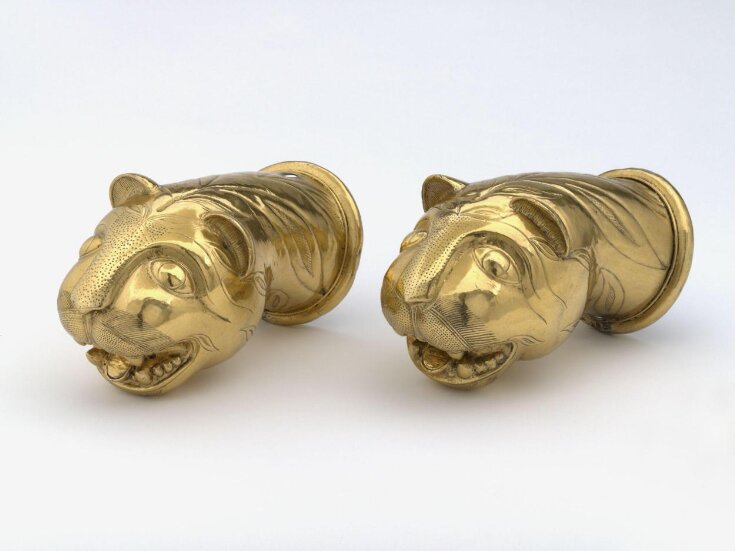
This finial is one of a pair made of thickly gilt silver was probably a terminal from one of the poles supporting a palanquin or howdah. Its decoration identifies it as having been made for Tipu Sultan (r.1782-1799) the Muslim ruler of Mysore in South India. Artefacts made for him personally were decorated with tiger motifs and tiger stripes. Although the use of a tiger head in the decoration of courtly objects was by no means confined to his court, the precise form of the stripes on this finial, the shape of the eye, and the scale of the stripes in relation to the head, all compare closely with other artefacts made for the ruler, notably his mechanical tiger which is also in the V&A (IS.2545). Tipu Sultan's treasury was seized by the British when they defeated the Mysore army at the Siege of Seringapatam in 1799, and divided between the victorious troops. Much of it was immediately resold, and anything made of silver or gold was probably melted down. Although any documentation that may have linked this piece directly with Tipu Sultan has been lost, its origins are apparent from its design. The circumstances under which his treasury was broken up make it very likely that it was taken at the 1799 siege and then given to the India Museum in London. In 1879, the India Museum's collections were transferred to various institutions including the South Kensingon Museum, later renamed the Victoria and Albert Museum.
Object details
| Categories | |
| Object type | |
| Materials and techniques | Silver, gilt |
| Brief description | palanquin, tiger's head; Ritual, silver, gilt punched chased, Mysore, c. 1790 |
| Physical description | Palanquins were the litters used when travelling, the poles used by the bearers to carry the palanquin. The gilt pole-ends are in the form of tigers-heads.The shape of the eyes and the scale of the stripes in relation to the head are closely similar to those of Tipu Sultan's wooden tiger. |
| Dimensions |
|
| Gallery label | POLE ENDS FROM A PALANQUIN
Gilded silver, cast and chased
Mysore
1780-1800
IPN.2599&A
Transferred from the Indian Museum
in 1879
These pole ends probably came from a litter (palanquin) used to carry women of the court when they travelled. The distinctive tiger-stripes, and the way in which the eyes are modelled, are strikingly similar to those on the wooden tiger in this case. This suggests the pole ends were made at Tipu Sultan’s court. All the ruler’s personal possessions were decorated with tiger-stripe motifs. These carried complex political and religious significance and led to the British referring to Tipu Sultan as ‘The Tiger of Mysore’.(27/9/2013) |
| Object history | Unknown because the original number is lost. The decoration, however, indicates that this and its companion were made for Tipu Sultan. |
| Production | probably finials from the ends of poles supporting a howdah or palanquin of Tipu Sultan |
| Subject depicted | |
| Summary | This finial is one of a pair made of thickly gilt silver was probably a terminal from one of the poles supporting a palanquin or howdah. Its decoration identifies it as having been made for Tipu Sultan (r.1782-1799) the Muslim ruler of Mysore in South India. Artefacts made for him personally were decorated with tiger motifs and tiger stripes. Although the use of a tiger head in the decoration of courtly objects was by no means confined to his court, the precise form of the stripes on this finial, the shape of the eye, and the scale of the stripes in relation to the head, all compare closely with other artefacts made for the ruler, notably his mechanical tiger which is also in the V&A (IS.2545). Tipu Sultan's treasury was seized by the British when they defeated the Mysore army at the Siege of Seringapatam in 1799, and divided between the victorious troops. Much of it was immediately resold, and anything made of silver or gold was probably melted down. Although any documentation that may have linked this piece directly with Tipu Sultan has been lost, its origins are apparent from its design. The circumstances under which his treasury was broken up make it very likely that it was taken at the 1799 siege and then given to the India Museum in London. In 1879, the India Museum's collections were transferred to various institutions including the South Kensingon Museum, later renamed the Victoria and Albert Museum. |
| Associated object | |
| Bibliographic reference | Stronge, Susan, Tipu's Tiger, London: V&A Publishing, 2009 ISBN. 9781851775750
p. 50, no. 49
Susan Stronge ‘Rediscovering Tipu Sultan’s Treasury’ in Aziatische Kunst. Feestbundel Voor Pauline Scheurleer, Jaargang 38, Nr. 4, December 2008, 150-157. |
| Collection | |
| Accession number | IPN.2599 |
About this object record
Explore the Collections contains over a million catalogue records, and over half a million images. It is a working database that includes information compiled over the life of the museum. Some of our records may contain offensive and discriminatory language, or reflect outdated ideas, practice and analysis. We are committed to addressing these issues, and to review and update our records accordingly.
You can write to us to suggest improvements to the record.
Suggest feedback
You can write to us to suggest improvements to the record.
Suggest feedback
| Record created | March 27, 2000 |
| Record URL |
Download as: JSONIIIF Manifest
