Cup and Saucer
1715-1720 (made), ca. 1715-1730 (enamelled)
| Artist/Maker | |
| Place of origin |
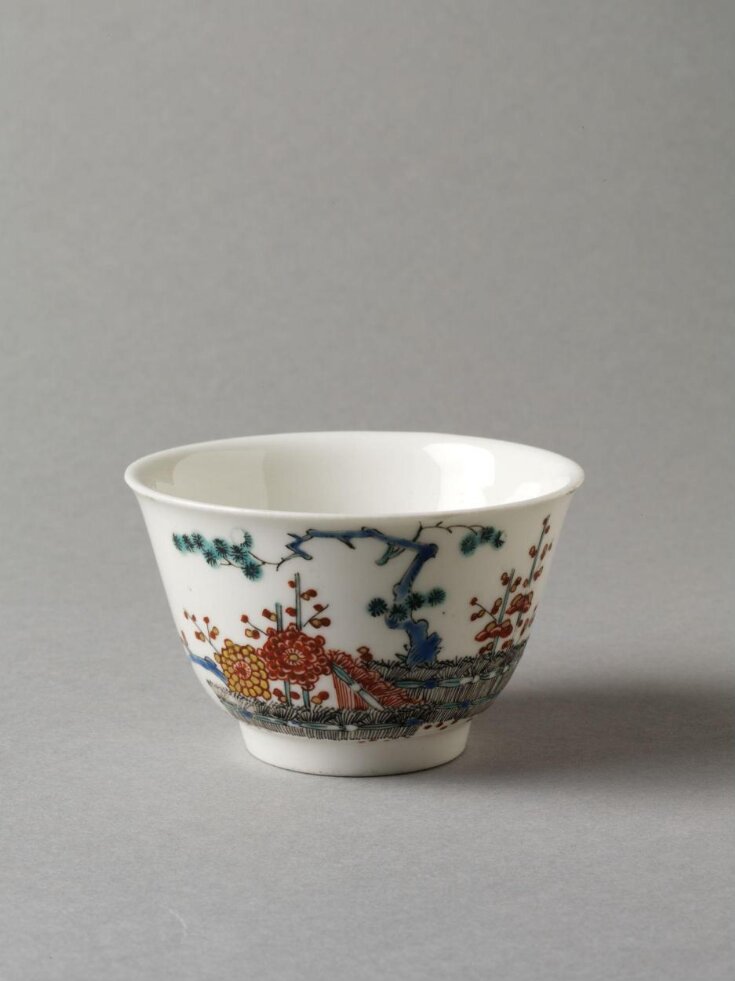
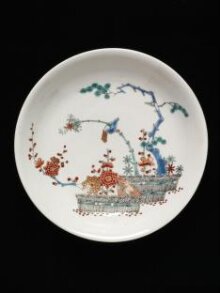
This tea bowl and saucer were made at Meissen but, unlike known Meissen pieces decorated in Japanese taste there are subtle differences, particularly in the palette, which indicate they were not decorated at the factory. They were in fact painted in the Netherlands and may have been part of an infamous scheme to dupe wealthy clients into buying imitations of Japanese porcelains which were very expensive and only imported in small numbers.
The plot centred on a French merchant named Lemaire who was spurred on by the demand for Kakiemon porcelain in Paris. He purchased undecorated Meissen porcelain from the factory warehouse in Dresden in 1728-29, and sent it to be decorated in Holland 'in the taste of old Japan'. He chose Dutch decorators as they were skilled at working on plain white Chinese porcelains and, of course, on their own homegrown earthenwares made in Delft. He arranged for the Meissen pieces he bought not to have the usual underglaze crossed sword marks applied to their bases, or to have the mark applied overglaze so that it could easily be ground off. Luckily the plot was discovered in 1731, by which time the Meissen factory was catering to the fashion for exotic porcelain by decorating its own wares with convincing Japanese designs, copied from authentic Japanese pieces in the Saxon royal collection.
The plot centred on a French merchant named Lemaire who was spurred on by the demand for Kakiemon porcelain in Paris. He purchased undecorated Meissen porcelain from the factory warehouse in Dresden in 1728-29, and sent it to be decorated in Holland 'in the taste of old Japan'. He chose Dutch decorators as they were skilled at working on plain white Chinese porcelains and, of course, on their own homegrown earthenwares made in Delft. He arranged for the Meissen pieces he bought not to have the usual underglaze crossed sword marks applied to their bases, or to have the mark applied overglaze so that it could easily be ground off. Luckily the plot was discovered in 1731, by which time the Meissen factory was catering to the fashion for exotic porcelain by decorating its own wares with convincing Japanese designs, copied from authentic Japanese pieces in the Saxon royal collection.
Object details
| Categories | |
| Object type | |
| Parts | This object consists of 2 parts.
|
| Materials and techniques | Hard-paste porcelain, thrown and enamelled in colours |
| Brief description | Tea bowl and saucer of hard-paste porcelain, made at the Meissen porcelain factory, 1715-20, decorated in Japanese style in the Netherlands about 1715-30. |
| Physical description | Hard-paste porcelain, enamelled in Japanese (kakiemon) style with garden landscapes |
| Style | |
| Subjects depicted | |
| Summary | This tea bowl and saucer were made at Meissen but, unlike known Meissen pieces decorated in Japanese taste there are subtle differences, particularly in the palette, which indicate they were not decorated at the factory. They were in fact painted in the Netherlands and may have been part of an infamous scheme to dupe wealthy clients into buying imitations of Japanese porcelains which were very expensive and only imported in small numbers. The plot centred on a French merchant named Lemaire who was spurred on by the demand for Kakiemon porcelain in Paris. He purchased undecorated Meissen porcelain from the factory warehouse in Dresden in 1728-29, and sent it to be decorated in Holland 'in the taste of old Japan'. He chose Dutch decorators as they were skilled at working on plain white Chinese porcelains and, of course, on their own homegrown earthenwares made in Delft. He arranged for the Meissen pieces he bought not to have the usual underglaze crossed sword marks applied to their bases, or to have the mark applied overglaze so that it could easily be ground off. Luckily the plot was discovered in 1731, by which time the Meissen factory was catering to the fashion for exotic porcelain by decorating its own wares with convincing Japanese designs, copied from authentic Japanese pieces in the Saxon royal collection. |
| Collection | |
| Accession number | C.601&A-1921 |
About this object record
Explore the Collections contains over a million catalogue records, and over half a million images. It is a working database that includes information compiled over the life of the museum. Some of our records may contain offensive and discriminatory language, or reflect outdated ideas, practice and analysis. We are committed to addressing these issues, and to review and update our records accordingly.
You can write to us to suggest improvements to the record.
Suggest feedback
You can write to us to suggest improvements to the record.
Suggest feedback
| Record created | June 24, 2009 |
| Record URL |
Download as: JSONIIIF Manifest
