Vase
1850-1860 (made)
| Artist/Maker | |
| Place of origin |
Object Type
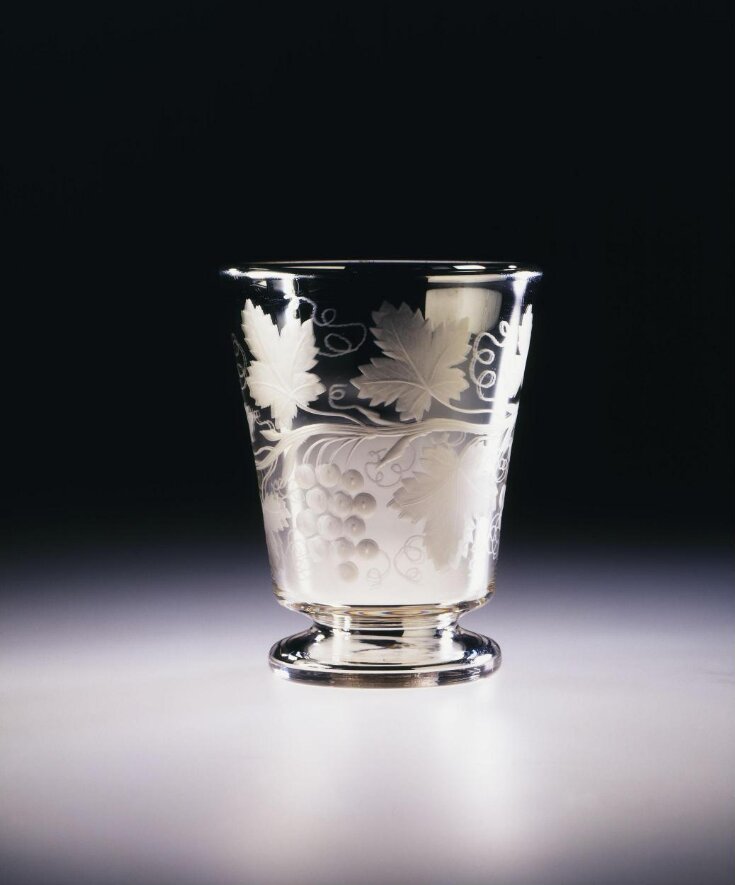
This goblet-shaped vase is a purely decorative object. Although made of glass, with its brilliant silvering and traditional pattern of engraved vine leaves and grapes it is nearest to the bright copper- or silver- lustred ceramic wares typical of north-eastern English potteries. Despite its apparently practical shape, it would have been bought as a curiosity, possibly to impress its owner's visitors.
Materials & Making
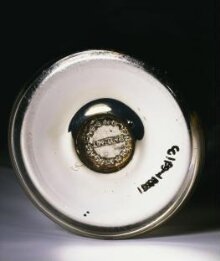
The process of making double-walled silvered glass was patented by Edward Varnish and Frederick Hale Thompson in 1849. A number of glassworks, such as that of James Powell & Sons of Whitefriars, London, made the blanks. A stemmed vase or goblet shape was formed, with the glass-blower stopping short of opening out the mouth. Instead, the top of the vase, still sealed as a bubble-shape, was reheated and 'dropped' inwards to form a double-walled interior. This plain, undecorated vase was then supplied to E. Varnish & Co., where it was filled between the walls from the foot end with a solution of silver nitrate and glucose (in the form of grape juice). The final stage was to seal the hole in the foot with a metal disc, in this example marked for Varnish's Patent.
Time
The silvered glass exhibited by E. Varnish & Co. fascinated commentators on the 1851 Great Exhibition. Varnish's salvers, vases, globes and goblets were bold in size and presentation, using non-tarnishing silver, ornamented with coloured casing, cutting and engraving. The process 'added a richness and beauty of colouring to that material of which few could deem it capable of receiving' (Illustrated London News).
This goblet-shaped vase is a purely decorative object. Although made of glass, with its brilliant silvering and traditional pattern of engraved vine leaves and grapes it is nearest to the bright copper- or silver- lustred ceramic wares typical of north-eastern English potteries. Despite its apparently practical shape, it would have been bought as a curiosity, possibly to impress its owner's visitors.
Materials & Making
The process of making double-walled silvered glass was patented by Edward Varnish and Frederick Hale Thompson in 1849. A number of glassworks, such as that of James Powell & Sons of Whitefriars, London, made the blanks. A stemmed vase or goblet shape was formed, with the glass-blower stopping short of opening out the mouth. Instead, the top of the vase, still sealed as a bubble-shape, was reheated and 'dropped' inwards to form a double-walled interior. This plain, undecorated vase was then supplied to E. Varnish & Co., where it was filled between the walls from the foot end with a solution of silver nitrate and glucose (in the form of grape juice). The final stage was to seal the hole in the foot with a metal disc, in this example marked for Varnish's Patent.
Time
The silvered glass exhibited by E. Varnish & Co. fascinated commentators on the 1851 Great Exhibition. Varnish's salvers, vases, globes and goblets were bold in size and presentation, using non-tarnishing silver, ornamented with coloured casing, cutting and engraving. The process 'added a richness and beauty of colouring to that material of which few could deem it capable of receiving' (Illustrated London News).
Object details
| Categories | |
| Object type | |
| Materials and techniques | Silvered glass, engraved |
| Brief description | Vase, England (probably London), patent of Hale Thomson, attributed to J. Powell & Sons, 1849-1855, C.19-1961 and C.19 A-1961 |
| Physical description | One of a pair of vases, double-walled, silvered and engraved. |
| Dimensions |
|
| Style | |
| Marks and inscriptions | 'Hale Thomson's Patent London' (Makers's mark) |
| Gallery label | British Galleries:
Double-walled silvered glass was a novelty that was very successful. Edward Varnish and Frederick Hale Thomson took out the main patent for the process in 1849. The effect was made by pouring a silvering solution between two walls of glass.(03/27/2003) |
| Object history | Probably made by James Powell & Sons, Whitefriars Glassworks, London. |
| Summary | Object Type This goblet-shaped vase is a purely decorative object. Although made of glass, with its brilliant silvering and traditional pattern of engraved vine leaves and grapes it is nearest to the bright copper- or silver- lustred ceramic wares typical of north-eastern English potteries. Despite its apparently practical shape, it would have been bought as a curiosity, possibly to impress its owner's visitors. Materials & Making The process of making double-walled silvered glass was patented by Edward Varnish and Frederick Hale Thompson in 1849. A number of glassworks, such as that of James Powell & Sons of Whitefriars, London, made the blanks. A stemmed vase or goblet shape was formed, with the glass-blower stopping short of opening out the mouth. Instead, the top of the vase, still sealed as a bubble-shape, was reheated and 'dropped' inwards to form a double-walled interior. This plain, undecorated vase was then supplied to E. Varnish & Co., where it was filled between the walls from the foot end with a solution of silver nitrate and glucose (in the form of grape juice). The final stage was to seal the hole in the foot with a metal disc, in this example marked for Varnish's Patent. Time The silvered glass exhibited by E. Varnish & Co. fascinated commentators on the 1851 Great Exhibition. Varnish's salvers, vases, globes and goblets were bold in size and presentation, using non-tarnishing silver, ornamented with coloured casing, cutting and engraving. The process 'added a richness and beauty of colouring to that material of which few could deem it capable of receiving' (Illustrated London News). |
| Other number | 0765 - Glass gallery number |
| Collection | |
| Accession number | C.19-1961 |
About this object record
Explore the Collections contains over a million catalogue records, and over half a million images. It is a working database that includes information compiled over the life of the museum. Some of our records may contain offensive and discriminatory language, or reflect outdated ideas, practice and analysis. We are committed to addressing these issues, and to review and update our records accordingly.
You can write to us to suggest improvements to the record.
Suggest feedback
You can write to us to suggest improvements to the record.
Suggest feedback
| Record created | December 13, 1997 |
| Record URL |
Download as: JSONIIIF Manifest
