
Shaving Set
1700-1730 (made)
| Artist/Maker | |
| Place of origin |
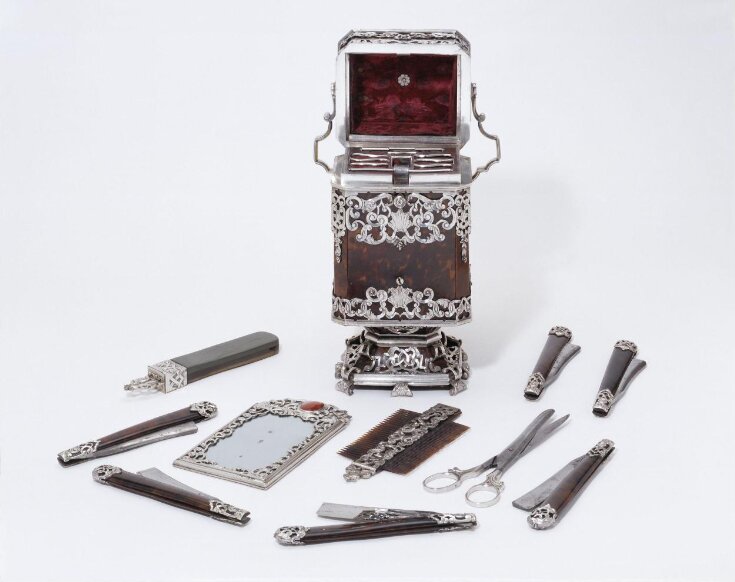
In the seventeenth century, male fashion favoured clean shaven features, and by the 1680s a new type of straight razor, with a narrow folding blade, made the process easier. The French barber Jean-Jacques Perret published a work on the art of shaving in 1769 -- a treatise intended to promote a razor with a protective L-shaped guard along one edge of the metal blade that he had designed himself. This case, with its toilet and shaving implements (the razors are of the folding type), is a well-preserved and early example.
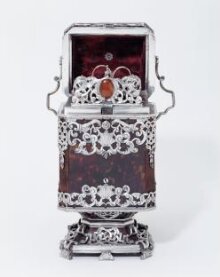
Turtleshell was used in the Netherlands as a background to silver openwork on bookbindings and caskets. The tassel and shell-like motifs, together with the curling, interlaced 'c' shapes which decorate this casket and its implements seem to be an interpretation of fashionable seventeenth-century designs such as those by the French-born designer Daniel Marot (1661–1752), who worked principally for the courts of Holland and England.
Turtleshell was used in the Netherlands as a background to silver openwork on bookbindings and caskets. The tassel and shell-like motifs, together with the curling, interlaced 'c' shapes which decorate this casket and its implements seem to be an interpretation of fashionable seventeenth-century designs such as those by the French-born designer Daniel Marot (1661–1752), who worked principally for the courts of Holland and England.
Object details
| Category | |
| Object type | |
| Parts | This object consists of 11 parts.
|
| Brief description | Shaving set, silver and tortoiseshell, on a ?wooden core; steel, glass, honestone and semi-precious stone (possibly carnelian) used in the manufacture of the instruments |
| Dimensions |
|
| Style | |
| Marks and inscriptions |
|
| Gallery label | Travelling razor set
Silver, tortoiseshell, steel
Possibly Portugal, early 17th c
Unmarked
This dressing case is more a functional item than a treasury piece but still represents the height of luxury. The tortoiseshell case is covered with silver strap-work and shell ornaments, and contains a mirror, comb, pair of scissors, three pairs of razors and a hone (file), all mounted in silver.(1991) |
| Object history | Nothing is known of the object's early history. Import marks stamped on the silver handle and rims of the casket show the object left the Netherlands, where it was probably made, at an unspecified date and in the nineteenth century travelled across Europe only to return to the Netherlands before 1881. In that year, it was purchased by the Museum from Samuel Wilson, 393 Strand, London, for the sum of £40, when it was described as a late-seventeenth-century dressing case from Portugal. A Museum nominal file ('Mr Wilson', file no. RP/ 1881/3099) records it was one of three objects bought at the time from the dealer, Wilson, in order expand the collections with 'specimens of work of a school hardly represented in the Museum'. The casket was described in the file by J. C. Robinson as 'I think Portuguese work of about the end of the 17th century, a specimen of very original design and beautiful execution of its epoch'. The other two objects purchased were silver caskets, 190-1881 and 192-1881. All the blades on the six razors are nineteenth-century replacements, probably made in around 1845 by William and Samuel Butcher of Sheffield (see Lummus, 'More Old Razors', p.373 (razor no.10 for the term 'universally approved' stamped on the handle of a razor). The Sheffield provenance of the razor blades, however, is not proof that the case and its contents were in England at this date because Sheffield steel was widely exported. (See Himsworth, The Story of Cutlery for the importance of the Sheffield trade.) Historical significance: Portuguese trade links with India and the Americas meant tortoiseshell was a material used by craftsmen across Portugal's territories in caskets and furniture. However, it was also typically used in the Netherlands as a background to silver openwork on bookbindings and caskets. The tassel and shell-like motifs, together with the curling, interlaced 'c' shapes which decorate this casket seem to be an interpretation of fashionable seventeenth-century designs such as those by the French-born designer Daniel Marot (1661–1752), who worked principally for the courts of Holland and England. See for example his design for a mirror frame and for a bed canopy in his Nouueaux Liure d'Ornements, ca. 1702. |
| Historical context | The Romans were clean-shaven and had associated beards with foreigners, or 'barbari' (barbarians). Debates over the desirability of a beard as a symbol of masculinity continued into the sixteenth-century (see for example Andrew Boorde's grotesque contribution to the argument for a clean-shaven chin in The Treatyse answerynge the boke of Berdes). In the seventeenth century, male fashion favoured clean shaven features, and by the 1680s a new type of straight razor, with a narrow folding blade, made the process easier (see Sherrow, Encyclopedia of Hair, sub. nom. 'shaving'). The French barber Jean-Jacques Perret published a work on the art of shaving in 1769 -- a treatise intended to promote a razor with a protective L-shaped guard along one edge of the metal blade that he had designed himself. This case, with its toilet and shaving implements (the razors are of the folding type), is a well-preserved and early example (for a slightly later example, see the Portuguese set, dated 1730 - 40, formerly in the collection of the late Earl of Rosebery: Mentmore, lot no. 1818). |
| Summary | In the seventeenth century, male fashion favoured clean shaven features, and by the 1680s a new type of straight razor, with a narrow folding blade, made the process easier. The French barber Jean-Jacques Perret published a work on the art of shaving in 1769 -- a treatise intended to promote a razor with a protective L-shaped guard along one edge of the metal blade that he had designed himself. This case, with its toilet and shaving implements (the razors are of the folding type), is a well-preserved and early example. Turtleshell was used in the Netherlands as a background to silver openwork on bookbindings and caskets. The tassel and shell-like motifs, together with the curling, interlaced 'c' shapes which decorate this casket and its implements seem to be an interpretation of fashionable seventeenth-century designs such as those by the French-born designer Daniel Marot (1661–1752), who worked principally for the courts of Holland and England. |
| Bibliographic references |
|
| Collection | |
| Accession number | 192:1-1881 |
About this object record
Explore the Collections contains over a million catalogue records, and over half a million images. It is a working database that includes information compiled over the life of the museum. Some of our records may contain offensive and discriminatory language, or reflect outdated ideas, practice and analysis. We are committed to addressing these issues, and to review and update our records accordingly.
You can write to us to suggest improvements to the record.
Suggest feedback
You can write to us to suggest improvements to the record.
Suggest feedback
| Record created | June 24, 2009 |
| Record URL |
Download as: JSONIIIF Manifest
