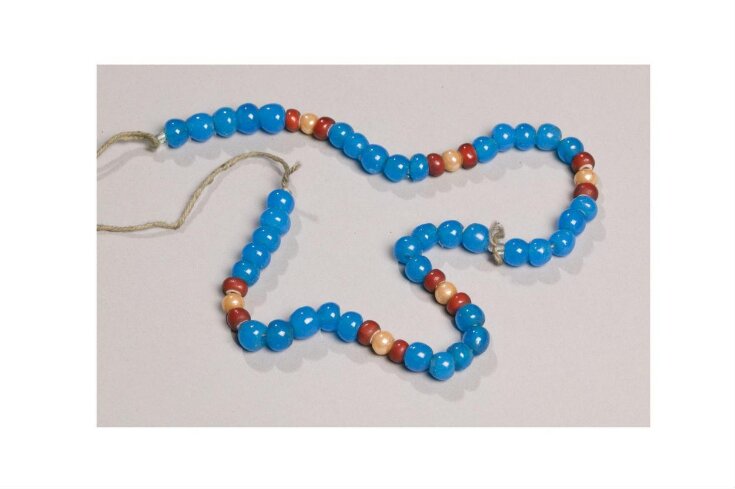

Necklace
1872 (purchased)
| Artist/Maker | |
| Place of origin |
The 1851 Great Exhibition inspired a series of 'London International Exhibitions' which took place in South Kensington in 1871, 1872, 1873 and 1874. Fine arts and scientific inventions and discoveries remained central display themes but each exhibition presented different aspects of manufacture. In 1872 one emphasis was on jewellery, including 'peasant jewellery'. The Exhibition Commissioners arranged with the South Kensington Museum (later V&A) to make a collection of peasant jewellery from 'all parts of the world, which should become public property, for exhibition in the Museum after the close of the Exhibition'. A letter was sent by the Secretary of State for Foreign Affairs to British representatives overseas asking for their help in securing pieces of jewellery, particularly examples with 'a direct connection with the native instinctive art, which has been handed down by a long tradition'. The outcome was considered to be 'most satisfactory … a collection of characteristic ornaments never before equalled was obtained'.
This string of glass beads was obtained in Egypt. It is formed of two strings of blue, red-brown and gold beads tied together which may originally have been acquired as two separate items.
This string of glass beads was obtained in Egypt. It is formed of two strings of blue, red-brown and gold beads tied together which may originally have been acquired as two separate items.
Object details
| Categories | |
| Object type | |
| Materials and techniques | Glass |
| Brief description | Necklace of glass beads, Egypt |
| Physical description | String of glass beads (or two strings tied together?) in the pattern 5 blue beads, 1 red/brown, 1 gold, 1 red/brown, 5 blue |
| Dimensions |
|
| Object history | Acquired by the Exhibition Commissioners of the London International Exhibition of 1872 as an example of 'peasant jewellery' and then transferred to the South Kensington Museum. |
| Summary | The 1851 Great Exhibition inspired a series of 'London International Exhibitions' which took place in South Kensington in 1871, 1872, 1873 and 1874. Fine arts and scientific inventions and discoveries remained central display themes but each exhibition presented different aspects of manufacture. In 1872 one emphasis was on jewellery, including 'peasant jewellery'. The Exhibition Commissioners arranged with the South Kensington Museum (later V&A) to make a collection of peasant jewellery from 'all parts of the world, which should become public property, for exhibition in the Museum after the close of the Exhibition'. A letter was sent by the Secretary of State for Foreign Affairs to British representatives overseas asking for their help in securing pieces of jewellery, particularly examples with 'a direct connection with the native instinctive art, which has been handed down by a long tradition'. The outcome was considered to be 'most satisfactory … a collection of characteristic ornaments never before equalled was obtained'. This string of glass beads was obtained in Egypt. It is formed of two strings of blue, red-brown and gold beads tied together which may originally have been acquired as two separate items. |
| Bibliographic reference | List of Objects in the Art Division, South Kensington Museum, acquired during the year 1873, London: George E. Eyre and William Spottiswoode |
| Collection | |
| Accession number | 1511-1873 |
About this object record
Explore the Collections contains over a million catalogue records, and over half a million images. It is a working database that includes information compiled over the life of the museum. Some of our records may contain offensive and discriminatory language, or reflect outdated ideas, practice and analysis. We are committed to addressing these issues, and to review and update our records accordingly.
You can write to us to suggest improvements to the record.
Suggest feedback
You can write to us to suggest improvements to the record.
Suggest feedback
| Record created | December 13, 1997 |
| Record URL |
Download as: JSONIIIF Manifest
