Beaker
early 16th century (made)
| Artist/Maker | |
| Place of origin |
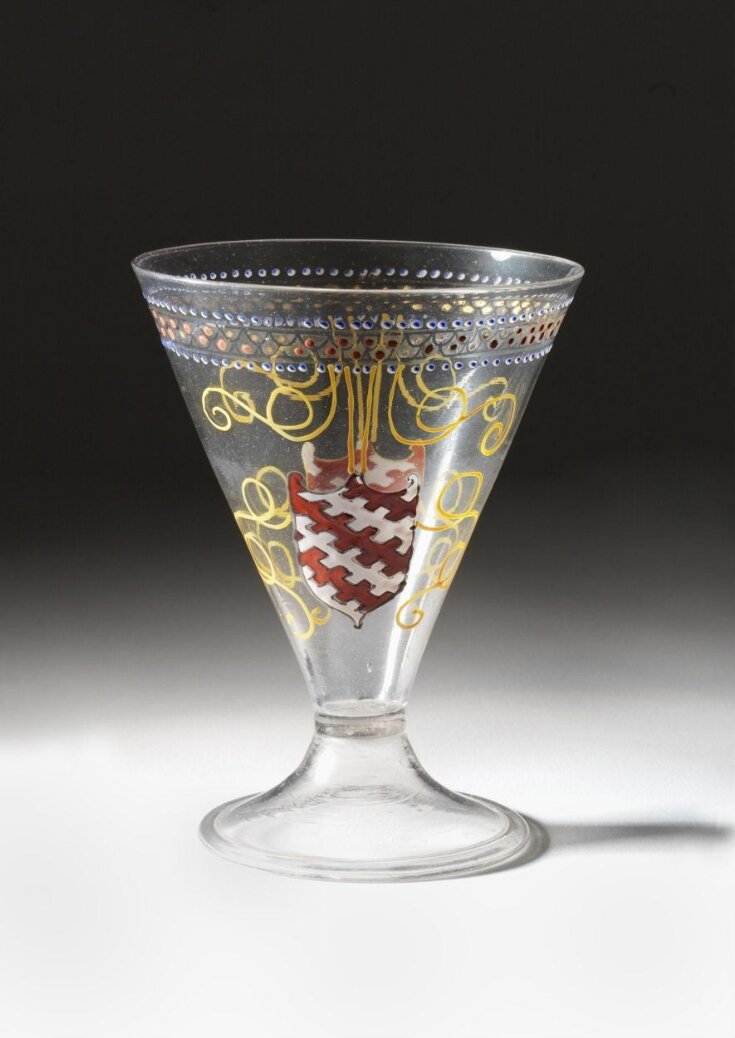
This goblet was made in Venice, by the famous glassblowers on the island of Murano. The decoration, in gold leaf and painted enamels, was applied after the goblet had been shaped and cooled. The glass then went back into the mouth of the furnace, where the enamels would melt and fuse with the glass surface. Once fired, the enamels cannot be rubbed off.
Finely decorated glass from Murano was a luxury product, much more expensive than glass made for daily use at other local Italian glass workshops.
Leading families thoughout Italy and also beyond, ordered their finest glass from Venice. Single dishes and goblets, decorated with family arms, have survived from the Renaissance period, but it is possible that they were once part of more extensive sets.
The Salviati were one of the leading families from Florence. They are known to have ordered several sets of decorated tin-glazed earthenware (maiolica) bearing their coat of arms. This goblet is the only surving glass with their arms.
Finely decorated glass from Murano was a luxury product, much more expensive than glass made for daily use at other local Italian glass workshops.
Leading families thoughout Italy and also beyond, ordered their finest glass from Venice. Single dishes and goblets, decorated with family arms, have survived from the Renaissance period, but it is possible that they were once part of more extensive sets.
The Salviati were one of the leading families from Florence. They are known to have ordered several sets of decorated tin-glazed earthenware (maiolica) bearing their coat of arms. This goblet is the only surving glass with their arms.
Object details
| Categories | |
| Object type | |
| Materials and techniques | Blown glass, enamelled and gilt |
| Brief description | Beaker, Italy (Venice), glass, 1500-20 |
| Physical description | Goblet of colourless glass, with enamelled decoration, with two depictions of the arms of Salviati in red and white, with yellow scrolls, and a border below the rim of blue and red dots with gilded scale pattern. |
| Dimensions |
|
| Style | |
| Gallery label |
|
| Credit line | Wilfred Buckley Collection |
| Object history | The arms are of the Salviati family of Florence, who probably ordered and owned it. |
| Historical context | Finely decorated glass from Murano was a luxury product, much more expensive than glass made for daily use at other local Italian glass workshops. Leading families thoughout Italy and also beyond, ordered their finest glass from Venice. Single dishes and goblets, decorated with family arms, have survived from the Renaissance period, but it is possible that they were once part of more extensive sets. The Salviati were one of the leading families from Florence. They are known to have ordered several sets of decorated tin-glazed earthenware (maiolica) bearing their coat of arms. This goblet is the only surving glass with their arms. |
| Summary | This goblet was made in Venice, by the famous glassblowers on the island of Murano. The decoration, in gold leaf and painted enamels, was applied after the goblet had been shaped and cooled. The glass then went back into the mouth of the furnace, where the enamels would melt and fuse with the glass surface. Once fired, the enamels cannot be rubbed off. Finely decorated glass from Murano was a luxury product, much more expensive than glass made for daily use at other local Italian glass workshops. Leading families thoughout Italy and also beyond, ordered their finest glass from Venice. Single dishes and goblets, decorated with family arms, have survived from the Renaissance period, but it is possible that they were once part of more extensive sets. The Salviati were one of the leading families from Florence. They are known to have ordered several sets of decorated tin-glazed earthenware (maiolica) bearing their coat of arms. This goblet is the only surving glass with their arms. |
| Bibliographic reference | Barovier Mentasti, R. and Tonini, C. Murano, chefs-d'oeuvre de verre de la Renaissance au XXIe siecle. Paris: Gallimard, 2013.
p.64 |
| Collection | |
| Accession number | C.174-1936 |
About this object record
Explore the Collections contains over a million catalogue records, and over half a million images. It is a working database that includes information compiled over the life of the museum. Some of our records may contain offensive and discriminatory language, or reflect outdated ideas, practice and analysis. We are committed to addressing these issues, and to review and update our records accordingly.
You can write to us to suggest improvements to the record.
Suggest feedback
You can write to us to suggest improvements to the record.
Suggest feedback
| Record created | December 13, 1997 |
| Record URL |
Download as: JSONIIIF Manifest
