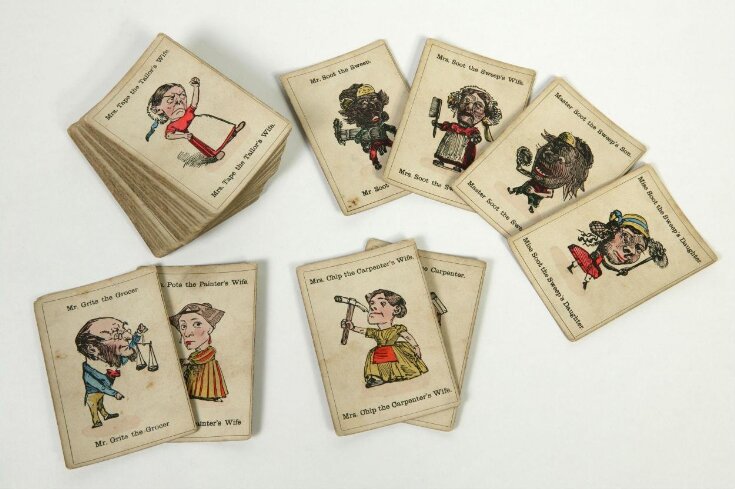

Happy Families, A New and Diverting Game for Juveniles
Card Game
ca. 1860 (published)
ca. 1860 (published)
| Artist/Maker | |
| Place of origin |
Happy Families was one of the first card games devised to amuse rather than educate children. It was developed by John Jaques & Son of London in the 1860s. The company was responsible for introducing into England the idea of cards showing families of four, each of which has an appropriate name relating to the father's occupation, such as Bun the Baker or Soot the Sweep. The early sets were famously illustrated by Sir John Tenniel who was the illustrator of Lewis Caroll's Alice's Adventures in Wonderland and Through The Looking Glass. Following Jaques' first sets of Happy Families, many publishers copied his idea, sometimes changing the name to Funny, Cheery or Merry Families.
Object details
| Categories | |
| Object type | |
| Title | Happy Families, A New and Diverting Game for Juveniles (manufacturer's title) |
| Materials and techniques | Hand coloured lithographed card |
| Brief description | Boxed card game, 'Happy Families', published by in England by John Jaques & Son about 1860 |
| Physical description | Design: hand coloured lithographs |
| Dimensions |
|
| Production type | Mass produced |
| Object history | Tenniel was the illustrator of Lewis Caroll's Alice's Adventures in Wonderland and Through The Looking Glass. See also E. 870-1950. |
| Historical context | Rewards: n/a Forfeits: n/a No. of Players: any Equipment required: 44 grotesque characters, 11 sets of 4 1 rules card card slip case with printed pictorial label Rules: *Perhaps the first card games devised to amuse rather than educate children were developed by John Jaques & Son of London during the 1860s. These were the games of Happy Families and Snap. The company was responsible for introducing in England the idea of cards showing families of four, each of which has an appropriate name relating to the father's occupation, such as Bun the Baker or Soot the Sweep. There had been set of four, usually relating to trades, which had one picture card and three more bearing a symbol for the set such as The Game of Trades, by Ives of Salem, Mass. Since it was devised, Happy Families has been consistently popular, and many other publishers have introduced their own variations. RULES. The rules are simple but competitive. All the cards are dealt, and the player to the left of the dealer starts by asking any of the other players for a character he or she is sort of to complete a set. The player should endeavour to collect all the cards relating to one family and when the four cards are held, they are placed, face downwards, as a trick, on the table. The word trick is really a misnomer in this game, as the aim is to collect a sequence and not to trump other cards. If a player asked has not got the character, he or she replies `Not at home' and it becomes his or her turn to ask. The game proceeds until all the family sets are complete, and the player holding the greatest number of tricks wins. Players cannot ask for characters unless they already hold a member of the family, and players are bound to produce the character asked for if they have it. The game can end here or continue following other rules. Only players holding tricks continue, and the one with the greatest number starts. He or she asks any other player for a family. Ifd the player asked does not have the family, it then becomes his or her turn. The game ends when one player holds all the families. An element of gambling can be introduced if each player puts up an agreed number of counters into a pool. The winner of the first part of the game takes half the kitty, and the winner of the second part takes the rest. An interesting extra to the rules of play that is incorporated into some of these card games, is the paying of a special forfeit. Instead of just losing a turn, a player must allow an unseen card to be drawn from his hand by an opponent. GENERAL HAPPY FAMILIES RULES Three or more can play and special cards are normally used, each showing four members of a family, mother, father, son and daughter, However, variations have been developed to use groups of 3, 4, 5, 6, and 7 to a set. Also subject variations occur and some are educational, for example The Counties of England. The object of the game is for each player to collect as many complete `families' as possible. One of the players deals out all the cards. If more than one round is played, the players take it in turn to deal. It does not matter if some players have one card more than others. Each player looks at his cards and sorts them into families. It is important that players keep their cards hidden from each other. With young children it is a good idea if they can lay their cards out of view of the other players. When all the players are ready, the person to the dealer's left asks any player, by name, for a particular card (eg Master Baker). He must already possess at least one of member of the same family, ie Mrs. Baker. If the person asked has the card, he must give it to the first player, who may again ask anybody for a card of any family as long as he already has one card belonging to that family. He continues to do this until he fails to obtain a card. If the person asked does not have the card requested, it is his turn to ask for cards. When a player collects all the cards of the same family, he puts them into a pile face down in front of him. Play continues until all the families have been completed The winner is the person who collects the most families. |
| Production | Illustrations reproduced from designs by Sir John Tenniel Cost 1/- |
| Subject depicted | |
| Summary | Happy Families was one of the first card games devised to amuse rather than educate children. It was developed by John Jaques & Son of London in the 1860s. The company was responsible for introducing into England the idea of cards showing families of four, each of which has an appropriate name relating to the father's occupation, such as Bun the Baker or Soot the Sweep. The early sets were famously illustrated by Sir John Tenniel who was the illustrator of Lewis Caroll's Alice's Adventures in Wonderland and Through The Looking Glass. Following Jaques' first sets of Happy Families, many publishers copied his idea, sometimes changing the name to Funny, Cheery or Merry Families. |
| Collection | |
| Accession number | MISC.47-1975 |
About this object record
Explore the Collections contains over a million catalogue records, and over half a million images. It is a working database that includes information compiled over the life of the museum. Some of our records may contain offensive and discriminatory language, or reflect outdated ideas, practice and analysis. We are committed to addressing these issues, and to review and update our records accordingly.
You can write to us to suggest improvements to the record.
Suggest feedback
You can write to us to suggest improvements to the record.
Suggest feedback
| Record created | March 4, 2000 |
| Record URL |
Download as: JSONIIIF Manifest
