
Clutha
Vase
ca. 1900 (made)
ca. 1900 (made)
| Artist/Maker | |
| Place of origin |
Object Type
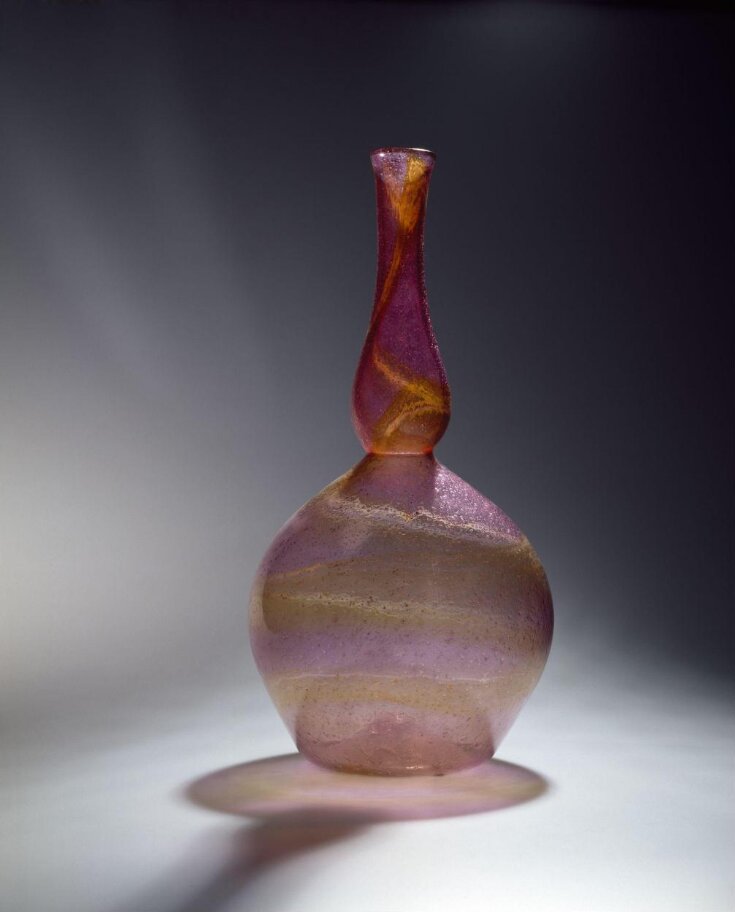
This shape is sometimes called 'double gourd'. Dresser was keenly interested in Japanese art and design and this shape derives from Japanese (and Chinese) vases. Mottled, bubbled glass became popular as excavated Roman glass took hold of designers' imagination. Like most 'art pottery' this is a sculptural work first and foremost.
Place
'Clutha' is the ancient, Roman name for a river god and the River Clyde. This vase was made by James Couper & Sons in Glasgow, which stands on the Clyde. Dresser's bubbled, Roman-style 'Clutha' glass was sold exclusively through the avant-garde shop, Liberty's in London, which registered it in 1888.
People
Dresser's glass was sold by the London shop Liberty's, founded by Arthur Lasenby Liberty as an emporium, importing goods from Asia. Soon Liberty's turned to British design, pioneering the Aesthetic style and then the shop's own version of art nouveau, known abroad as Stile Liberty.
This shape is sometimes called 'double gourd'. Dresser was keenly interested in Japanese art and design and this shape derives from Japanese (and Chinese) vases. Mottled, bubbled glass became popular as excavated Roman glass took hold of designers' imagination. Like most 'art pottery' this is a sculptural work first and foremost.
Place
'Clutha' is the ancient, Roman name for a river god and the River Clyde. This vase was made by James Couper & Sons in Glasgow, which stands on the Clyde. Dresser's bubbled, Roman-style 'Clutha' glass was sold exclusively through the avant-garde shop, Liberty's in London, which registered it in 1888.
People
Dresser's glass was sold by the London shop Liberty's, founded by Arthur Lasenby Liberty as an emporium, importing goods from Asia. Soon Liberty's turned to British design, pioneering the Aesthetic style and then the shop's own version of art nouveau, known abroad as Stile Liberty.
Object details
| Categories | |
| Object type | |
| Title | Clutha (manufacturer's title) |
| Materials and techniques | Blown coloured glass |
| Brief description | 'Clutha' vase, designed by Christopher Dresser, for James Couper and Sons, Glasgow, ca.1899. |
| Physical description | Vase of pink with yellowish bands. The bulbous lower part narrows to the base of a tall thin neck, flaring slightly at the mouth. |
| Dimensions |
|
| Style | |
| Marks and inscriptions | 'Clutha / Designed by CD / Registered' (etching (corroding)) |
| Gallery label | British Galleries:
Dresser's blown 'Clutha' glass is deliberately bubbled and streaked in daring colours with irregular metallic streaks or foils, imitating the effects of Roman and Venetian glass. It was sold by the famous London department store, Liberty's, and attracted considerable attention in the press for its artistic merit and originality.(27/03/2003) |
| Object history | Designed by Christopher Dresser (born in Glasgow, 1834, died in Mulhouse, France, 1904); made by James Couper & Sons, Glasgow Historical significance: 'Clutha' glass is deliberately bubbled and streaked in daring colours and is permeated with irregular metallic streaks or foils, imitating the effects of Roman and Venetian glass. Vases with elongated slightly bent necks were inspired by Japanese, Persian and Indian water sprinklers acquired by the South Kensington Museum during the 1870s and 1880s. Clutha glass was shown alongside Sowerby's Art Glass at an exhibition organised by the Art Furnishers' Alliance in 1882. The show attracted considerable attention in the press and the Cabinet Maker announced, 'A new kind of glass of English manufacture which in point of artistic merit and originality promises to rival the finest examples of the old Venetian glass-blowers.' |
| Historical context | Dresser's 'Clutha' art glass was retailed by Liberty's. |
| Summary | Object Type This shape is sometimes called 'double gourd'. Dresser was keenly interested in Japanese art and design and this shape derives from Japanese (and Chinese) vases. Mottled, bubbled glass became popular as excavated Roman glass took hold of designers' imagination. Like most 'art pottery' this is a sculptural work first and foremost. Place 'Clutha' is the ancient, Roman name for a river god and the River Clyde. This vase was made by James Couper & Sons in Glasgow, which stands on the Clyde. Dresser's bubbled, Roman-style 'Clutha' glass was sold exclusively through the avant-garde shop, Liberty's in London, which registered it in 1888. People Dresser's glass was sold by the London shop Liberty's, founded by Arthur Lasenby Liberty as an emporium, importing goods from Asia. Soon Liberty's turned to British design, pioneering the Aesthetic style and then the shop's own version of art nouveau, known abroad as Stile Liberty. |
| Bibliographic references |
|
| Collection | |
| Accession number | C.146-1977 |
About this object record
Explore the Collections contains over a million catalogue records, and over half a million images. It is a working database that includes information compiled over the life of the museum. Some of our records may contain offensive and discriminatory language, or reflect outdated ideas, practice and analysis. We are committed to addressing these issues, and to review and update our records accordingly.
You can write to us to suggest improvements to the record.
Suggest feedback
You can write to us to suggest improvements to the record.
Suggest feedback
| Record created | December 13, 1997 |
| Record URL |
Download as: JSONIIIF Manifest
