
Walnuts
Watercolour
ca. 1575 (painted)
ca. 1575 (painted)
| Artist/Maker | |
| Place of origin |
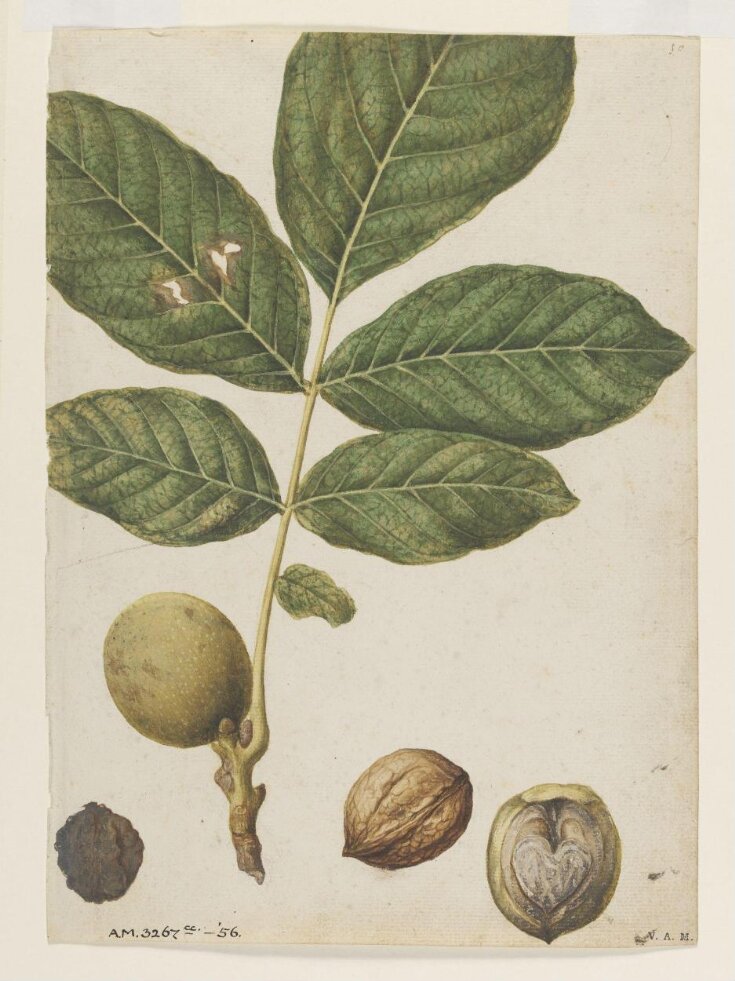
This drawing belongs to an album of 59 botanical watercolours on paper attributed to the Huguenot artist Jacques Lemoyne de Morgues (1533-88). Some of these are double-sided unlike the present one. Dated around 1575, the present work shows a twig from the walnut tree, with both a halved and a whole walnut lesser. Although Lemoyne has long been considered as an obscure artist providing designs for simple woodcuts, his botanical watercolours which were rediscovered at the beginning of the 20th century have earned him a place in history as one of the most remarkable early botanical painters.
Object details
| Categories | |
| Object type | |
| Title | Walnuts (generic title) |
| Materials and techniques | watercolour and body colour on paper |
| Brief description | Watercolour, Walnuts, by Jacques Le Moyne de Morgues, French school, ca. 1575 |
| Physical description | Recto: a twig from a walnut tree: the fruit is brownish green, the shell brown, the kernel grey-white with light brown skin. There is a separate kernel at the bottom, on the left, coloured deep brown. Verso blank. |
| Dimensions |
|
| Style | |
| Marks and inscriptions | Numbered '50' in brown ink on the top right corner (Watermark similar to Briquet 12326
Lugt 2503 on lower right corner) |
| Object history | Purchased in 1856 as part of a sketchbook bought for its 16th-century binding. In 1922, De Morgues's signature was discovered and the significance of the watercolours recognised. Following this, the 34 leaves with watercolours were extracted from the volume to be transferred to the Prints and Drawings department (now Museum nos. A.M.3267a – 3267hh-1856). The binding remained in the library |
| Historical context | The present drawing belongs to an album of 59 botanical watercolours depicted on 34 sheets of paper and attributed to Jacques Lemoyne de Morgues. The drawings from this series were acquired in 1856 as one of the first purchases of the V&A, almost by accident, and solely because they were bound up in an extremely fine French late-16th-century brown calf binding. Although Lemoyne has been long considered as an obscure artist providing designs for simple woodcuts, he was recognised at the beginning of the 20th century as one of the most remarkable early botanical painters. The V&A binding and the inscriptions on the drawings in both French and Latin suggest that the series was probably made in France around 1575. Lemoyne left the Continent to London where he settled shortly before1580. The V&A album can be compared with another album, reputed to have been made around 1585 in England, and now in the British Museum. Another group of 27 sheets stylistically close and on similar paper to the V&A watercolours appeared on the market in 2004, followed by a bound florilegium with eighty drawings in an 18th-century French mottled calf gilt and lettered ‘anno 1770’ in 2005.(See Sotheby's, New York, 21 January 2004, lots 29-55 and Sotheby's, New York, 26 January 2005, lot 46.) A highly finished group of six gouaches on vellum on blue and gold background were sold from the Korner collection in 1997 (Sotheby's, New York, January 29, 1997, lots 55-60). The interest in plants for their medicinal properties and religious symbolism was well anchored since the Middle Ages in Western Europe. A great number of manuscripts were beautifully illuminated with flowers and plants, echoing an interest that goes back to the Antiquity. However this impressive album of botanical watercolours shows a renewed curiosity for the flora from both a scientific and an aesthetic point of view. In this respect, Lemoyne de Morgues’ representations of plants and insects, which show a particular attention to details and a great sense of realism, can be seen as a forerunner of such projects as the Museum Chartaceum (Latin for ‘Paper Museum’), made by Cassiano dal Pozzo (1588-1657)who commissioned to minor and major artists a vast collection of drawings recording, among others, natural history subjects (see V&A E.731-1949 to E.735-1949, E.2776-1962 to E.2777-1962, E.426-2009 to E.428-2009, and E.1026-2011 – and also Royal Library, Windsor Castle, and British Museum, London). |
| Subject depicted | |
| Summary | This drawing belongs to an album of 59 botanical watercolours on paper attributed to the Huguenot artist Jacques Lemoyne de Morgues (1533-88). Some of these are double-sided unlike the present one. Dated around 1575, the present work shows a twig from the walnut tree, with both a halved and a whole walnut lesser. Although Lemoyne has long been considered as an obscure artist providing designs for simple woodcuts, his botanical watercolours which were rediscovered at the beginning of the 20th century have earned him a place in history as one of the most remarkable early botanical painters. |
| Bibliographic references |
|
| Other number | AM.3267CC-1856 - Incorrect number |
| Collection | |
| Accession number | AM.3267CC-1856 |
About this object record
Explore the Collections contains over a million catalogue records, and over half a million images. It is a working database that includes information compiled over the life of the museum. Some of our records may contain offensive and discriminatory language, or reflect outdated ideas, practice and analysis. We are committed to addressing these issues, and to review and update our records accordingly.
You can write to us to suggest improvements to the record.
Suggest feedback
You can write to us to suggest improvements to the record.
Suggest feedback
| Record created | March 3, 2000 |
| Record URL |
Download as: JSONIIIF Manifest
