Drinking Glass
1685-1690 (made)
| Artist/Maker | |
| Place of origin |
Object Type
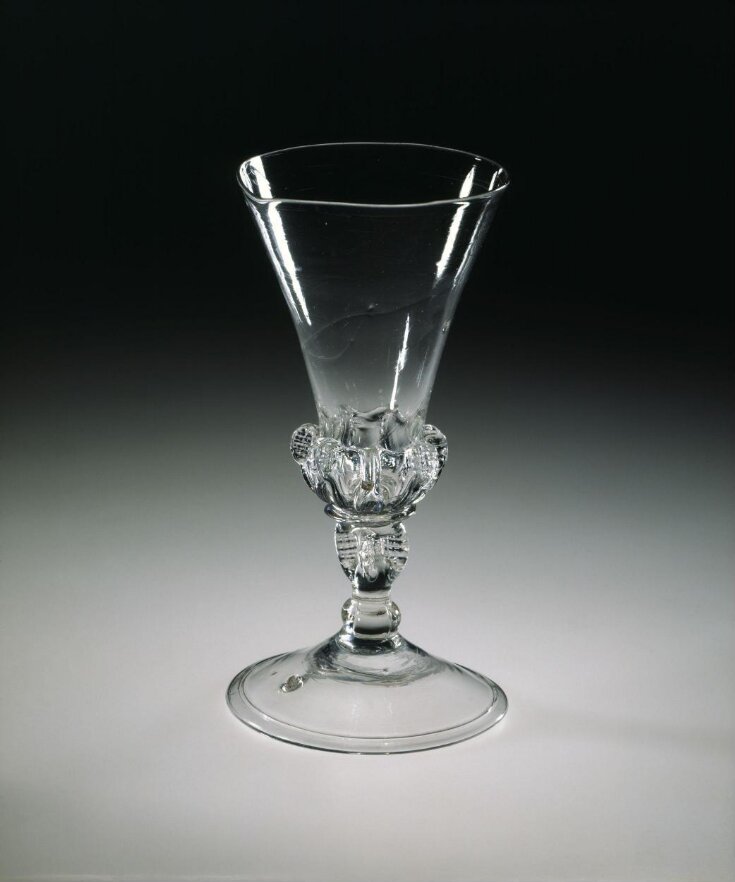
Wine glasses such as this must have been made in large numbers at the end of the 17th century, though very few survive. Clear 'flint' drinking glasses (one of the basic ingredients being calcined and powdered flint) were available in two grades, according to their weight. The thin bowl and light construction of this glass show that it is an example of 'single flint' rather than the thicker and more expensive 'double flint' glass.
Time
It was the glassmaker George Ravenscroft (1632-1681) who developed English lead or flint glass. By 1690, however, the influence of the Italian glassmakers he had employed some 15 years earlier was fading. But just before the truly English heavy baluster stem was invented, some foreign influence was still sometimes to be found. Of the small number of specialist tools needed to work hot glass, the pincers (tongs or pucellas introduced by Italian glassmakers) were one of the most useful. On this piece, the pincering of the mould-blown ribbing and the stem are typical Venetian techniques. Here they were applied to hot molten lead glass that could easily be compressed, but was unwilling to be pulled and teased into the fantastic shapes beloved of Italian glassmakers.
Wine glasses such as this must have been made in large numbers at the end of the 17th century, though very few survive. Clear 'flint' drinking glasses (one of the basic ingredients being calcined and powdered flint) were available in two grades, according to their weight. The thin bowl and light construction of this glass show that it is an example of 'single flint' rather than the thicker and more expensive 'double flint' glass.
Time
It was the glassmaker George Ravenscroft (1632-1681) who developed English lead or flint glass. By 1690, however, the influence of the Italian glassmakers he had employed some 15 years earlier was fading. But just before the truly English heavy baluster stem was invented, some foreign influence was still sometimes to be found. Of the small number of specialist tools needed to work hot glass, the pincers (tongs or pucellas introduced by Italian glassmakers) were one of the most useful. On this piece, the pincering of the mould-blown ribbing and the stem are typical Venetian techniques. Here they were applied to hot molten lead glass that could easily be compressed, but was unwilling to be pulled and teased into the fantastic shapes beloved of Italian glassmakers.
Object details
| Categories | |
| Object type | |
| Materials and techniques | Lead glass, mould-blown, with pincered ribbing and 'propeller' stem |
| Brief description | Drinking glass, England, , 1685-1690, C.144-1928 . |
| Physical description | Foot: folded; Knop: lobed; Bowl: funnel |
| Dimensions |
|
| Style | |
| Gallery label | British Galleries:
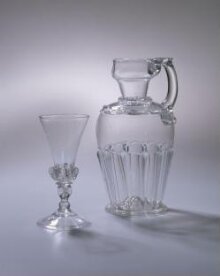
GLASSWARE FOR WINE Consumption of alcohol was a driving force behind developments in glass-making. George Ravenscroft (1632-1681) produced mainly beer and wine glasses, of which few have survived. The personalised 'black' bottle for storing wine in good condition was a product of the prosperous Restoration period, while the decanter-jug showed the beauty of the wine on the table.(27/03/2003) |
| Object history | Made in England |
| Summary | Object Type Wine glasses such as this must have been made in large numbers at the end of the 17th century, though very few survive. Clear 'flint' drinking glasses (one of the basic ingredients being calcined and powdered flint) were available in two grades, according to their weight. The thin bowl and light construction of this glass show that it is an example of 'single flint' rather than the thicker and more expensive 'double flint' glass. Time It was the glassmaker George Ravenscroft (1632-1681) who developed English lead or flint glass. By 1690, however, the influence of the Italian glassmakers he had employed some 15 years earlier was fading. But just before the truly English heavy baluster stem was invented, some foreign influence was still sometimes to be found. Of the small number of specialist tools needed to work hot glass, the pincers (tongs or pucellas introduced by Italian glassmakers) were one of the most useful. On this piece, the pincering of the mould-blown ribbing and the stem are typical Venetian techniques. Here they were applied to hot molten lead glass that could easily be compressed, but was unwilling to be pulled and teased into the fantastic shapes beloved of Italian glassmakers. |
| Bibliographic reference | R J Charleston, English Glass (1984), pl.26b |
| Other number | 6288 - Glass gallery number |
| Collection | |
| Accession number | C.144-1928 |
About this object record
Explore the Collections contains over a million catalogue records, and over half a million images. It is a working database that includes information compiled over the life of the museum. Some of our records may contain offensive and discriminatory language, or reflect outdated ideas, practice and analysis. We are committed to addressing these issues, and to review and update our records accordingly.
You can write to us to suggest improvements to the record.
Suggest feedback
You can write to us to suggest improvements to the record.
Suggest feedback
| Record created | December 13, 1997 |
| Record URL |
Download as: JSONIIIF Manifest
