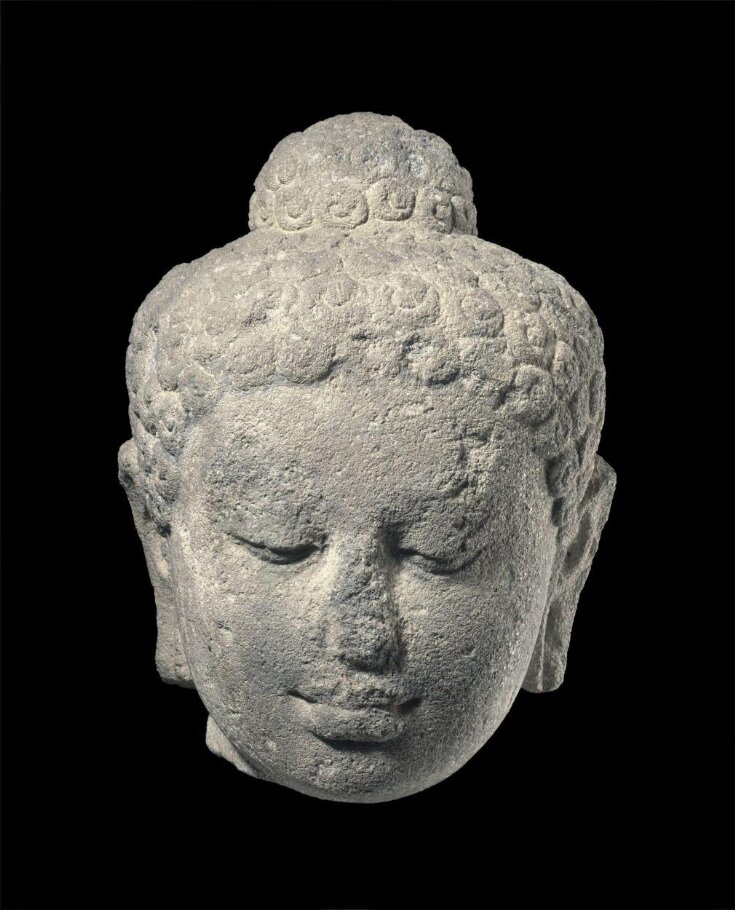
Head of the Buddha
Sculpture
early 9th century (made)
early 9th century (made)
| Artist/Maker | |
| Place of origin |
This head originally formed part of a large-scale image of Buddha Shakyamuni. It may date from the end of the Shailendra dynasty, which ruled Java between 760 and 830AD. The Shailendra rulers were strong supporters of Mahayana Buddhism and erected many Buddhist monuments in central Java, including the great temple complex of Borobudur.
Object details
| Categories | |
| Object type | |
| Title | Head of the Buddha (generic title) |
| Materials and techniques | Stone |
| Brief description | Head of the Buddha Shakyamuni, stone, Central Javanese style, Java, Indonesia, early 9th century. |
| Physical description | Head of Buddha Shakyamuni of carved stone. |
| Dimensions |
|
| Style | |
| Gallery label |
|
| Credit line | Given by the Walmore Collection |
| Object history | Given by the Walmore collection in 1988, received from Mr A. Biancardi. |
| Historical context | The Sailendra dynasty, which ruled central Java from 760 until 800, was responsible for establishing Mahayana Buddhism in the region and for constructing a series of remarkable Buddhist monuments. The most spectacular of these was Borobudor, designed as a three-dimensional mandala (cosmological diagram). This and other monuments in the region were richly decorated with narrative reliefs and free-standing sculptures. This head is probably from a large scale seated Buddha image in this region. Early in the 9th century the Sailendras were displaced by the Sanjaya dynasty who, whilst allowing Buddhism to continue to flourish, instigated a Hindu renaissance symbolised by the construction of the great temple complex at Prambanan. The region fell into neglect with the move of the ruling houses to east Java in the 10th century. |
| Production | Java, Indonesia |
| Subject depicted | |
| Summary | This head originally formed part of a large-scale image of Buddha Shakyamuni. It may date from the end of the Shailendra dynasty, which ruled Java between 760 and 830AD. The Shailendra rulers were strong supporters of Mahayana Buddhism and erected many Buddhist monuments in central Java, including the great temple complex of Borobudur. |
| Collection | |
| Accession number | IS.38-1988 |
About this object record
Explore the Collections contains over a million catalogue records, and over half a million images. It is a working database that includes information compiled over the life of the museum. Some of our records may contain offensive and discriminatory language, or reflect outdated ideas, practice and analysis. We are committed to addressing these issues, and to review and update our records accordingly.
You can write to us to suggest improvements to the record.
Suggest feedback
You can write to us to suggest improvements to the record.
Suggest feedback
| Record created | February 13, 2000 |
| Record URL |
Download as: JSONIIIF Manifest
