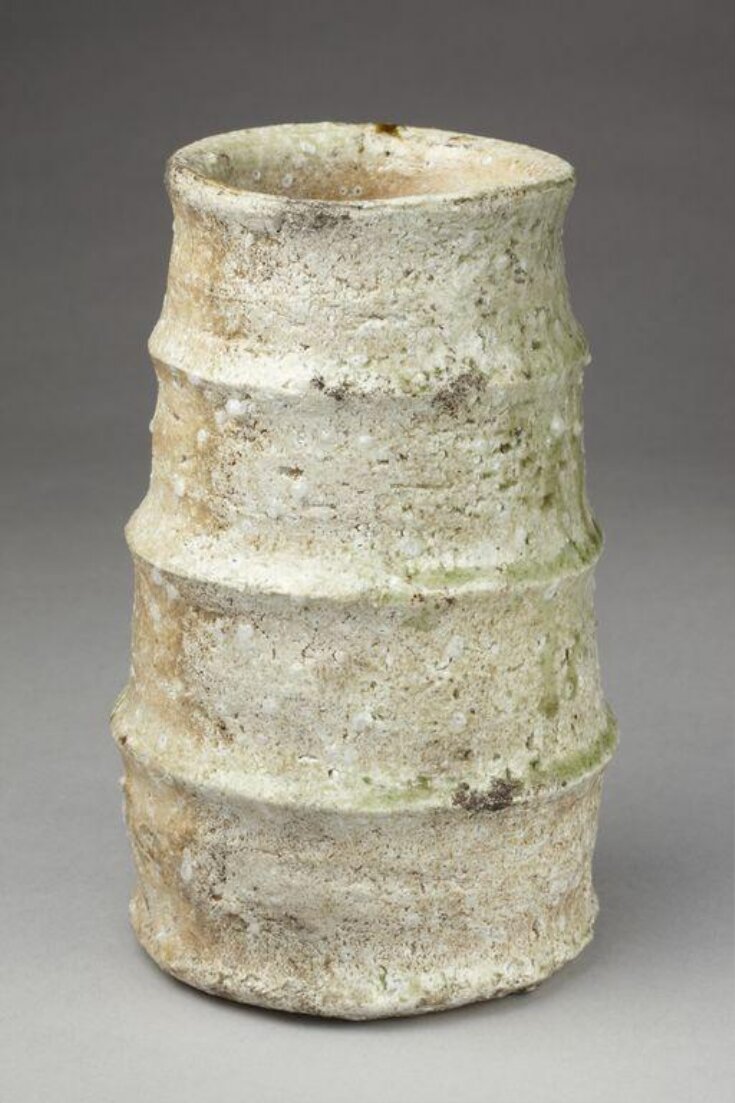
Vase
Yoshida's work is distinguished by a profound sensitivity towards the materials and techniques he uses. Understated and contemplative, his pots have a quiet grandeur that has brought him considerable recognition in recent years. Yoshida does not belong to the Japan Crafts Association or any other such organisation. Furthermore, unlike most artists working in traditional styles, who tend to focus on a single idiom, he is something of a polymath. As the foremost student of Arakawa Toyozo (1894-1985), under whom he worked from 1956 to 1968, he is a master of Shino and Black Seto wares. He is also well known for his so-called kohiki wares, stonewares covered in white slip and clear glaze in a style reminiscent of Chosôn period (1392-1910) Korean ceramics of the fifteenth and sixteenth centuries. His experiments with Shigaraki clay are a fairly recent development, as is his exploration of burnished earthenware.
Object details
| Categories | |
| Object type | |
| Parts | This object consists of 2 parts.
|
| Brief description | Vase (with storage box), Shigaraki type stoneware with natural ash glaze, made by Yoshida Yoshihiko, Japan, 1989 |
| Summary | Yoshida's work is distinguished by a profound sensitivity towards the materials and techniques he uses. Understated and contemplative, his pots have a quiet grandeur that has brought him considerable recognition in recent years. Yoshida does not belong to the Japan Crafts Association or any other such organisation. Furthermore, unlike most artists working in traditional styles, who tend to focus on a single idiom, he is something of a polymath. As the foremost student of Arakawa Toyozo (1894-1985), under whom he worked from 1956 to 1968, he is a master of Shino and Black Seto wares. He is also well known for his so-called kohiki wares, stonewares covered in white slip and clear glaze in a style reminiscent of Chosôn period (1392-1910) Korean ceramics of the fifteenth and sixteenth centuries. His experiments with Shigaraki clay are a fairly recent development, as is his exploration of burnished earthenware. |
| Bibliographic reference | Faulkner, Rupert Japanese Studio Crafts: Tradition and the Avant-Garde, London: Laurence King Publishing, 1995, plate no. 4. |
| Collection | |
| Accession number | FE.30&BOX-1989 |
About this object record
Explore the Collections contains over a million catalogue records, and over half a million images. It is a working database that includes information compiled over the life of the museum. Some of our records may contain offensive and discriminatory language, or reflect outdated ideas, practice and analysis. We are committed to addressing these issues, and to review and update our records accordingly.
You can write to us to suggest improvements to the record.
Suggest feedback
You can write to us to suggest improvements to the record.
Suggest feedback
| Record created | February 12, 2000 |
| Record URL |
Download as: JSON
