

Cape
19th century (made)
| Artist/Maker | |
| Place of origin |
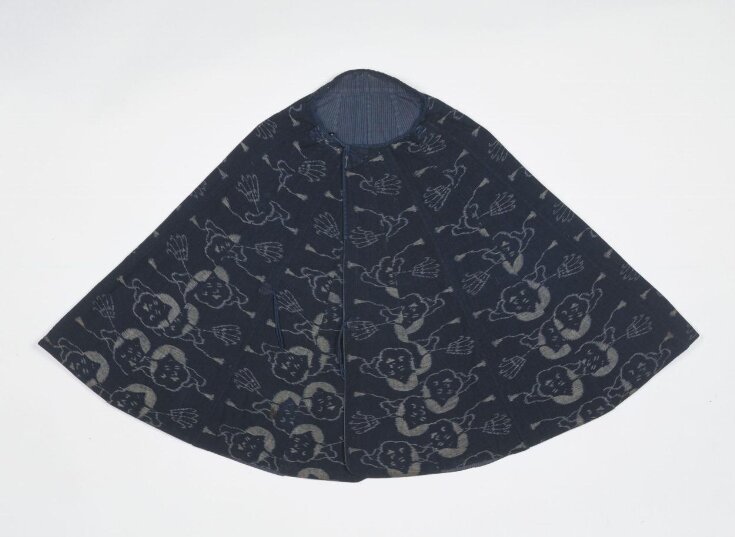
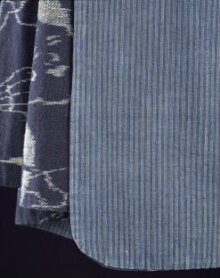
This style of cape was adapted from those worn by Portuguese missionaries in 16th-century Japan. It is called a ‘bôzukappa’, from the Japanese word for priest (bôzu) and the transliteration of the Portuguese for cape (kappa). Their use was initially restricted to members of the military (samurai) class, but by the 18th century other sections of society were wearing them for travel along the expanding network of roads that linked Japan’s towns and cities. The cape is reversible and is patterned on one side using the kasuri technique, whereby yarns are selectively dyed prior to weaving, and on the other with fabric striped in blue, black and orange. The design on the patterned side is the face of Okame, the goddess of mirth, which was no doubt chosen to cheer the traveller on his journey.
Object details
| Categories | |
| Object type | |
| Materials and techniques | Cotton woven with selectively pre-dyed yarns (kasuri) |
| Brief description | Cape, cotton woven with selectively resist-dyed yarns, Japan, 19th century |
| Physical description | Circular cape made from 16 gored panels of cotton with a stand up collar. The plain weave cotton has a design of the face of Okame, goddess of mirth in the picture kasuri technique. The faces are white against a dark blue ground. The cape is lined throughout with plain weave cotton with blue, black and orange stripes. The collar and top edge of the garment are trimmed with a narrow blue cotton edging which is of plain weave structure having paired warps and tripled wefts. The cape is worn wraparound style, the left side overlapping the right. The fastenings at the top consist of a pair of dark brown buttons, each sewn onto the end of a short length of blue cotton braid and each one closing through a loop of the same braid. The fastening at waist level consists of two long blue cotton braid loops, one each side of the cape and each sewn underneath a circular patch of card covered in cotton. |
| Dimensions |
|
| Styles | |
| Object history | Purchased. Registered File number 1988/168. |
| Subject depicted | |
| Summary | This style of cape was adapted from those worn by Portuguese missionaries in 16th-century Japan. It is called a ‘bôzukappa’, from the Japanese word for priest (bôzu) and the transliteration of the Portuguese for cape (kappa). Their use was initially restricted to members of the military (samurai) class, but by the 18th century other sections of society were wearing them for travel along the expanding network of roads that linked Japan’s towns and cities. The cape is reversible and is patterned on one side using the kasuri technique, whereby yarns are selectively dyed prior to weaving, and on the other with fabric striped in blue, black and orange. The design on the patterned side is the face of Okame, the goddess of mirth, which was no doubt chosen to cheer the traveller on his journey. |
| Bibliographic reference | Jackson, Anna, Japanese Country Textiles, London: V&A Publications, 1997, p.82, fig 53 |
| Collection | |
| Accession number | FE.1-1988 |
About this object record
Explore the Collections contains over a million catalogue records, and over half a million images. It is a working database that includes information compiled over the life of the museum. Some of our records may contain offensive and discriminatory language, or reflect outdated ideas, practice and analysis. We are committed to addressing these issues, and to review and update our records accordingly.
You can write to us to suggest improvements to the record.
Suggest feedback
You can write to us to suggest improvements to the record.
Suggest feedback
| Record created | February 12, 2000 |
| Record URL |
Download as: JSONIIIF Manifest
