Dish
9th century-10th century (made)
| Artist/Maker | |
| Place of origin |
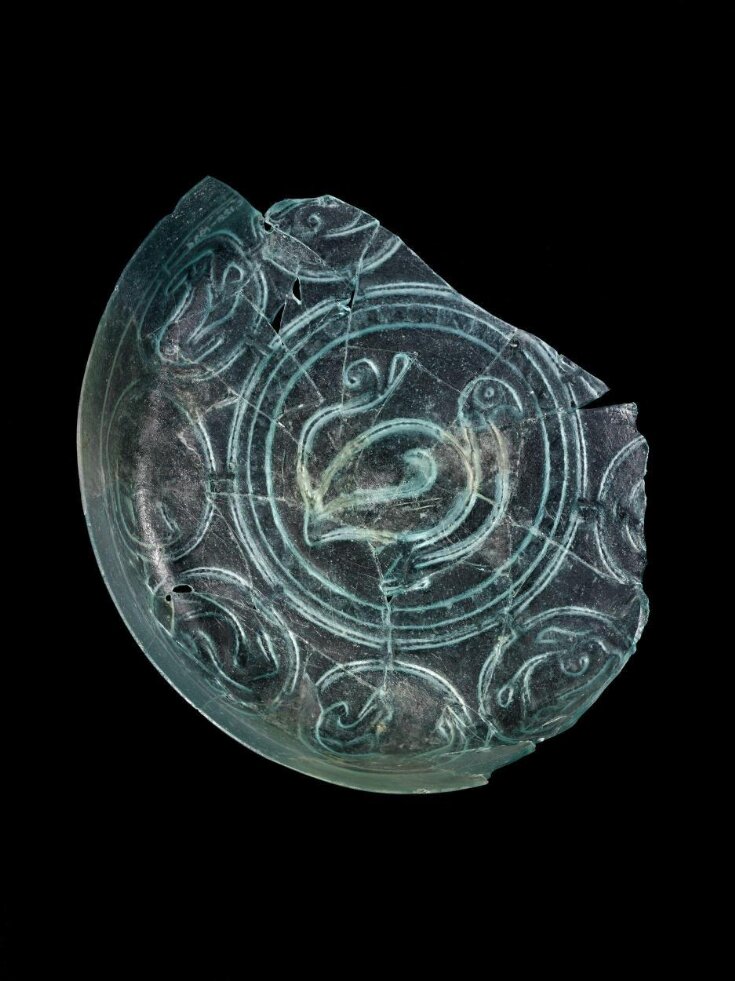
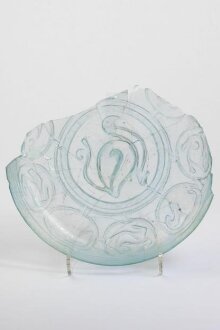
After 800 the cut-glass vessels produced in Iraq and Iran became more sophisticated. The thick walls were ground or cut away to leave the decoration in bold relief. Designs such as this quail-like bird surrounded by a pearl border on the dish were often inspired by Sasanian models.
Object details
| Category | |
| Object type | |
| Materials and techniques | Cut blown glass |
| Brief description | Dish, clear, pale blue tinted relief-cut glass with a quail-like bird, Iraq or Iran, 9th-10th century. |
| Physical description | Fragmentary plate of pale blue glass, deeply cut. Central medallion of bird with smaller medallions featuring running animals around rim, originally nine. Medallion borders with pearl motif, smaller medallions linked to each other and to the larger central one by a simple cut. One horizontal band around shoulder. Some small bubbles in glass. Profile rather splayed. |
| Dimensions |
|
| Style | |
| Gallery label |
|
| Credit line | Wilfred Buckley Collection |
| Object history | The running freize of animals on this plate relates it to a body of deeply cut glass vessels which have been attributed to Iran and to the 9th-10th centuries. The bird in the central medallion, however, is consistant with Byzantine iconography, particularly on metalwork. |
| Production | Said to have been found at Rayy, near Tehran. |
| Subject depicted | |
| Summary | After 800 the cut-glass vessels produced in Iraq and Iran became more sophisticated. The thick walls were ground or cut away to leave the decoration in bold relief. Designs such as this quail-like bird surrounded by a pearl border on the dish were often inspired by Sasanian models. |
| Bibliographic reference | Kroger, Berlin no. 195 |
| Other number | 8220 - Glass gallery number |
| Collection | |
| Accession number | C.128-1936 |
About this object record
Explore the Collections contains over a million catalogue records, and over half a million images. It is a working database that includes information compiled over the life of the museum. Some of our records may contain offensive and discriminatory language, or reflect outdated ideas, practice and analysis. We are committed to addressing these issues, and to review and update our records accordingly.
You can write to us to suggest improvements to the record.
Suggest feedback
You can write to us to suggest improvements to the record.
Suggest feedback
| Record created | December 13, 1997 |
| Record URL |
Download as: JSONIIIF Manifest
