Teapot
1700-1720 (made)
| Artist/Maker | |
| Place of origin |
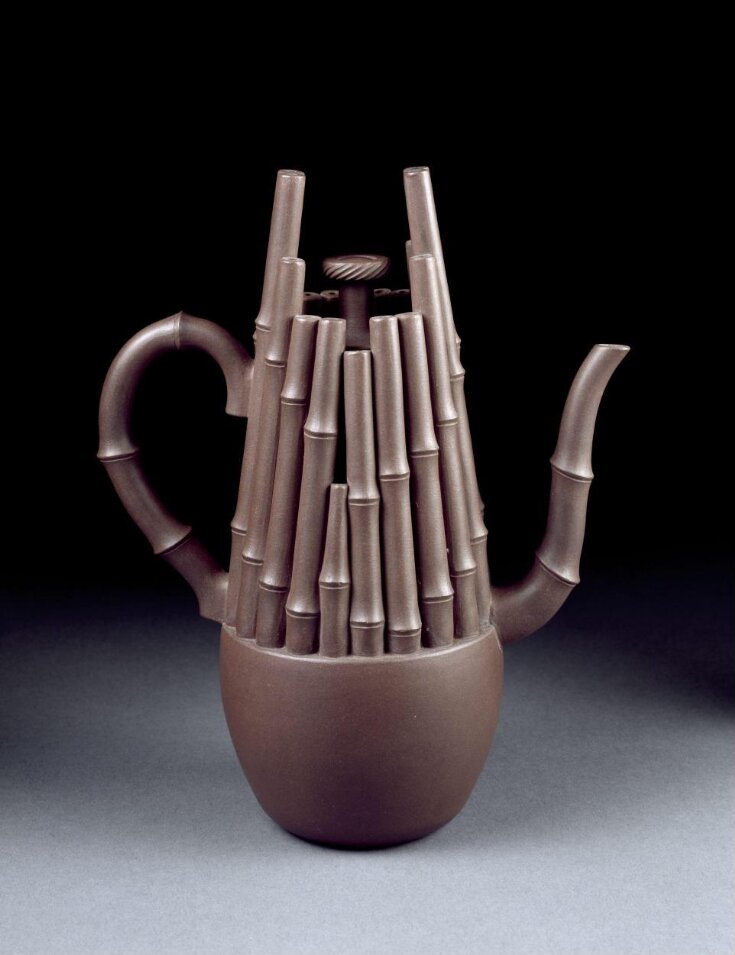
This stoneware teapot is in the form of a sheng. This was a Chinese musical wind instrument made from a group of reeds or bamboo tubes of different heights. The sheng was a particularly popular type of decoration in the Qing dynasty (1644-1912). At this time it was used to represent the Chinese word for 'growing' or 'give birth to', which is also pronounced 'sheng'.
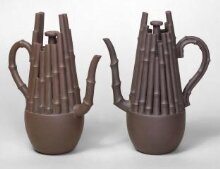
This teapot is one of a pair, but since they were hand-made the two pieces are not identical. Even the brown clay fired to a slightly different colour. They were listed in the inventory of the great British collector William Beckford after his death in 1844. The two teapots appeared in the sale of his estate in 1845, and in the same year illustrations of them featured in the Illustrated London News.
This teapot is one of a pair, but since they were hand-made the two pieces are not identical. Even the brown clay fired to a slightly different colour. They were listed in the inventory of the great British collector William Beckford after his death in 1844. The two teapots appeared in the sale of his estate in 1845, and in the same year illustrations of them featured in the Illustrated London News.
Object details
| Categories | |
| Object type | |
| Parts | This object consists of 4 parts.
|
| Materials and techniques | Red stoneware, hand moulded |
| Brief description | Teapot in the form of a sheng, brown stoneware, Yixing, China, 1700-1720 |
| Physical description | A Yixing brown stoneware teapot in the form of a sheng, a musical wind instrument formed by a group of reeds or bamboo tubes of different heights. A cash pattern has been cut into the base to reveal the inner wall of the pot - a feature that would not be visible except when pouring the tea. A small cartouche with the name Menghou in seal script appears below the handle. The sheng was a particularly popular decorative motif in the Qing dynasty as a rebus for 'growing' or 'give birth to', a word also pronounced 'sheng'. The teapot is one of a pair, but since they were hand-made the two pieces are not identical. Even the brown clay fired to a slightly different colour. A very similar teapot is in Dresden (N93, PO 3896), which was catalogued in 1721. |
| Dimensions |
|
| Styles | |
| Marks and inscriptions | A small cartouche with the name Menghou in seal script appears below the handle. |
| Gallery label |
|
| Credit line | W. H. Cope Bequest |
| Object history | Bequeathed by Mr. W. H. Cope, accessioned in 1903. This acquisition information reflects that found in the Asia Department registers, as part of a 2022 provenance research project. |
| Historical context | Bet McLeod's research has revealed that these two teapots were in William Beckford's inventory after his death in 1844, appeared in the sale 1845 and illustrated in the Illustrated London News 1845. She found no trace of Beckford's acquisition of the teapots. Valuation is for one teapot |
| Summary | This stoneware teapot is in the form of a sheng. This was a Chinese musical wind instrument made from a group of reeds or bamboo tubes of different heights. The sheng was a particularly popular type of decoration in the Qing dynasty (1644-1912). At this time it was used to represent the Chinese word for 'growing' or 'give birth to', which is also pronounced 'sheng'. This teapot is one of a pair, but since they were hand-made the two pieces are not identical. Even the brown clay fired to a slightly different colour. They were listed in the inventory of the great British collector William Beckford after his death in 1844. The two teapots appeared in the sale of his estate in 1845, and in the same year illustrations of them featured in the Illustrated London News. |
| Bibliographic references |
|
| Collection | |
| Accession number | 662 to C-1903 |
About this object record
Explore the Collections contains over a million catalogue records, and over half a million images. It is a working database that includes information compiled over the life of the museum. Some of our records may contain offensive and discriminatory language, or reflect outdated ideas, practice and analysis. We are committed to addressing these issues, and to review and update our records accordingly.
You can write to us to suggest improvements to the record.
Suggest feedback
You can write to us to suggest improvements to the record.
Suggest feedback
| Record created | February 9, 2000 |
| Record URL |
Download as: JSONIIIF Manifest
