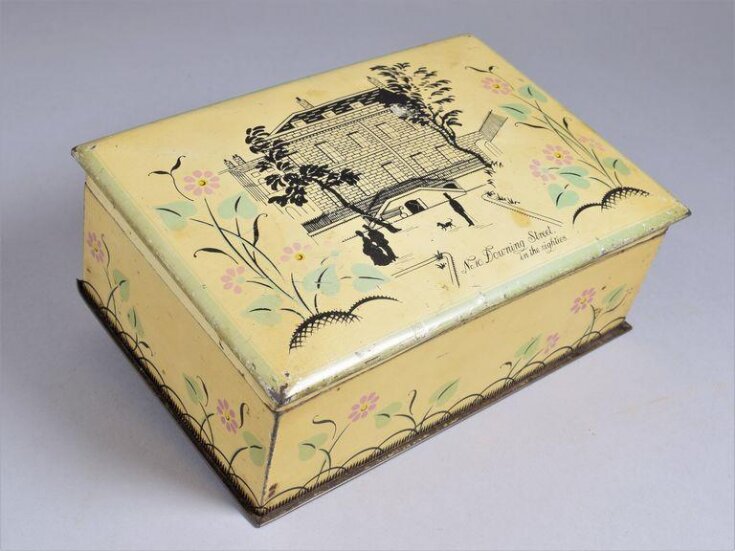

No. 10 Downing Street
Biscuit Tin
1924 (made)
1924 (made)
| Artist/Maker | |
| Place of origin |
The British biscuit tin came about when the Licensed Grocer's Act of 1861 allowed groceries to be individually packaged and sold. Coinciding with the removal of the duty on paper for printed labels. It was only a short step to the idea of printing directly on to tinplate. The new process of offset lithography, patented in 1877 allowed multicoloured designs to be printed on to exotically shaped tins.
The most exotic designs were produced in the early years of the 20th century, just prior to the First World War. In the 1920s and 1930s, costs had risen substantially and the design of biscuit tins tended to be more conservative, with the exception of the tins targeted at the Christmas market and intended to appeal primarily to children. The designs, generally speaking are a barometer of popular interests.
The advent of the Second World War stopped all production of decorative tin ware and after it ended in 1945, the custom never really revived.
The most exotic designs were produced in the early years of the 20th century, just prior to the First World War. In the 1920s and 1930s, costs had risen substantially and the design of biscuit tins tended to be more conservative, with the exception of the tins targeted at the Christmas market and intended to appeal primarily to children. The designs, generally speaking are a barometer of popular interests.
The advent of the Second World War stopped all production of decorative tin ware and after it ended in 1945, the custom never really revived.
Object details
| Categories | |
| Object type | |
| Titles |
|
| Materials and techniques | Offset litho printed tinplate. |
| Brief description | Biscuit tin, `No. 10 Downing Street', offset litho printed tinplate, England, made for McVitie & Price, 1924. |
| Physical description | Biscuit tin, offset litho printed tinplate. |
| Dimensions |
|
| Production type | Mass produced |
| Marks and inscriptions | 'No. 10 Downing Street, / in the eighties' (on lid) |
| Credit line | Given by M. J. Franklin |
| Object history | M.J. Franklin Collection of British Biscuit Tins. |
| Historical context | This tin was never issued. |
| Subject depicted | |
| Place depicted | |
| Association | |
| Summary | The British biscuit tin came about when the Licensed Grocer's Act of 1861 allowed groceries to be individually packaged and sold. Coinciding with the removal of the duty on paper for printed labels. It was only a short step to the idea of printing directly on to tinplate. The new process of offset lithography, patented in 1877 allowed multicoloured designs to be printed on to exotically shaped tins. The most exotic designs were produced in the early years of the 20th century, just prior to the First World War. In the 1920s and 1930s, costs had risen substantially and the design of biscuit tins tended to be more conservative, with the exception of the tins targeted at the Christmas market and intended to appeal primarily to children. The designs, generally speaking are a barometer of popular interests. The advent of the Second World War stopped all production of decorative tin ware and after it ended in 1945, the custom never really revived. |
| Bibliographic references |
|
| Collection | |
| Accession number | M.617-1983 |
About this object record
Explore the Collections contains over a million catalogue records, and over half a million images. It is a working database that includes information compiled over the life of the museum. Some of our records may contain offensive and discriminatory language, or reflect outdated ideas, practice and analysis. We are committed to addressing these issues, and to review and update our records accordingly.
You can write to us to suggest improvements to the record.
Suggest feedback
You can write to us to suggest improvements to the record.
Suggest feedback
| Record created | February 7, 2000 |
| Record URL |
Download as: JSON
