
Mirror Frame
1490-1520 (made)
| Artist/Maker | |
| Place of origin |
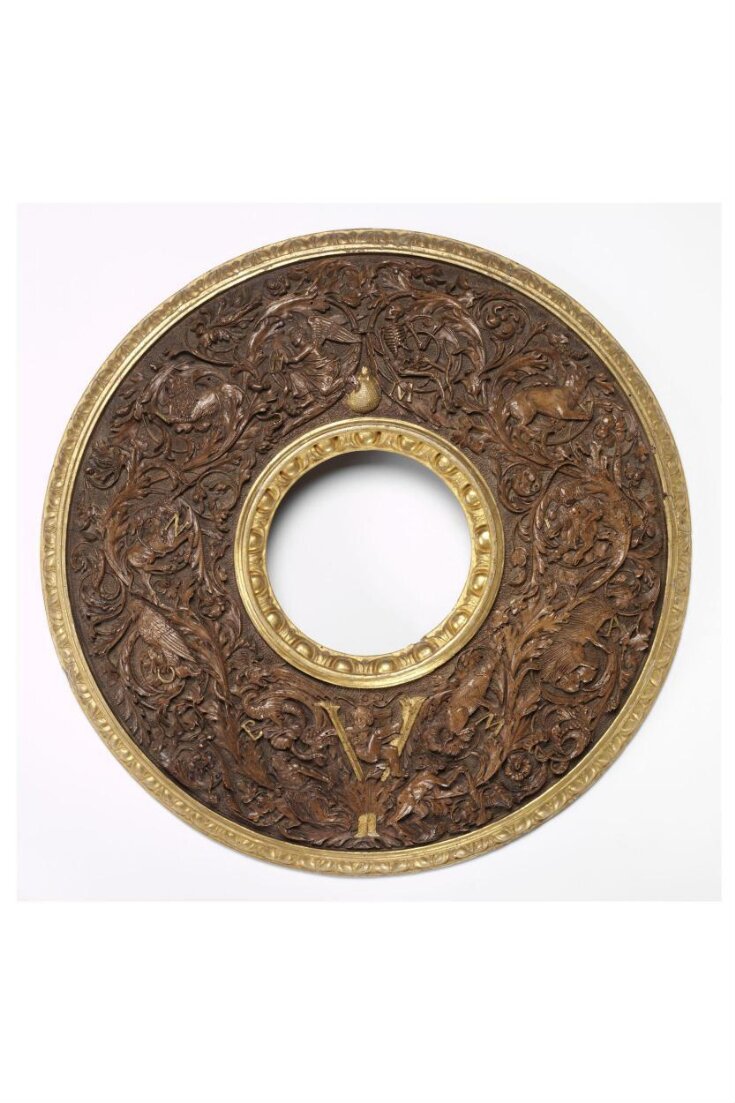
This frame has been romantically associated with the notorious Lucrezia Borgia (1480–1519), but it bears a flaming grenade, the personal emblem of her husband, Alfonso d’Este (1486–1534), 3rd Duke of Ferrara. The frame would have housed either a mirror or a devotional image, as suggested by the moralising theme of the carving. The various animals symbolise virtue and vice, and the ‘Y’ at the bottom signifies the choice between good and evil. The maker remains unknown, but the frame could have come from the ducal workshops of Ferrara in the north Italian state of Emilia-Romagna, a city famous for its patronage of artists like Cosmè Turo (1430–1495) and Antonio Pisanello (about 1395–1455).
Object details
| Categories | |
| Object type | |
| Materials and techniques | Walnut, carved and partly gilt |
| Brief description | Mirror frame, Italian, Ferrara, c1490-1505 |
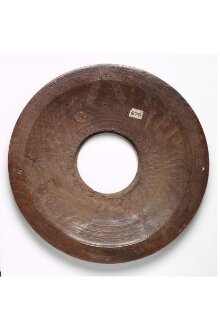
| Physical description | Carved walnut and partially water gilded tondo, with the emblem of Alfonso d'Este, 3rd Duke of Ferrara (1486-1534). Round, gently convex carved walnut mirror frame with gilt egg and dart ovolo sight edge moulding, and gilt leaf and dart ovolo back edge moulding. The frame is carved in an acanthus scroll pattern, interspersed with allegorical figures and animals holding gilt letters that make up the words "bonum" (good) on the left side and 'malum' (evil) on the right side. At the bottom is a gilt letter 'Y', the Pythagorean symbol for the choice between a life of virtue and vice, in which a naked boy reclines in front of and partly obscuring a shield. To his left, ascending on the side of virtue, is a cornucopia held by a young woman from which spring allegorical figures and animals holding gilt letters that spell the word BONUM (good): dragon for vigilance(?) (B), Eagle with a hare in its talons for power(?) (O), unicorn for chastity (N), lion for fortitude (O), angel for salvation (M). To the right of the Y is a lustful goat with a cornucopia and allegorical animals holding gilded letters that spell the word MALUM (evil): boar for gluttony or lust (M), porcupine for invincibility or ferocity (A), monkey for lust or heresy (L), wolf for fierce, cunning and greedy (V), skeleton for death (M). Between the angel and the skeleton is a gilt flaming grenade, the personal emblem of Alfonso d'Este, 3rd Duke of Ferrara (1486 - 1534). Construction The mirror is made of one piece of wood. It was apparently face-plate turned: what is now the back of the mirror would have been cut first to its dished form (with turner's marks left visible), then reversed on the lathe to turn the convex profile of the front, including the sight and back edge mouldings. The central aperture would presumably have been drilled and chiselled out before the front carving was carried out with a series of small chisels, gouges and punches, to avoid the risk of undue damage to the carving. The space between both edges has been carved in relief, with some undercutting which occasionally runs right underneath plant stems or the bones of the skeleton for example. The background surface is consistently and closely punched, giving almost a granular effect. Decorative Finish The frame is partially gilded. There are two decorative schemes. The most recent gilding is oil gilding on a yellow mordant over a white ground and is found on the egg and dart sight edge, leaf and dart outer edge, lettering and flaming grenade. An earlier water gilded scheme on red bole over a thin, white ground can be seen, visible on the outer leaf moulding below the most recent oil gilded scheme. Hanging Device At the top there is pale area in the shape of an inverted V where a hanging device, possibly a wrought metal crossover strap, held with nails with a loop at the top. There are three screw holes, bored isosceles triangle fashion, and two screw holes at the extremities of the imprint of a 'V' shaped bracket at the top of the mirror; two pairs of screw holes at the PL side and one pair at the PR side of the mirror. The turner's marks can just be seen on the edges of the gilt borders and clearly so on the back of the mirror. The back is dished, with a flat outer rim 4.2. cm wide. There are three main patches of bastard graining (the growth rings orientated between 30 degrees and 60 degrees to the surface) in the dished area, one below and another to the proper right hand side of the inner ring, and one close to the flattened outer rim, on the proper left hand side. Later interventions and damage Despite the appearance of being in good condition, the front has numerous worm holes: the pig's and porcupine's snouts are partly eaten away, and the monkey's cheek and upper lip have been replaced with filler. An old split runs across the dished surface of the back, roughly behind the monkey. The present glass mirror and its wooden support are likely to be Museum additions. |
| Dimensions |
|
| Production type | Unique |
| Marks and inscriptions | 670 (Inscribed in black ink on a white label pasted on the back of the frame) |
| Gallery label |
|
| Object history | Bought, with a gilt-bronze relief (V&A 7694: A-1861) from the Managers of the Guarantee Fund for purchasing the Collection of Monsieur Soulages of Toulouse for £150. Lent to GLORIA DELL’ARTE: a renaissance perspective, an exhibition at Philbrook, Art center, Tulsa, Oklahoma, October 28th, 1979- January 27th, 1980 Although traditionally linked with Lucrezia Borgia (1480-1519), this frame is emblazoned with the flaming grenade, the personal emblem of her husband, Alfonso d'Este (1486-1534). It formed part of the collections of Jules Soulages (died ca. 1857), a lawyer from Toulouse, which were bought by subscription and exhibited at the Museum of Ornamental Art, London, between December 1856 and January 1857. It was item 670 in the exhibition catalogue and described as a "circular Metallic Mirror, in carved walnut-wood frame. Italian – date, second half of fifteenth century … The ornamentation forms a continued frieze of the richest and most elaborate carving ...M. Soulages states that this mirror was reputed to have been the property of the celebrated Lucrezia Borgia, and that the flaming grenado … was her device". Despite initial reluctance, the Government acquired the collection from the subscribers piecemeal, including this item which was purchased for £150 in 1861. At that time, the frame came with a late 15th gilt bronze disk (7964A-1861) of a Madonna with child. This frame probably held a mirror. Conclusions and Observations (taken from Powell and Allen 2010) An earlier water gilded scheme has been observed. Had the gilded areas on the frame been originally water gilded they would have appeared much brighter than they do today resulting in a different balance of the ornament. It is further possible that some elements such as the lettering were highlighted through burnishing. It is not possible to fully establish this possibility as the original surface is largely concealed by the present oil gilded scheme. Historical significance: This item presumably once belonged to Alfonso I d' Este (reigned 1505 - 1534) Duke of Ferrara, who was chiefly remembered for his military prowess. Nevertheless, Alfonso had his own workshop where he practiced turning, then very much regarded as a princely hobby, with the help of two woodworkers, Maestro Marocho and Maestro Zohan da Ricobon. The circular moulding and cutting on the back of the frame indicate the use of the lathe, and Alfonso I may conceivably have had a hand in the turning if not the carving. Although there survive plenty of documents connected with furniture makers based in Ferrara, almost none of the pieces they made have actually survived. The maker of this frame remains unknown, but the personal emblem indicates the owner. If this frame was made in Ferrara - which seems likely enough - then it is an almost unique survival, revealing the most interesting blend between classical moulding and folliate ornament and late gothic model book figures and animals. Dating The precise dating of the frame is uncertain. A dating 1502-19 was followed in 1996 by the author of the entry in Western Furniture 1350 to the Present Day (see references), these being the dates of Alfonso's marriage to Lucrezia Borgia, with whom the frame had traditionally been associated. Shepherd (see references) argues that the mirror was a gift from Ercole d'Este (1431-1505) to his son Alfonso, most likely in the mid-1490s, but sometime between the late 1480s and the late 1490s or possibly to mark the latter's marriage in 1502. On that basis, a range c1490-1505 (the date of Ercole's death) is suggested here. |
| Historical context | This item could have been used as a mirror or a frame for a small religious painting or ancona, most likely of a Madonna and child or crucifix. Such items were frequently found in inventories, usually placed in more intimate rooms such as the bedchamber. The glass for mirrors was often imported from Venice, although the ducal workshops of Ferrara employed a mirror-glass maker by the name of Lazarus. They would have been regarded as an expensive luxury, more often used by the lady of the house than her husband. Given the somewhat moralizing theme of the decoration, the choice between good (bonum) over evil (malum) and the allegorical beasts that go with it, this frame may well have originally gone with a small religious painting. Comparable frames: Carved mirror frame, Tuscan early 16th century; H:79cm W:67cm Michel Angelo Guggenheim, Le cornici italiane dalle metà del secolo XVo allo scorcio del XVIo., Milan: U. Hoepli, 1897, plate 60, recorded as Prince of Liechtenstein collection |
| Subjects depicted | |
| Associations | |
| Summary | This frame has been romantically associated with the notorious Lucrezia Borgia (1480–1519), but it bears a flaming grenade, the personal emblem of her husband, Alfonso d’Este (1486–1534), 3rd Duke of Ferrara. The frame would have housed either a mirror or a devotional image, as suggested by the moralising theme of the carving. The various animals symbolise virtue and vice, and the ‘Y’ at the bottom signifies the choice between good and evil. The maker remains unknown, but the frame could have come from the ducal workshops of Ferrara in the north Italian state of Emilia-Romagna, a city famous for its patronage of artists like Cosmè Turo (1430–1495) and Antonio Pisanello (about 1395–1455). |
| Associated object | 7694A-1861 (Object) |
| Bibliographic references |
|
| Collection | |
| Accession number | 7694-1861 |
About this object record
Explore the Collections contains over a million catalogue records, and over half a million images. It is a working database that includes information compiled over the life of the museum. Some of our records may contain offensive and discriminatory language, or reflect outdated ideas, practice and analysis. We are committed to addressing these issues, and to review and update our records accordingly.
You can write to us to suggest improvements to the record.
Suggest feedback
You can write to us to suggest improvements to the record.
Suggest feedback
| Record created | January 31, 2000 |
| Record URL |
Download as: JSONIIIF Manifest
