Armchair
1884-1886 (made)
| Artist/Maker | |
| Place of origin |
Object Type
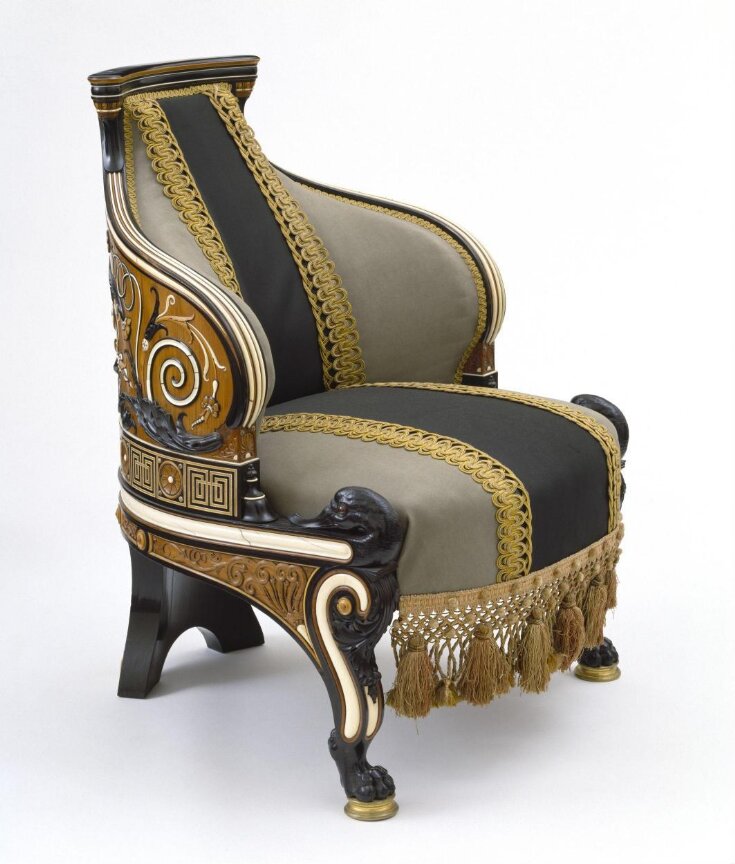
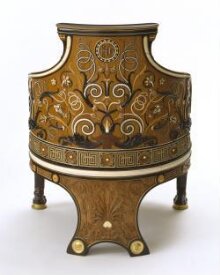
This armchair formed part of a luxurious suite of furniture, costing £25,000, designed for the music room of the New York mansion of Henry Gurdon Marquand (1819-1902). He was a highly successful American entrepreneur, art collector and benefactor. The armchair bears Marquand's initials on the back. The suite included two settees, the pair of this armchair (Melbourne, National Gallery of Victoria), two piano stools and a piano decorated by Sir Edward Poynter (1836-1919).
People
This armchair was designed by Sir Lawrence Alma-Tadema (1836-1912), and made in London by Johnstone, Norman & Co, for Henry Gurdon Marquand who was, among other things, a trustee and later president of the Metropolitan Museum, New York.
Materials & Making
This armchair is made of mahogany, with cedar and ebony veneer, and inlaid in ivory and abalone shell. The original upholstery was described in the 1903 Marquand sales catalogue as 'silk of an ashen olive hue, embroidered with panels ... of the Greek wave design.'
Place
The furniture is designed in the Grecian style for the 'Greek Parlor' or music room of Marquand's house on Madison Avenue in New York. This music room also housed Marquand's classical antiquities. Other rooms were decorated in styles that reflected the different aspects of his collections. This furniture was exhibited in Johnstone & Norman's shop in New Bond Street, London, before being sent to America.
This armchair formed part of a luxurious suite of furniture, costing £25,000, designed for the music room of the New York mansion of Henry Gurdon Marquand (1819-1902). He was a highly successful American entrepreneur, art collector and benefactor. The armchair bears Marquand's initials on the back. The suite included two settees, the pair of this armchair (Melbourne, National Gallery of Victoria), two piano stools and a piano decorated by Sir Edward Poynter (1836-1919).
People
This armchair was designed by Sir Lawrence Alma-Tadema (1836-1912), and made in London by Johnstone, Norman & Co, for Henry Gurdon Marquand who was, among other things, a trustee and later president of the Metropolitan Museum, New York.
Materials & Making
This armchair is made of mahogany, with cedar and ebony veneer, and inlaid in ivory and abalone shell. The original upholstery was described in the 1903 Marquand sales catalogue as 'silk of an ashen olive hue, embroidered with panels ... of the Greek wave design.'
Place
The furniture is designed in the Grecian style for the 'Greek Parlor' or music room of Marquand's house on Madison Avenue in New York. This music room also housed Marquand's classical antiquities. Other rooms were decorated in styles that reflected the different aspects of his collections. This furniture was exhibited in Johnstone & Norman's shop in New Bond Street, London, before being sent to America.
Object details
| Categories | |
| Object type | |
| Parts | This object consists of 2 parts.
|
| Materials and techniques | Mahogany, with cedar and ebony veneer, carving and inlay of several woods, ivory and abalone shell, replaced upholstery |
| Brief description | Mahogany, with cedar and ebony veneer, carving and inlay of several woods, ivory and abalone shell, replaced upholstery; designed by Sir Lawrence Alma-Tadema and made by Johnstone, Norman and Co. for H.G. Marquand, English 1884-6 |
| Physical description | Armchair, the curved back and legs with elaborate carved and inlaid scrolling anthemia (flower heads) and acanthus, bell flowers, paterae (medallions) and Greek key patterns. The initials H.G.M incorporated into the inlaid decoration on the back of the chair. The front legs have swans'/ducks' heads at top, and lion's paw feet. The cover is blue with a central black stripe and tassels at the seat front. |
| Dimensions |
|
| Marks and inscriptions | Initials of patron 'HGM' inlaid in roundel on back |
| Gallery label | British Galleries:
This armchair was made for a Greek-style Music Room in a New York mansion. The artist who designed the room specialised in paintings of classical subjects in correctly-detailed settings. He had an extensive knowledge of classical motifs such as the Greek key pattern and the paterae (medallions) on the seat rails.(27/03/2003) |
| Object history | The armchair was part of a suite commissioned by H.G. Marquand, a prominent collector and second President of the Metropolitan Museum of Art, New York, for the Music Room in his New York mansion. The theme of the Music Room, also designed by Alma-Tadema, was Grecian.. The suite included a grand piano, painted by Sir Edward Poynter (Sterling and Francine Clark Art Institute, Williamstown, Massachusetts), two piano stools, a music cabinet (Chrysler Museum of Art, Norfolk, Virginia) and two corner cabinets, two round tables, long and curved settees (one long settee in the Metropolitan Museum of Art, New York), four small chairs, and a second armchair (National Gallery of Victoria, Melbourne). The Metropolitan Museum also have one of the original portières of embroidered sik. Marquand's initials are inlaid into the back of the armchair, which was originally covered in grey-green silk with an embroidered panel running down the back and across the seat. The armchair, and most of the other pieces in the suite, were sold from the Martin Beck Theatre at Sothebys, New York, 26th March 1980, and it was purchsed for the Museum by Haslam & Whiteway Ltd, London. Associated with the suite of furniture is a framed and glazed panel of sandalwood with carved decoration in ivory, boxwood, ebony and abalone, with a design of Ibis drinking from a fountain, and the same scrolling acanthus leaves and flowering tendrils as on the back of the armchair. The frame, which bears an indistinct inscription referring to the grand piano, was sold at Sothebys, London, Victorian & British Impresssionist Pictures, 16 December 2009, lot 29. Object sampling carried out by Jo Darrah, V&A Science; drawer/slide reference 5/1. Historical significance: Favourable contemporary comment, both in Britain and America, on the commission referred to the Greek style of the decoration and the exotic materials used for the furnishings. This amount of publicity and the unusual display of some of the furniture in the New Bond Street shop of Johnstone, Norman and Co. in 1884 (where it was inspected by the Prince and Princess of Wales), emphasized the importance of this commission from an American millionare collector to an English artist and furniture manufacturer. The design of the various pieces of furniture clearly reveals Alma-Tadema's knowledge of the Classical world, based on his studies in the British Museum, on visits to Pompeii and Herculaneum, and on his extensive photographic collection of Classical antiquities and architecture. |
| Subjects depicted | |
| Summary | Object Type This armchair formed part of a luxurious suite of furniture, costing £25,000, designed for the music room of the New York mansion of Henry Gurdon Marquand (1819-1902). He was a highly successful American entrepreneur, art collector and benefactor. The armchair bears Marquand's initials on the back. The suite included two settees, the pair of this armchair (Melbourne, National Gallery of Victoria), two piano stools and a piano decorated by Sir Edward Poynter (1836-1919). People This armchair was designed by Sir Lawrence Alma-Tadema (1836-1912), and made in London by Johnstone, Norman & Co, for Henry Gurdon Marquand who was, among other things, a trustee and later president of the Metropolitan Museum, New York. Materials & Making This armchair is made of mahogany, with cedar and ebony veneer, and inlaid in ivory and abalone shell. The original upholstery was described in the 1903 Marquand sales catalogue as 'silk of an ashen olive hue, embroidered with panels ... of the Greek wave design.' Place The furniture is designed in the Grecian style for the 'Greek Parlor' or music room of Marquand's house on Madison Avenue in New York. This music room also housed Marquand's classical antiquities. Other rooms were decorated in styles that reflected the different aspects of his collections. This furniture was exhibited in Johnstone & Norman's shop in New Bond Street, London, before being sent to America. |
| Bibliographic references |
|
| Collection | |
| Accession number | W.25:1, 2-1980 |
About this object record
Explore the Collections contains over a million catalogue records, and over half a million images. It is a working database that includes information compiled over the life of the museum. Some of our records may contain offensive and discriminatory language, or reflect outdated ideas, practice and analysis. We are committed to addressing these issues, and to review and update our records accordingly.
You can write to us to suggest improvements to the record.
Suggest feedback
You can write to us to suggest improvements to the record.
Suggest feedback
| Record created | January 31, 2000 |
| Record URL |
Download as: JSONIIIF Manifest
