Jelly Glass
1750-1775 (made)
| Artist/Maker | |
| Place of origin |
Object Type
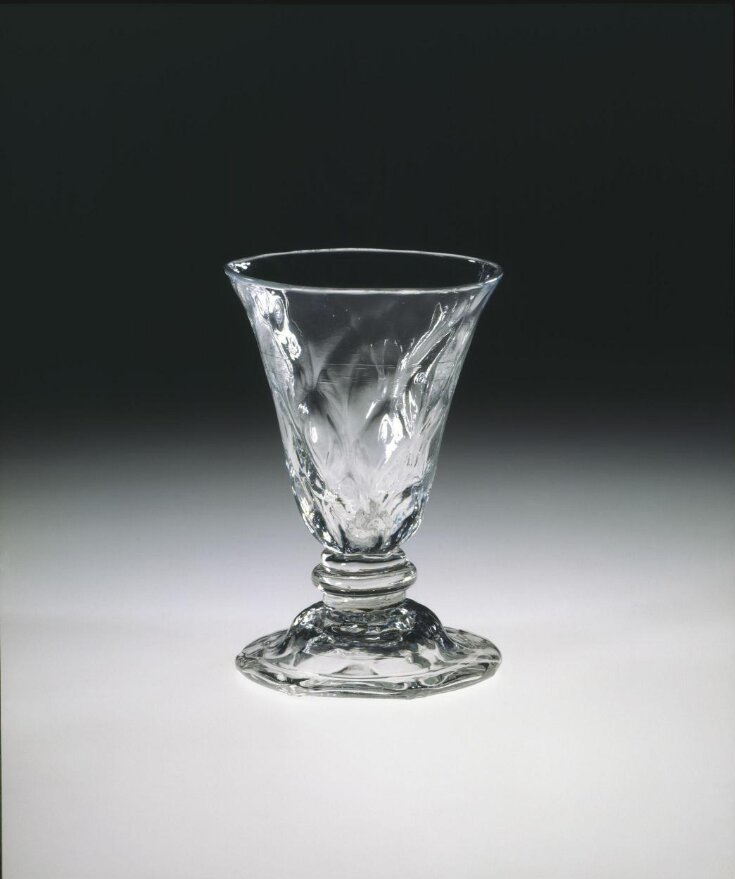
One of the simplest form of jelly glass, a funnel-shaped bowl on a slightly-domed foot, which was made in infinite variety and huge numbers during the second half of the 18th century and early 19th century.
Materials & Making
As with much Staffordshire pottery of the period, English lead-glass drinking vessels and dessert wares successfully combined refined material with consummate skill. Here, the bowl and foot of a humble jelly glass have been blown separately into a mould to form a mesh pattern (as a cheap imitation of facet-cutting), and the two pieces joined with a small 'knop' (a decorative bulbous swelling) of molten glass. The foot is domed to raise the pontil scar well above a polished mahogany table (the scar is the rough mark left when the pontil, or metal rod, used for handling the glass during manufacture is broken off). The edge is folded to strengthen it and terminate the mesh-moulding. It is said that a glassmakers' 'chair', consisting of a 'gaffer' in his special chair working in a perfectly-orchestrated way with three assistants, could make a three-piece wine glass in four minutes. No doubt this jelly glass would have taken about the same time.
One of the simplest form of jelly glass, a funnel-shaped bowl on a slightly-domed foot, which was made in infinite variety and huge numbers during the second half of the 18th century and early 19th century.
Materials & Making
As with much Staffordshire pottery of the period, English lead-glass drinking vessels and dessert wares successfully combined refined material with consummate skill. Here, the bowl and foot of a humble jelly glass have been blown separately into a mould to form a mesh pattern (as a cheap imitation of facet-cutting), and the two pieces joined with a small 'knop' (a decorative bulbous swelling) of molten glass. The foot is domed to raise the pontil scar well above a polished mahogany table (the scar is the rough mark left when the pontil, or metal rod, used for handling the glass during manufacture is broken off). The edge is folded to strengthen it and terminate the mesh-moulding. It is said that a glassmakers' 'chair', consisting of a 'gaffer' in his special chair working in a perfectly-orchestrated way with three assistants, could make a three-piece wine glass in four minutes. No doubt this jelly glass would have taken about the same time.
Object details
| Categories | |
| Object type | |
| Materials and techniques | Glass, with mould-blown mesh pattern |
| Brief description | Jelly glass, England, , 1725-1775, C.10-1950 . |
| Physical description | Bowl: honeycomb-moulded |
| Dimensions |
|
| Style | |
| Gallery label | British Galleries:
One of the most popular forms of dessert centrepiece was the jelly tree. This was a pyramid of glass salvers, desked with individual glasses containing brightly coloured jellies, custards, syllabubs, sugared fruits and flowers.(27/03/2003) |
| Credit line | Given by Mrs. C. E. M. Parker |
| Summary | Object Type One of the simplest form of jelly glass, a funnel-shaped bowl on a slightly-domed foot, which was made in infinite variety and huge numbers during the second half of the 18th century and early 19th century. Materials & Making As with much Staffordshire pottery of the period, English lead-glass drinking vessels and dessert wares successfully combined refined material with consummate skill. Here, the bowl and foot of a humble jelly glass have been blown separately into a mould to form a mesh pattern (as a cheap imitation of facet-cutting), and the two pieces joined with a small 'knop' (a decorative bulbous swelling) of molten glass. The foot is domed to raise the pontil scar well above a polished mahogany table (the scar is the rough mark left when the pontil, or metal rod, used for handling the glass during manufacture is broken off). The edge is folded to strengthen it and terminate the mesh-moulding. It is said that a glassmakers' 'chair', consisting of a 'gaffer' in his special chair working in a perfectly-orchestrated way with three assistants, could make a three-piece wine glass in four minutes. No doubt this jelly glass would have taken about the same time. |
| Collection | |
| Accession number | C.10-1950 |
About this object record
Explore the Collections contains over a million catalogue records, and over half a million images. It is a working database that includes information compiled over the life of the museum. Some of our records may contain offensive and discriminatory language, or reflect outdated ideas, practice and analysis. We are committed to addressing these issues, and to review and update our records accordingly.
You can write to us to suggest improvements to the record.
Suggest feedback
You can write to us to suggest improvements to the record.
Suggest feedback
| Record created | December 13, 1997 |
| Record URL |
Download as: JSONIIIF Manifest
