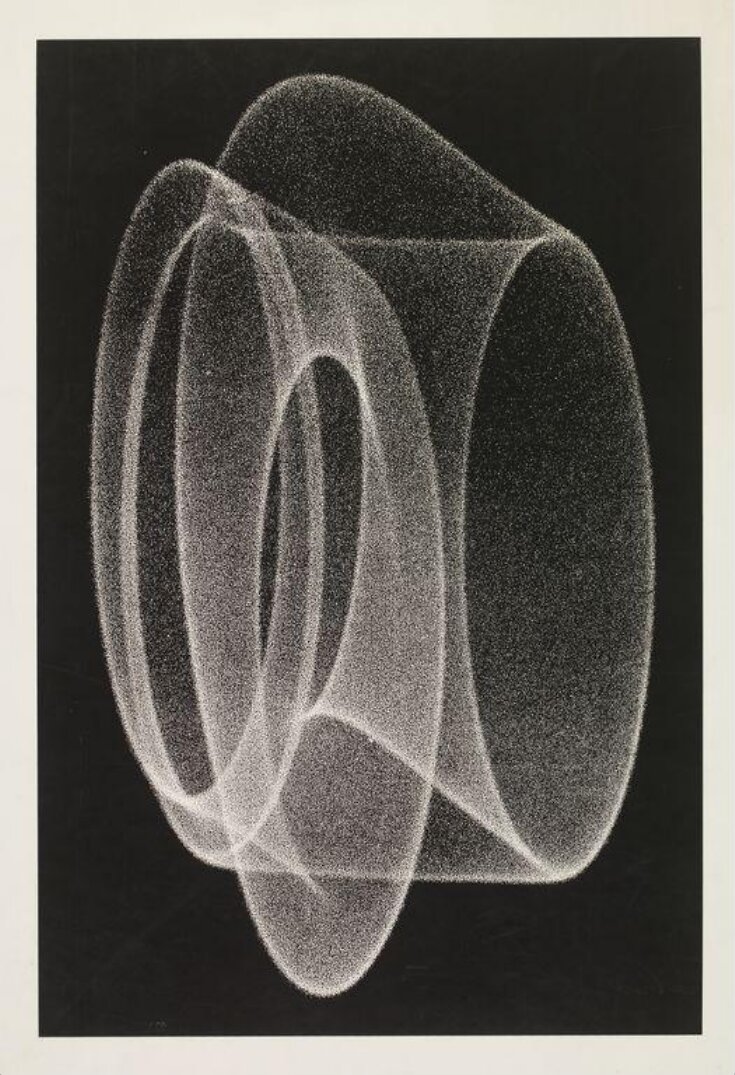

Analog-Grafik D2 (Dance of the Electrons)
Print
1970 (made)
1970 (made)
| Artist/Maker | |
| Place of origin |
This picture is from the series ‘Dance of the Electrons’. In 1962 Franke produced the image using his analogue computer called Demo-Gerät (demonstration-set) and a cathode-ray oscillograph. The latter converted electronic signals into images and Franke borrowed the apparatus from the company Siemens. In his earlier Pendular Oscillograms series of work Franke had moved the camera in-front of the screen to capture images. However, to create this new body of work Franke now mounted a camera onto a tripod in-front of the screen. The resulting pictures show fine sharp lines in white and grey colour gradients.
Object details
| Categories | |
| Object type | |
| Title | Analog-Grafik D2 (Dance of the Electrons) (assigned by artist) |
| Materials and techniques | Silkscreen print on board |
| Brief description | Black and white screenprint of a photograph, Analog-Grafik D2 (Dance of the Electrons), 1970 (original photograph 1962) by Herbert W. Franke. |
| Physical description | A black and white silkscreen print of a photograph. Mounted on board. |
| Dimensions |
|
| Credit line | Given by the Computer Arts Society, supported by System Simulation Ltd, London |
| Summary | This picture is from the series ‘Dance of the Electrons’. In 1962 Franke produced the image using his analogue computer called Demo-Gerät (demonstration-set) and a cathode-ray oscillograph. The latter converted electronic signals into images and Franke borrowed the apparatus from the company Siemens. In his earlier Pendular Oscillograms series of work Franke had moved the camera in-front of the screen to capture images. However, to create this new body of work Franke now mounted a camera onto a tripod in-front of the screen. The resulting pictures show fine sharp lines in white and grey colour gradients. |
| Bibliographic reference | Herzogenrath, Wulf and Barbara Nierhoff-Wielk, eds. Ex-Machina - Frühe Computergrafik bis 1979. Germany: Deutscher Kunstverlag, 2007. ISBN 978-3-422-06689-2. p.343, ill (cat. 76). |
| Other number | CAS/A/0094 - Previous owner's number |
| Collection | |
| Accession number | E.118-2008 |
About this object record
Explore the Collections contains over a million catalogue records, and over half a million images. It is a working database that includes information compiled over the life of the museum. Some of our records may contain offensive and discriminatory language, or reflect outdated ideas, practice and analysis. We are committed to addressing these issues, and to review and update our records accordingly.
You can write to us to suggest improvements to the record.
Suggest feedback
You can write to us to suggest improvements to the record.
Suggest feedback
| Record created | February 25, 2009 |
| Record URL |
Download as: JSON
