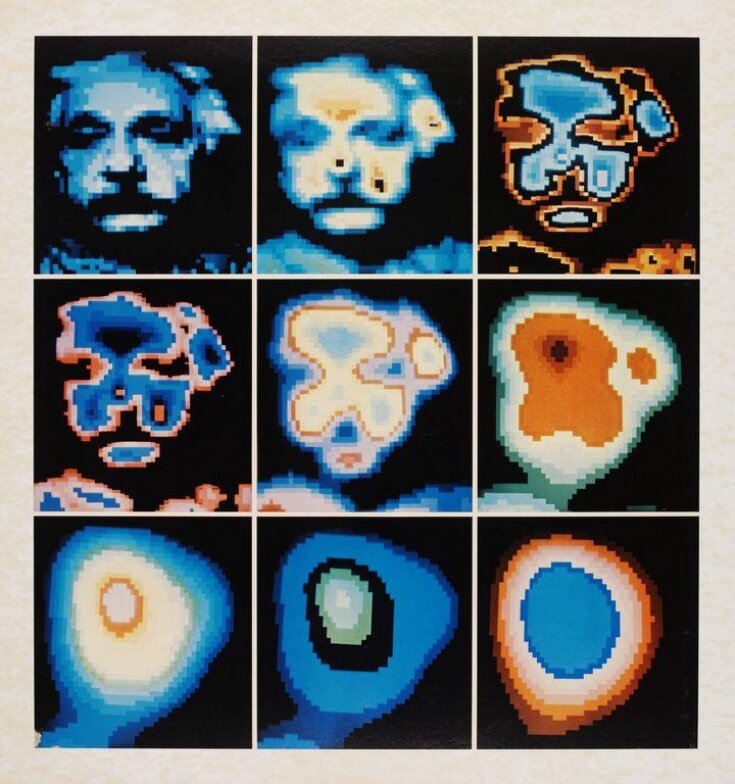

Elektronischer Einstein (Picture Processing)
Print
1972 (made)
1972 (made)
| Artist/Maker | |
| Place of origin |
These nine offset lithographs were created from photographs taken of images on a computer screen. The artist, Herbert W. Franke (born Austria, 1927), used an early digital picture processing that was developed by the computer scientists Jürgen van Kranenbrock and Helmut Schenk. Picture processing involves using a specially created computer program to apply a set of processes to an image, such as a photograph. These processes could include analysing, interpreting and manipulating the image, for example. Here the program slowly transforms a scanned picture of Albert Einstein, one stage at a time, into an abstract image. The program was based on the picture processing system used at this time for the analysis of scintigrams, a type of medical imagery that uses radioactive material to show up tissue or organs in the human body.
The images exist as lithographs because there was no output device capable of producing these pictures at the time. Instead, Franke photographed the images as stills on the screen and then produced slides, from which he was able to make a series of lithographs.
Digital picture processing, or image processing as it is sometimes known, is now very common. However, the process itself was only developed in the 1960s. Institutions such as the NASA Jet Propulsion Laboratory and Bell Laboratories, both in America, were responsible for developing techniques used in manipulating images, as applied in the fields of medicine and science. By the 1970s, when this image was created, digital image processing was becoming more accessible because of the arrival of cheaper computers and dedicated hardware.
The images exist as lithographs because there was no output device capable of producing these pictures at the time. Instead, Franke photographed the images as stills on the screen and then produced slides, from which he was able to make a series of lithographs.
Digital picture processing, or image processing as it is sometimes known, is now very common. However, the process itself was only developed in the 1960s. Institutions such as the NASA Jet Propulsion Laboratory and Bell Laboratories, both in America, were responsible for developing techniques used in manipulating images, as applied in the fields of medicine and science. By the 1970s, when this image was created, digital image processing was becoming more accessible because of the arrival of cheaper computers and dedicated hardware.
Object details
| Categories | |
| Object type | |
| Title | Elektronischer Einstein (Picture Processing) (assigned by artist) |
| Materials and techniques | Offset lithographs mounted on board |
| Brief description | Nine colour offset lithographs from photographs of computer-generated images, mounted on board, 'Electronic Einstein', 1972, by Herbert W. Franke. |
| Physical description | Nine colour offset lithographs mounted on board, depicting the step-by-step transformation of a portrait of Albert Einstein into an abstract image. |
| Dimensions |
|
| Credit line | Given by the Computer Arts Society, supported by System Simulation Ltd, London |
| Production | Elektronischer Einstein translates as 'Electronic Einstein'. The computer code, which included the picture processing system, was created by Jürgen van Kranenbrock and Helmut Schenk. Attribution note: The computer program used to produce these images was developed by Jürgen van Kranenbrock and Helmut Schenk, and was called 'Bildspeicher N'. The program included a picture processing system used in scintigraphy, a type of medical imaging which records a radioactive tracer The picture processing system was used by Siemens in Erlangen for whom Franke worked from 1952 until 1957. In theory, the program could have generated a moving film of the transforming portrait, but this would have been very costly at the time. |
| Subject depicted | |
| Summary | These nine offset lithographs were created from photographs taken of images on a computer screen. The artist, Herbert W. Franke (born Austria, 1927), used an early digital picture processing that was developed by the computer scientists Jürgen van Kranenbrock and Helmut Schenk. Picture processing involves using a specially created computer program to apply a set of processes to an image, such as a photograph. These processes could include analysing, interpreting and manipulating the image, for example. Here the program slowly transforms a scanned picture of Albert Einstein, one stage at a time, into an abstract image. The program was based on the picture processing system used at this time for the analysis of scintigrams, a type of medical imagery that uses radioactive material to show up tissue or organs in the human body. The images exist as lithographs because there was no output device capable of producing these pictures at the time. Instead, Franke photographed the images as stills on the screen and then produced slides, from which he was able to make a series of lithographs. Digital picture processing, or image processing as it is sometimes known, is now very common. However, the process itself was only developed in the 1960s. Institutions such as the NASA Jet Propulsion Laboratory and Bell Laboratories, both in America, were responsible for developing techniques used in manipulating images, as applied in the fields of medicine and science. By the 1970s, when this image was created, digital image processing was becoming more accessible because of the arrival of cheaper computers and dedicated hardware. |
| Bibliographic reference | Herzogenrath, Wulf and Nierhoff-Wielk, Barbara, eds. Ex-Machina - Frühe Computergrafik bis 1979. Munich: Deutscher Kunstverlag, 2007. ISBN 978-3-422-06689-2. p.355 (cat. 133), ill. |
| Collection | |
| Accession number | E.69-2008 |
About this object record
Explore the Collections contains over a million catalogue records, and over half a million images. It is a working database that includes information compiled over the life of the museum. Some of our records may contain offensive and discriminatory language, or reflect outdated ideas, practice and analysis. We are committed to addressing these issues, and to review and update our records accordingly.
You can write to us to suggest improvements to the record.
Suggest feedback
You can write to us to suggest improvements to the record.
Suggest feedback
| Record created | February 24, 2009 |
| Record URL |
Download as: JSON
