Please complete the form to email this item.

Oil painting - The Martyrdom of St. Ursula and the 11,000 Virgins
  • The Martyrdom of St. Ursula and the 11,000 Virgins
    Master of the St. Ursula Legend
  • Enlarge image

The Martyrdom of St. Ursula and the 11,000 Virgins

  • Object:

    Oil painting

  • Place of origin:

    Köln (city), Germany (painted)

  • Date:

    ca. 1492 (painted)

  • Artist/Maker:

    Master of the St. Ursula Legend (artist)

  • Materials and Techniques:

    Oil on canvas

  • Museum number:

    5938-1857

  • Gallery location:

    Medieval and Renaissance, room 50b, case NORTH WALL

  • Download image

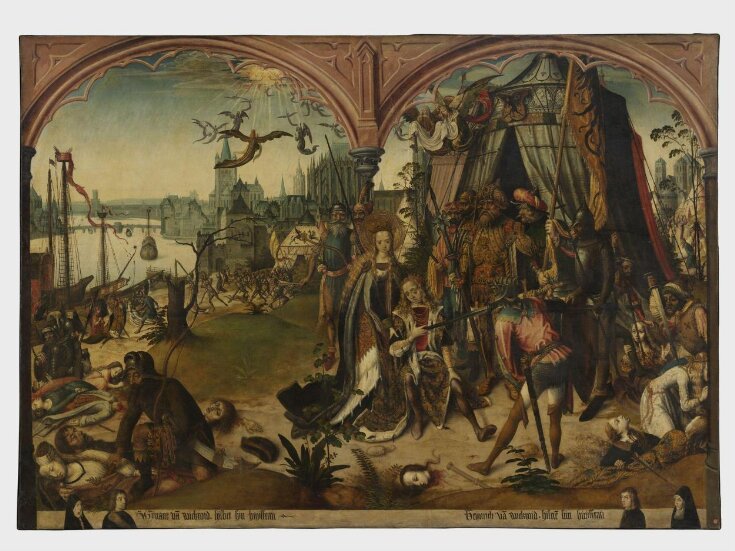
According to a medieval legend, St Ursula and her 11,000 companions returned to Cologne from their pilgrimage to Rome just at the time when unbeknown to them, the Huns were besieging the city. As soon as they disembarked, the Huns leapt upon them with savage cries and the massacre began. In the picture, the leader of the Huns on the right is willing to stop the massacre if Ursula would consent to marry him, but she refuses and is martyred together with her companions, while the angels carry their souls to heaven. The Huns are depicted here in fanciful Turkish costume, as when this picture was painted, the Ottoman Turks were perceived to be the modern equivalent of Huns, the major enemy of Christendom. A thousand years before, Attila and his Huns had invaded Europe and ruled a large area of central Europe and Italy from 434, including Rome, until his death in 453.

Physical description

St. Ursula is shown here holding her bridegroom who is pierced by a sword, centre. The leader of the Huns, with followers, stands in front of tent at right. Angels carry the souls of the Virgins to heaven. The massacre of Virgins is depicted at left, right and background.

Topographical view of Cologne behind, with Rhine at left, with large church of St. Martin on the bank, the tower of the city hall adjoins the great cathedral and the church of St. Gereon appears at the right of the tent. The top is painted with two arches, and below are represented two pairs of donors, with identifying inscriptions.

Place of Origin

Köln (city), Germany (painted)

Date

ca. 1492 (painted)

Artist/maker

Master of the St. Ursula Legend (artist)

Materials and Techniques

Oil on canvas

Dimensions

Height: 163.3 cm estimate, Width: 232.4 cm estimate, Depth: 11 cm Framed

Object history note

Provenance: Possibly from the Church of St Bridget's, Cologne (contents auctioned in 1805); bought by the Museum from an unknown source in 1857 `as an illustration of costume and ornament' for £31.10s.

Historical context note

Below, two pairs of donors are identified by inscription as Wynant van Wickroid, his wife Lysbet, and Heinrich van Wickroid with his wife Hilgen. It has been possible to identify the donors with actual citizens of Cologne recorded in the city archives. It was they who paid for these pictures to be hung in a church, probably St. Bridget's . The donors of this painting, Wynant and Heinrich van Wickroid, were brothers: Wynant was a tax collector, Heinrich a silk weaver, city councillor and magistrate in the 1480s and 90s. His wife, Hilgen, was also an independent silk weaver; she married in 1492/3 and died some four years later. They belonged to the class of wealthy manufacturers and tradesmen that provided much of the artistic patronage, not only in Cologne, but also in the other commercial centres of 15th century Germany.

[Michael Kauffmann, '100 Great Paintings from the V&A', p.32]

Although thought to be the daughter of a British king, the main areas of Ursula's cult were the Rhineland, the low countries, Northern France and Venice, but it is Cologne in Germany, the supposed location of her martyrdom where the cult of the saint was centred. There in the Church of St Ursula a stone carved in about 400 AD bears an inscription to the effect that Clematius restored the church in the honour of some local virgin martyrs. Their names, number, dates and the nature of their deaths are not recorded. This stone is the most likely source for the legend of St Ursula which was to gather considerable embelishment over time. In the nineth century the number of Virgins fluctuated between eight and eleven and by the end of the tenth century it had become fixed at 11,000 (possibly as a result of the wrong extension of an abbreviated text which read 'XI MV' into - undecim millia virgines rather than - undecim martyres virgines). The story of Ursula was recorded in the thirteenth century Golden Legend as follows:

Ursula was the daughter of a British king called Notus or Maurus. She came to the attention of the pagan King of Anglia who wished to marry her to his son. Ursual agreed with the proviso that she could have three years to to fulfill her dedication to virginity and that the king's son should eb beaptised and receive instruction in the faith.A further condition was that she could set sail with ten virgin companions, each of who would have a thousand further virgin attendants. Winds blew them into the mouth of the Rhine; they sailed to Cologne and Basle, went on pilgrimage to Rome and returned to Cologne. There they were martyred by Huns for their Christianity, Ursula having refused to marry their chief, In the picture, the leader of the Huns on the right is willing to stop the massacre if Ursula would consent to marry him, but she refuses and is martyred together with her companions, while the angels carry their souls to heaven. The Huns are depicted here in fanciful Turkish costume, as when this picture was painted, the Ottoman Turks were perceived to be the modern equivalent of Huns, the major enemy of Christendom. A thousand years before, Attila and his Huns had invaded Europe and ruled a large area of central Europe and Italy from 434, including Rome, until his death in 453.
In 1155 a vast collection of bones was discovered in Cologne which were considered to be those of the martyrs and these were used to feed a market for relics. Further support for the cult was provided by Elizabeth of Schönau favoured, from 1152, with ecstasies and visions of various kinds, these she related to her brother who recorded them in three books including 'The revelation on the Martyrdom of St. Ursula and her companions' full of fantastic exaggerations and anachronisms.
Ursula's late medieval iconography is exremely rich: about twenty five cycles of her life survive, painted from the 14th to the 16th century several of these are in Cologne.

Descriptive line

Oil painting depicting the matryrdom of St.Ursula and the 11,000 virgins, the Master of the St.Ursula Legend, ca.1492.

Bibliographic References (Citation, Note/Abstract, NAL no)

C. M. Kauffmann The Legend of St Ursula, V&A Museum Monograph, 1964.
Frank Günter Zehnder, Katalog der altkölner Malerei, Kataloge des Wallraf-Richartz-Museums XI, Köln, 1990, pp. 382-91.
Information on the Master of the Saint Ursula legend, primarily on works in the Wallraf-Richartz Museum, Cologne, but with reference to the V&A's painting on p. 384.
Kauffmann, C.M., Catalogue of Foreign Paintings, I. Before 1800. London: Victoria and Albert Museum, 1973, p. 184-6, cat. no. 222.
The following is the full text of the entry:

MASTER OF THE ST URSULA LEGEND (active c. 1480-ca. 1510)
School of Cologne
The name derives from a large, scattered series of paintings of the life of St Ursula. This was originally attributed to the Master of St Severin, but in 1902 Carl Aldenhoven concluded from a stylistic analysis that the St Ursula series was the principal work of a separate painter whom he called the Master of the St Ursula Legend. The assertion led to considerable controversy which was not settled until 1924, when H. Brockman devoted almost a whole volume to demonstrating that there were in fact two distinct painters: the Master of St Severin and the Master of the Ursula Legend. Since then the separate identity of the latter has no longer been seriously contested, but it was left to H. W. Hupp (1926) and Alfred Stange (1952) to show that he was in fact the earlier, better and more influential painter of the two.
He was active in Cologne from ca. 1480, the date of the triptych in the Church as Euskirchen; but Dutch, or to be more accurate, North Netherlandish, influences in his work have frequently elicited the suggestion that he came from the Netherlands. The St Ursula series may be dated ca. 1492 - ca. 1496, and, for lack of evidence about any obviously later works, it is usually assumed that he died not long afterwards.
Lit. E. Firmenich-Richartz in Zeitschrift für Christliche Kunst, v, 1892, p. 306; J. J. Merlo, Kölnische Künstler in alter und neuer Zeit, new ed. by E. Firmenich-Richartz and H. Keussen, 1895, col. II88 ff.; C. Aldenhoven, Geschichte der Kölner Malerschule, 1902, p. 298 ff. (St Ursula Master as a separate painter); M. J. Friedländer in Repertorium für Kunstzoissenschaft, xxvii, 1904, p. 81; Scheibler, ibid., p. 559; W. Cohen, Katalog der Gemäldegalerie Provinzial Museum Bonn, 1914, p. 72; C. G. Heise, Norddeutsche Maler, 1918, pp. 22,135 (all these disagreed with Aldenhoven); H. Brockmann, Die Späteeit der Kölner Malerschule (1924); H. W. Hupp in Repertorium fur Kunstzoissenschaft, xlvii, 1926, p. 116 ff, (Ursula Master as superior to Severin Master); Thieme-Becker, xxxvii, 1950, p. 335; A. Stange, Deutsche Malerie der Gotik, v, 1952, p. 91 ff. (with further lit.).

222
THE MARTYRDOM OF ST URSULA AND THE 11,000 VIRGINS
Canvas
5 ft 5 in. x 7 ft 8t in. (165 x 186.7)
5938-1857

The scene shows St Ursula holding her bridegroom, who is being pierced with a sword. The leader of the Huns, on the right, is willing to stop the massacre if Ursula would consent to marry him, but she refuses. Among the martyrdom of the Virgins one can detect, on the left, that of a Pope ('Cyriacus') and of a Cardinal. The setting is Cologne, where the 11,000 have disembarked; most of the buildings are accurately depicted and easily identified. From left to right we see the Abbey of St Heribert at Deutz on the other side of the river, the Bayenturm in the distance, St Martin, the large church with the spire, then the city hall with its tower, before it the Church of St Maria ad Gradus and, in the centre of the picture, the cathedral. Lastly, on the right of the tent stands the Church of St Gereon.
Below, two pairs of donors are accompanied by the following inscription:
Wynant va[n] Wickroid. Lysbet syn huysfrau
Heinrich va[n] Wickroid, hilge[n] sun hiusfrau.

We know that Wynant and Heinrich van Wickroid were brothers; Wynant was a tax farmer and Heinrich a silk weaver, city councillor and magistrate.
This is one of 19 known paintings of this series, though it has double the width of any of the others. Of these, two were destroyed during the last War, one is lost and the remainder are distributed among the following collections: Cologne, Wallraf-Richartz Museum (4); Diocesan Museum (I); Bonn, Landesmuseum (4); Nuremberg, Germanisches Museum (2); Louvre (2); Munich, Alte Pinakothek (I); Euskirchenland, Von Stedman Collection (I). Most of the pictures have been considerably cut down, especially at the bottom. Originally each scene had an explanatory inscription, as well as the names, portraits and shields of the donors, and from the size of the four complete pictures at Bonn we can guess that the Martyrdom has been cut by about 8 in. at the bottom.
Many of the compositions of this series, including that of the Martyrdom, are based on the Ursula scenes painted by an unknown artist for the Church of St Ursula, Cologne, in 1456, where they still hang (see Tervarent, 1931).
We can infer from what we know of the lives of the donors that the series was commissioned ca. 1492-96, but we are less well informed about its original home. Brockmann argued for St Bridget's, Cologne, but his hypothesis lacks final proof.
As well as being a major monument of the School of Cologne in the late 15th century, the St Ursula series was highly influential: we know of at least four other cycles of saints' lives for which it served as a model in size, format, framework and style.

Prov. (?) St Bridget's Cologne (contents auctioned in 1805); bought by the Museum from an unknown source in 1857 'as an illustration of costume and ornament' for £31 10s.
Lit. (In addition to that listed under the artist) G. de Tervarent, La légende de Sainte Ursule dans la littérature et l'art du Moyen Age, 1931, p. 56 ff.; E. Delpy, Die Legende uon der heiligen Ursula in der Kölner Malerschule, 1901, p. 153 ff.; C. M. Kauffmann, The Legend of St Ursula, V. & A. Museum Monograph, 1964.
100 Great Paintings in The Victoria & Albert Museum.London: V&A, 1985, p.32
The following is the full text of the entry:

"Master of the St. Ursula Legend active c.1480-c.1510
School of Cologne
THE MARTYRDOM OF ST. URSULA AND THE 11,000 VIRGINS,
c.1492-6
Oil on canvas, 165 X 186.7 cm
5938-1867

St. Ursula and her 11,000 companions returned to Cologne from their pilgrimage to Rome just at the time when, unbeknown to them, the Huns were besieging the city.
As soon as they disembarked, the Huns leapt upon them with savage cries and the massacre began. St. Ursula is shown holding her bridegroom who is pierced with a sword. The leader of the Huns on the right is willing to stop the massacre if Ursula would consent to marry him, but she refuses and is martyred together with her companions, while the angels carry their souls to heaven.
Careful attention has been paid to topographical accuracy in representing the city of Cologne: each of the buildings can be readily identified. The large church of St. Martin dominates on the banks of the Rhine; the tower of the city hall adjoins the great cathedral and the church of St. Gereon appears on the right of the tent. Below, two pairs of donors are identified by inscription as Wynant van Wickroid, his wife Lysbet, and Heinrich van Wickroid with his wife Hilgen.
This is the largest of nineteen pictures of the life of St. Ursula, which are scattered in various museums, mainly in Germany, by an artist whose name we do not know, but who is called 'Master of the St. Ursula Legend' from this series. He is one of the principal painters of the Cologne School at the end of its period of greatness. His ability to endow his figures convincingly individual features and expression and to render architecture in a wholly realistic manner links his work with Netherlandish painting, which was very influential in Cologne throughout the 15th century. Perhaps his most individual contribution lies in conveying distance, atmosphere and light, to an extent unusual before 1500.

This St. Ursula series is of particular interest, as it has been possible to identify the donors, who were shown at the foot of each of them, with actual citizens of Cologne recorded in the city archives. It was they who paid for these pictures to be hung in a church, probably St. Bridget's. The donors of the Martyrdom, Wynant and Heinrich van Wickroid, were brothers: Wynant was a tax collector, Heinrich a silk weaver, city councillor and magistrate in the 1480s and 90s.
His wife, Hilgen, was also an independent silk weaver; she married in 1492/3 and died some four years later. They belonged to the class of wealthy manufacturers and tradesmen that provided much of the artistic patronage, not only in Cologne, but also in the other commercial centres of 15th-century Germany.

Michael Kauffmann"

Materials

Canvas; Oil colour

Techniques

Oil painting

Subjects depicted

War; Soldiers; River; Church; Cathedral; Rhine; Köln (city); Martyrs; Ursula (Saint)

Categories

Paintings; Photographs; Myths & Legends; Topography

Collection code

PDP

Download image
Qr_O18975
Ajax-loader