
Nasturtiums
Oil Painting
1880 (painted)
1880 (painted)
| Artist/Maker | |
| Place of origin |
Henri Fantin-Latour (1836-1904) was born in Grenoble and first trained with his father, Jean-Théodore Fantin-Latour (1805–75), and then with Horace Lecocq de Boisbaudran at the Petite Ecole de Dessin in Paris from 1850 to 1856. In 1861 he worked in Gustave Courbet’s studio for several months as a pupil. After a period of portraiture, Fantin-Latour concentrated on flowers paintings and still-lifes for which he is now best known. His flower pieces were especially popular with British collectors, and he exhibited at the Royal Academy in London from 1862 onwards, especially thanks to the patronage of James McNeill Whistler (1834-1903), whom he met in 1858.
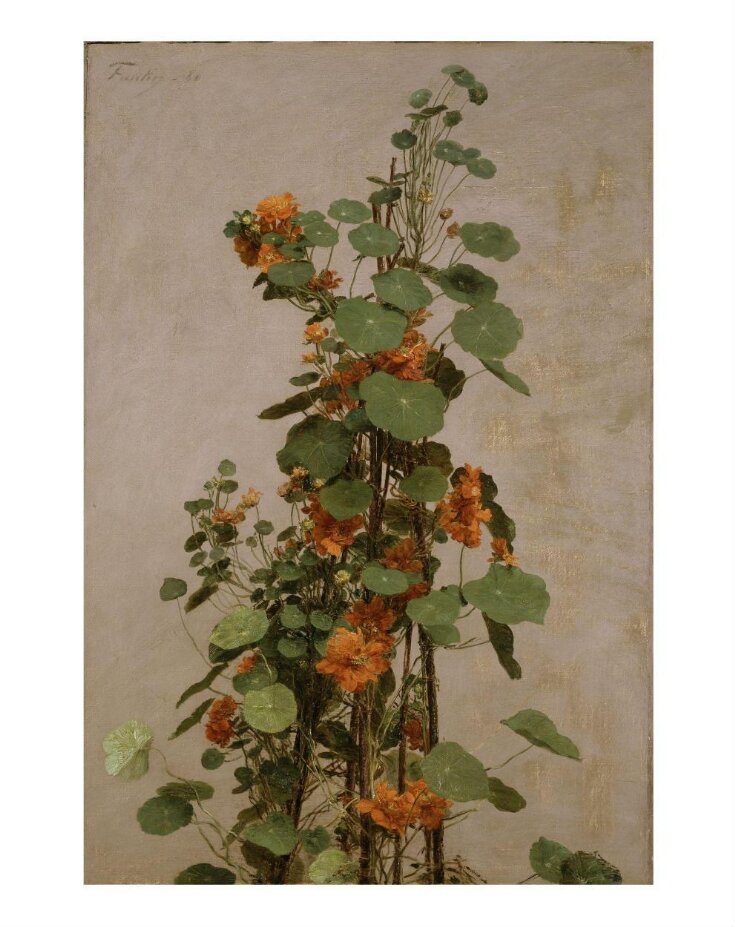
This painting is a fine example of Fantin-Latour’s paintings of flower, a category in which he progressively specialised executing up to 500 floral compositions. This painting shows double nasturtiums whose bright orange and green contrast against the plain grey background. This effect of light and colour are characteristic of the new naturalism developed in French art in the second half of the 19th century, which anticipate the Impressionists’ new experimentations.
This painting is a fine example of Fantin-Latour’s paintings of flower, a category in which he progressively specialised executing up to 500 floral compositions. This painting shows double nasturtiums whose bright orange and green contrast against the plain grey background. This effect of light and colour are characteristic of the new naturalism developed in French art in the second half of the 19th century, which anticipate the Impressionists’ new experimentations.
Object details
| Categories | |
| Object type | |
| Titles |
|
| Materials and techniques | oil on canvas |
| Brief description | Oil painting, 'Nasturtiums', Henri Fantin-Latour, 1880 |
| Physical description | Several stems of nasturtiums are grouped together vertically at the centre of the image against a plain grey background. |
| Dimensions |
|
| Style | |
| Marks and inscriptions | 'Fantin - 80' (Signed and dated upper left) |
| Gallery label |
|
| Credit line | Purchased 1884 |
| Object history | Purchased from Mrs Edwin Edwards, 1884. One of Fantin's rare flower pieces featuring a single flower silhouetted against a plain background, this work was acquired as an 'example' of still-life painting, to be circulated to schools for use in art classes. Probably exhibited at the Royal Manchester Institution in 1881 as no. 63, then priced at £94-10-0. Purchased, 1884 Historical significance: This painting was probably painted in Paris or in Buré (Normandy) where Fantin-Latour spent the summer in 1880. It shows double nasturtiums, a plant that according C.A.P Willsdon, was often used as a subject for training flower painters because of its complex structure. It is one of the three paintings the South Kensington School of Design, now Victoria and Albert Museum, acquired as a model for its students (see also S.Ex.4-1889 and S.Ex.61-1882). They all share the characteristic of presenting a single plant rather than a bouquet, depicted without a vase or table, on a plain background. The Barbizon School and the Impressionists engendered a new interest for naturalism and the objective rendering of light and colours. However, Fantin-Latour did not share their enthusiasm for open air painting and most of his compositions were executed in his studio. This painting was purchased from Mrs Elizabeth Ruth Edwards, who was acquainted with Fantin-Latour as she and her husband hosted the artist for a few months in their house at Sunbury-on-Thames in 1861. On this occasion, Fantin-Latour executed her portrait, now in the Musée du Petit-Palais, Paris. Mr and Mrs Edwards became his dealers in England and their friendship with the painter is witnessed by his portrait of them dated 1875, now in the Tate Gallery, London (F.738). |
| Historical context | 19th-century French art is marked by a succession of movements based on a more or less close relationship with nature. At the beginning of the century, Romantic artists were fascinated by nature they interpreted as a mirror of the mind. They investigated human nature and personality, the folk culture, the national and ethnic origins, the medieval era, the exotic, the remote, the mysterious and the occult. This movement was heralded in France by such painter as Eugène Delacroix (1798-1863). In its opposition to academic art and its demand for a modern style Realism continued the aims of the Romantics. They assumed that reality could be perceived without distortion or idealization, and sought after a means to combine the perception of the individual with objectivity. This reaction in French painting against the Grand Manner is well represented by Gustave Courbet (1819-1877) who wrote a 'Manifesto of Realism', entitled Le Réalisme published in Paris in 1855. These ideas were challenged by the group of the Barbizon painters, who formed a recognizable school from the early 1830s to the 1870s and developed a free, broad and rough technique. They were mainly concerned by landscape painting and the rendering of light. The works of Narcisse Virgile Diaz de la Peña (1807-1876), Jules Dupré (1811-1889), Théodore Rousseau (1812-1867), Constant Troyon (1810-1865) and Jean-François Millet (1814-1875) anticipate the plein-air landscapes of the Impressionists. |
| Subject depicted | |
| Summary | Henri Fantin-Latour (1836-1904) was born in Grenoble and first trained with his father, Jean-Théodore Fantin-Latour (1805–75), and then with Horace Lecocq de Boisbaudran at the Petite Ecole de Dessin in Paris from 1850 to 1856. In 1861 he worked in Gustave Courbet’s studio for several months as a pupil. After a period of portraiture, Fantin-Latour concentrated on flowers paintings and still-lifes for which he is now best known. His flower pieces were especially popular with British collectors, and he exhibited at the Royal Academy in London from 1862 onwards, especially thanks to the patronage of James McNeill Whistler (1834-1903), whom he met in 1858. This painting is a fine example of Fantin-Latour’s paintings of flower, a category in which he progressively specialised executing up to 500 floral compositions. This painting shows double nasturtiums whose bright orange and green contrast against the plain grey background. This effect of light and colour are characteristic of the new naturalism developed in French art in the second half of the 19th century, which anticipate the Impressionists’ new experimentations. |
| Bibliographic references |
|
| Collection | |
| Accession number | S.EX.24-1884 |
About this object record
Explore the Collections contains over a million catalogue records, and over half a million images. It is a working database that includes information compiled over the life of the museum. Some of our records may contain offensive and discriminatory language, or reflect outdated ideas, practice and analysis. We are committed to addressing these issues, and to review and update our records accordingly.
You can write to us to suggest improvements to the record.
Suggest feedback
You can write to us to suggest improvements to the record.
Suggest feedback
| Record created | January 5, 2000 |
| Record URL |
Download as: JSONIIIF Manifest
