
Table
ca. 1876 (made)
| Artist/Maker | |
| Place of origin |
Object Type
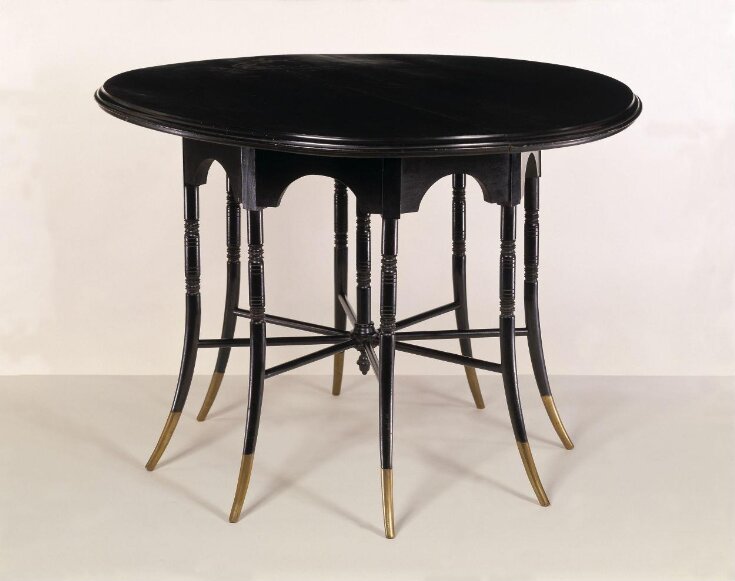
The first example of this circular table was designed by Edward William Godwin (1833-1886) in about 1870 for his own home. The ebonised finish was inspired by Japanese woodwork, while the design of the legs is based on a Chinese stand. The table was very popular and subsequently different versions were made by various manufacturers. In 1876 a table like this cost £7.75, while a walnut version cost £7.35. Brass feet cost an extra £1.50.
People
Edward William Godwin (1833-1886) was an architect and designer. He was particularly interested in Japanese art and culture. When he began designing furniture for his own home in London in 1867, he used ideas taken from Japanese sources. He designed a circular table with eight turned legs for himself in about 1870. In 1877, Godwin collaborated with a London manufacturer, William Watt, over a catalogue, 'Art Furniture', which included the design for this table.
Time
Ebonised furniture like this table was very fashionable during the 1870s and 1880s in Britain because of the influence of Japanese designs. Circular tables were also popular because they could be used in the centre of a room with flowers, ornaments or books on them.
The first example of this circular table was designed by Edward William Godwin (1833-1886) in about 1870 for his own home. The ebonised finish was inspired by Japanese woodwork, while the design of the legs is based on a Chinese stand. The table was very popular and subsequently different versions were made by various manufacturers. In 1876 a table like this cost £7.75, while a walnut version cost £7.35. Brass feet cost an extra £1.50.
People
Edward William Godwin (1833-1886) was an architect and designer. He was particularly interested in Japanese art and culture. When he began designing furniture for his own home in London in 1867, he used ideas taken from Japanese sources. He designed a circular table with eight turned legs for himself in about 1870. In 1877, Godwin collaborated with a London manufacturer, William Watt, over a catalogue, 'Art Furniture', which included the design for this table.
Time
Ebonised furniture like this table was very fashionable during the 1870s and 1880s in Britain because of the influence of Japanese designs. Circular tables were also popular because they could be used in the centre of a room with flowers, ornaments or books on them.
Object details
| Categories | |
| Object type | |
| Materials and techniques | Ebonised wood, probably mahogany, with brass feet |
| Brief description | Table, ebonised wood, probably mahogany, with brass feet; designed by E.W. Godwin, Watt and possibly made by either William Watt or Collinson and Lock, British 1876-85 |
| Physical description | Circular ebonised wood table, eight legs with turned decoration and spokes to a central pillar. The ends of the legs have brass mounts. |
| Dimensions |
|
| Gallery label |
|
| Object history | Designed by Edward William Godwin (born in Bristol, 1833, died in London, 1886) Possibly manufactured by the firm of William Watt or by Collinson and Lock, London |
| Summary | Object Type The first example of this circular table was designed by Edward William Godwin (1833-1886) in about 1870 for his own home. The ebonised finish was inspired by Japanese woodwork, while the design of the legs is based on a Chinese stand. The table was very popular and subsequently different versions were made by various manufacturers. In 1876 a table like this cost £7.75, while a walnut version cost £7.35. Brass feet cost an extra £1.50. People Edward William Godwin (1833-1886) was an architect and designer. He was particularly interested in Japanese art and culture. When he began designing furniture for his own home in London in 1867, he used ideas taken from Japanese sources. He designed a circular table with eight turned legs for himself in about 1870. In 1877, Godwin collaborated with a London manufacturer, William Watt, over a catalogue, 'Art Furniture', which included the design for this table. Time Ebonised furniture like this table was very fashionable during the 1870s and 1880s in Britain because of the influence of Japanese designs. Circular tables were also popular because they could be used in the centre of a room with flowers, ornaments or books on them. |
| Collection | |
| Accession number | W.54-1980 |
About this object record
Explore the Collections contains over a million catalogue records, and over half a million images. It is a working database that includes information compiled over the life of the museum. Some of our records may contain offensive and discriminatory language, or reflect outdated ideas, practice and analysis. We are committed to addressing these issues, and to review and update our records accordingly.
You can write to us to suggest improvements to the record.
Suggest feedback
You can write to us to suggest improvements to the record.
Suggest feedback
| Record created | January 5, 2000 |
| Record URL |
Download as: JSONIIIF Manifest
