
Ceremonial Skirt-Cloth
late 18th century (made)
| Artist/Maker | |
| Place of origin |
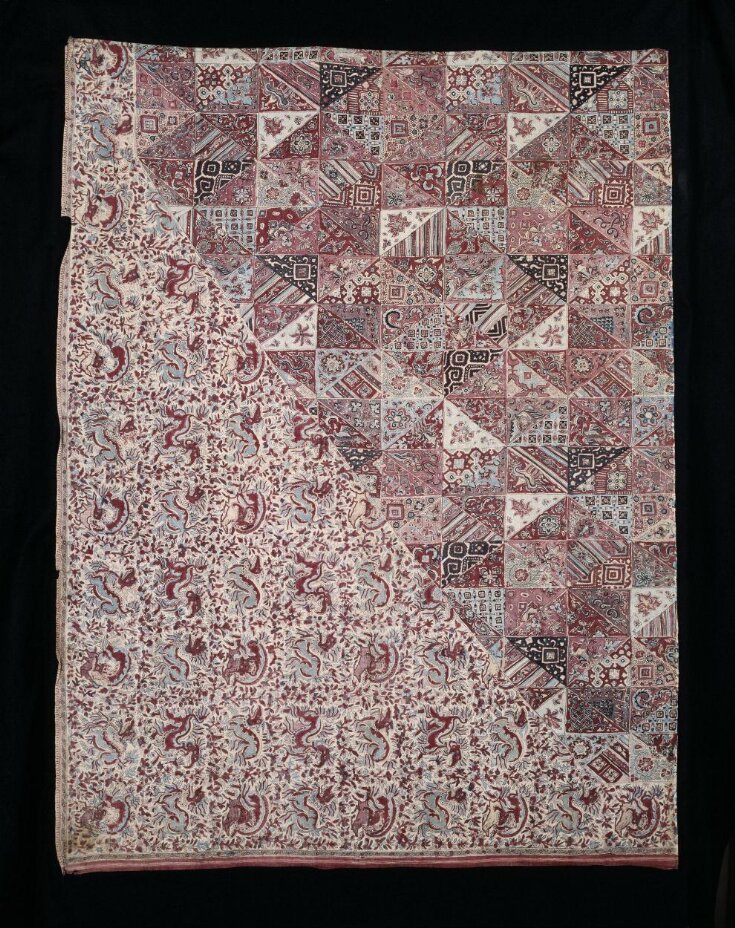
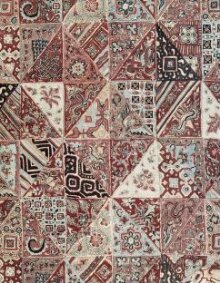
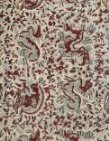
This exceptionally large cotton ceremonial skirt-cloth (‘dodot’) was made on the Coromandel Coast of India for the Javanese market in Indonesia. The design combines a central medallion with a 'patchwork' pattern and borders decorated with fabulous animals including the Chinese ‘kylin’ (dragon-headed horse) and Indian ‘gajasimha’ (elephant-lion).
The Indian textile workers used a variety of techniques to create the design. With mordant-dyeing, a metallic salt is used to fix natural dyes. Resist-dyeing involves treating certain areas of the cloth with a ‘resist’ to prevent them absorbing the dye.
The Indian textile workers used a variety of techniques to create the design. With mordant-dyeing, a metallic salt is used to fix natural dyes. Resist-dyeing involves treating certain areas of the cloth with a ‘resist’ to prevent them absorbing the dye.
Object details
| Categories | |
| Object type | |
| Parts | This object consists of 2 parts.
|
| Materials and techniques | Painted cotton, mordant-dyed and resist-dyed |
| Brief description | Ceremonial skirt-cloths (dodot) of painted cotton, mordant-dyed and resist-dyed, probably made in the Coromandel Coast, late 18th century. |
| Physical description | Ceremonial skirt-cloths (dodot) of painted cotton, mordant-dyed and resist-dyed. A ceremonial garment combining a central medallion with a 'patchwork' design and borders decorated with animals including the Chinese kylin (dragon-headed horse) and Indian gajasimha (elephant-lion) in shades of red with pale blue on a cream ground. |
| Dimensions |
|
| Object history | Ceremonial garment. An exceptionally large cloth produced for the Indonesian market. |
| Production | Made on the Coromandel Coast for the Javanese market, Indonesia |
| Summary | This exceptionally large cotton ceremonial skirt-cloth (‘dodot’) was made on the Coromandel Coast of India for the Javanese market in Indonesia. The design combines a central medallion with a 'patchwork' pattern and borders decorated with fabulous animals including the Chinese ‘kylin’ (dragon-headed horse) and Indian ‘gajasimha’ (elephant-lion). The Indian textile workers used a variety of techniques to create the design. With mordant-dyeing, a metallic salt is used to fix natural dyes. Resist-dyeing involves treating certain areas of the cloth with a ‘resist’ to prevent them absorbing the dye. |
| Bibliographic reference | John Guy and Deborah Swallow eds. Arts of India: 1550-1900 London : V&A Publications, 1990. 240 p., ill. ISBN 1851770224.p.26, no.13.
John Guy, Woven Cargoes. Indian Textiles in the East, Thames and Hudson, 1998, pl. 90, 91. |
| Collection | |
| Accession number | IS.41&A-1988 |
About this object record
Explore the Collections contains over a million catalogue records, and over half a million images. It is a working database that includes information compiled over the life of the museum. Some of our records may contain offensive and discriminatory language, or reflect outdated ideas, practice and analysis. We are committed to addressing these issues, and to review and update our records accordingly.
You can write to us to suggest improvements to the record.
Suggest feedback
You can write to us to suggest improvements to the record.
Suggest feedback
| Record created | December 23, 1999 |
| Record URL |
Download as: JSONIIIF Manifest
