
The Van Diemen Box
Document Box
1636-1639 (made)
1636-1639 (made)
| Artist/Maker | |
| Place of origin |
Object Type
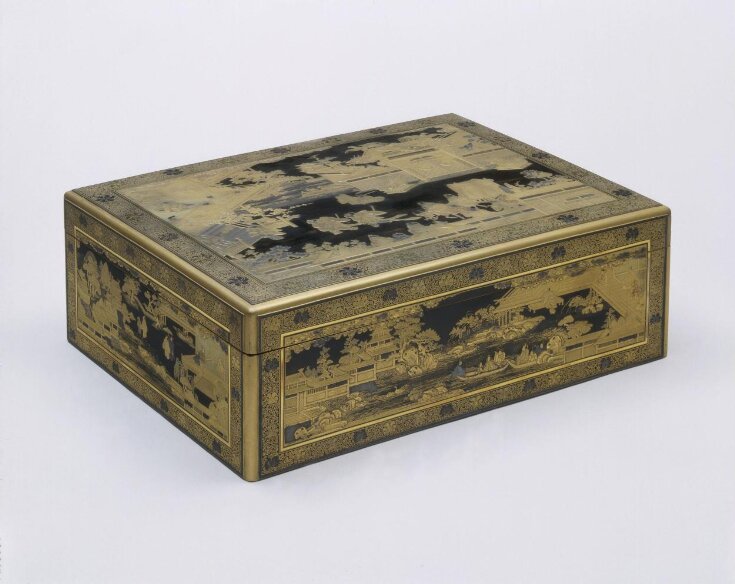
Although Japanese export lacquerware was usually shaped to meet western tastes, this piece takes the form of a Japanese document box with a tray. It belongs to a small group of extremely high quality export lacquerwork produced between about 1630 and 1640. As in the case of this box, these were typically decorated using expensive and elaborate lacquer techniques with scenes from Japanese classical literature.
Places
High quality export lacquerware was made to special order in Kyoto, Japan's former imperial capital. It was then transported to Deshima, a small island in Nagasaki harbour, for shipment abroad by Dutch merchants. During the late 17th century merchants of the Dutch East India Company were the only Europeans permitted to conduct trade in Japan.
People
The inside of the lid of this box is inscribed with the name of Maria van Diemen, wife of Anton van Diemen, Governor-General of the Dutch East Indies from 1636 to 1645. The famous author, designer and collector William Beckford (1760-1844) also owned a very similar box known as the Buys box. Beckford's box was inscribed with the name of Pieternellae Buys, married to Philips Lucasz in 1634. Lucasz served as second-in-command to Anton van Diemen in Batavia from 1635 to 1639. This combination of biographical details allows the two boxes to be dated to between 1636 and 1639. These are among the very few export lacquer objects known to have any direct connection with women.
Although Japanese export lacquerware was usually shaped to meet western tastes, this piece takes the form of a Japanese document box with a tray. It belongs to a small group of extremely high quality export lacquerwork produced between about 1630 and 1640. As in the case of this box, these were typically decorated using expensive and elaborate lacquer techniques with scenes from Japanese classical literature.
Places
High quality export lacquerware was made to special order in Kyoto, Japan's former imperial capital. It was then transported to Deshima, a small island in Nagasaki harbour, for shipment abroad by Dutch merchants. During the late 17th century merchants of the Dutch East India Company were the only Europeans permitted to conduct trade in Japan.
People
The inside of the lid of this box is inscribed with the name of Maria van Diemen, wife of Anton van Diemen, Governor-General of the Dutch East Indies from 1636 to 1645. The famous author, designer and collector William Beckford (1760-1844) also owned a very similar box known as the Buys box. Beckford's box was inscribed with the name of Pieternellae Buys, married to Philips Lucasz in 1634. Lucasz served as second-in-command to Anton van Diemen in Batavia from 1635 to 1639. This combination of biographical details allows the two boxes to be dated to between 1636 and 1639. These are among the very few export lacquer objects known to have any direct connection with women.

Object details
| Categories | |
| Object type | |
| Parts | This object consists of 3 parts.
|
| Title | The Van Diemen Box (popular title) |
| Materials and techniques | Wood, covered in black lacquer, with gold, silver and red hiramaki-e and takamaki-e lacquer and gold and silver foil |
| Brief description | Japanese document box with suspended inner tray, wood and lacquer with gold and silver details, lid depicts scenes from The Tale of Genji, 1636-1639. |
| Physical description | Document Box, with tray. Black lacquer ground decorated in relief with gold lacquer of various shades, silver lacquer, and gold and silver foil. On the lid a scene in the grounds of the palace at Kyoto. On the left the emperor is seated on a dais, and towards him noblemen advance in court attire, in the foreground is a court carriage, on the right is the entrance to the palace. Around the sides of the box are scenes from Japanese court life. These, as well as the panel of the lid, are surrounded by a border of leafy scrollwork with conventional clematis in gold and silver. The tray is painted with a landscape with buildings in black lacquer on gold within a shaped panel which is edged with floral scrolls and surrounded by a diaper border. |
| Dimensions |
|
| Style | |
| Gallery label | British Galleries:
Beckford's collection contained important pieces of Japanese lacquer, including this one. It came from the collection of Madame de Pompadour, mistress of the French king, Louis XV. Beckford was nostalgic for 18th-century court culture and the collecting of lacquer became a symbol of this for him. Lacquer also reflected his liking for highly finished objects and his interest in the 'Orient'.(27/03/2003) |
| Credit line | Given by the children of Sir Trevor Lawrence, Bt |
| Object history | Made in Japan, for the European market. |
| Summary | Object Type Although Japanese export lacquerware was usually shaped to meet western tastes, this piece takes the form of a Japanese document box with a tray. It belongs to a small group of extremely high quality export lacquerwork produced between about 1630 and 1640. As in the case of this box, these were typically decorated using expensive and elaborate lacquer techniques with scenes from Japanese classical literature. Places High quality export lacquerware was made to special order in Kyoto, Japan's former imperial capital. It was then transported to Deshima, a small island in Nagasaki harbour, for shipment abroad by Dutch merchants. During the late 17th century merchants of the Dutch East India Company were the only Europeans permitted to conduct trade in Japan. People The inside of the lid of this box is inscribed with the name of Maria van Diemen, wife of Anton van Diemen, Governor-General of the Dutch East Indies from 1636 to 1645. The famous author, designer and collector William Beckford (1760-1844) also owned a very similar box known as the Buys box. Beckford's box was inscribed with the name of Pieternellae Buys, married to Philips Lucasz in 1634. Lucasz served as second-in-command to Anton van Diemen in Batavia from 1635 to 1639. This combination of biographical details allows the two boxes to be dated to between 1636 and 1639. These are among the very few export lacquer objects known to have any direct connection with women. |
| Collection | |
| Accession number | W.49-1916 |
About this object record
Explore the Collections contains over a million catalogue records, and over half a million images. It is a working database that includes information compiled over the life of the museum. Some of our records may contain offensive and discriminatory language, or reflect outdated ideas, practice and analysis. We are committed to addressing these issues, and to review and update our records accordingly.
You can write to us to suggest improvements to the record.
Suggest feedback
You can write to us to suggest improvements to the record.
Suggest feedback
| Record created | December 22, 1999 |
| Record URL |
Download as: JSONIIIF Manifest
