Elephant goad (ankus)
Elephant Goad
ca. 1870 (made)
ca. 1870 (made)
| Place of origin |
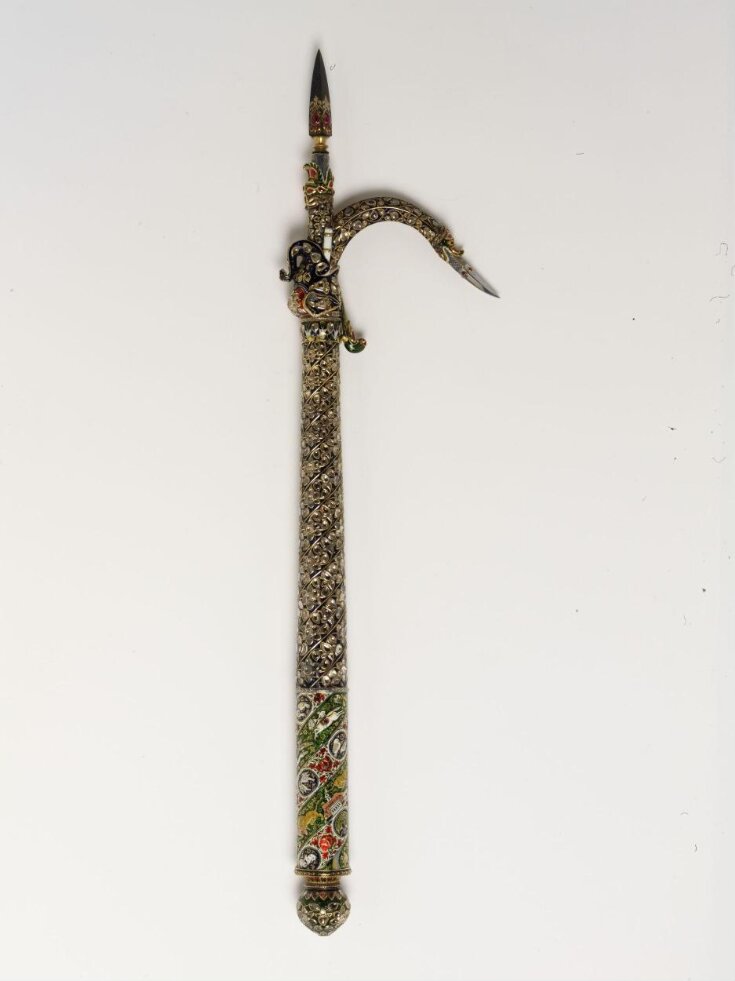
The ankus is a tool for the handling and training of elephants consisting of a metal hook attached to a short handle. The elephant is trained to respond to pressure applied to the sensitive skin behind the ears in much the same manner as horses by spurs.
Elephants have been used during religious ceremonies and processions and as mounts for royalty since antiquity. The ankus is therefore found in armouries and temples all across India, often ornately decorated with gemstones, or engraved with passages of sacred text
The ankus is one of the eight auspicious objects known as Astamangala in Hinduism, and is associated with certain other religions of the Indian subcontinent. A goad is also an attribute of many Hindu gods, including Ganesha.
Elephants have been used during religious ceremonies and processions and as mounts for royalty since antiquity. The ankus is therefore found in armouries and temples all across India, often ornately decorated with gemstones, or engraved with passages of sacred text
The ankus is one of the eight auspicious objects known as Astamangala in Hinduism, and is associated with certain other religions of the Indian subcontinent. A goad is also an attribute of many Hindu gods, including Ganesha.
Object details
| Categories | |
| Object type | |
| Title | Elephant goad (ankus) |
| Materials and techniques | Gold, enamelled and set with natural colourless sapphires, and possibly colourless beryls and topazes. |
| Brief description | Elephant goad ankus gold set with natural colourless sapphires, polychrome enamel, Jaipur, ca. 1870 |
| Physical description | Elaborately ornamented elephant goad, with two terminal spikes of blued steel, one straight and one curved. Gold set with natural colourless sapphires and other diamond simulants on blue, green or red enamel with polychrome painted enamel on the grip, depicting scenes of the hunt. |
| Dimensions |
|
| Gallery label | 20. ELEPHANT GOAD (ANKUS)
Enamelled gold set with diamonds
Jaipur
c. 1870
02693 (IS)
This probably belonged to a traditional khilat, or dress of honour, given by a maharaja to a person of distinction. It was bought by the museum from London’s 1871 Annual International Exhibition.(27/9/2013) |
| Credit line | Transferred from the India Museum in 1879 |
| Object history | Acquired for the India Museum after being shown at the 1871 Exhibition; transferred to the South Kensington Museum in 1879. Acquisition records note the presence of diamonds; examination by Joanna Whalley on 3 September 2009 indicates that these are all diamond simulants, mostly natural colourless sapphires and possibly some colourless beryls and topaz. |
| Subjects depicted | |
| Summary | The ankus is a tool for the handling and training of elephants consisting of a metal hook attached to a short handle. The elephant is trained to respond to pressure applied to the sensitive skin behind the ears in much the same manner as horses by spurs. Elephants have been used during religious ceremonies and processions and as mounts for royalty since antiquity. The ankus is therefore found in armouries and temples all across India, often ornately decorated with gemstones, or engraved with passages of sacred text The ankus is one of the eight auspicious objects known as Astamangala in Hinduism, and is associated with certain other religions of the Indian subcontinent. A goad is also an attribute of many Hindu gods, including Ganesha. |
| Bibliographic references |
|
| Other number | 391 A - Egerton Catalogue Number |
| Collection | |
| Accession number | 02693(IS) |
About this object record
Explore the Collections contains over a million catalogue records, and over half a million images. It is a working database that includes information compiled over the life of the museum. Some of our records may contain offensive and discriminatory language, or reflect outdated ideas, practice and analysis. We are committed to addressing these issues, and to review and update our records accordingly.
You can write to us to suggest improvements to the record.
Suggest feedback
You can write to us to suggest improvements to the record.
Suggest feedback
| Record created | December 21, 1999 |
| Record URL |
Download as: JSONIIIF Manifest
