
The Shipwreck of Don Juan: A Sketch
Oil Painting
1820s (painted)
1820s (painted)
| Artist/Maker | |
| Place of origin |
Delacroix was born near Paris but grown up in The Hague where his father was Ministre Plénipotentiaire. He first trained with Pierre Guérin (1774-1833) and then entered the Ecole des Beaux-Arts in Paris in 1816. He soon specialised in history and religious paintings while recognition from the public started with his debut at the Salon in 1822, which immediately heralded him as a major figure of the French school.
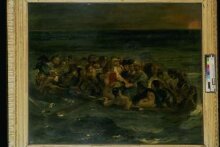
This painting depicts a scene from Lord Byron's Don Juan and shows the moment in which Don Juan and a few survivors from a shipwreck draw lots for whom would be sacrificed to feed his starving companions. This painting was probably made in the 1820s at the very beginning of Delacroix's career. It is a fine example of the type of subject matter combining suffering and death, which was most favour by Delacroix and the Romantic movement.
This painting depicts a scene from Lord Byron's Don Juan and shows the moment in which Don Juan and a few survivors from a shipwreck draw lots for whom would be sacrificed to feed his starving companions. This painting was probably made in the 1820s at the very beginning of Delacroix's career. It is a fine example of the type of subject matter combining suffering and death, which was most favour by Delacroix and the Romantic movement.
Object details
| Categories | |
| Object type | |
| Titles |
|
| Materials and techniques | oil on canvas |
| Brief description | Oil painting, 'The Shipwreck of Don Juan', Eugène Delacroix, 1820s |
| Physical description | In the foreground is a large rowing-boat crowded with figures; one man holds a hat in which another has placed his hand. The sea and a sunset sky in the background. |
| Dimensions |
|
| Styles | |
| Credit line | Bequeathed by Constantine Alexander Ionides |
| Object history | Delacroix's posthumous sale, Feb.1864, lot 140 for 1.500 francs to Mr Haro; with Durand-Ruel by 1874; Sold to Emile de Girardin; Exposition Durand-Ruel 1878, n. 147, as belonging to Edwin Edwards; his sale, Paris, 24 February 1881, lot 18; sold for 7.700 fr.(ca.£305); Constantine Alexander Ionides by November 1881 (listed in his inventory as 'Don Juans Boat' at a valuation of £600); Bequeathed by Constantine Alexander Ionides, 1900. Historical significance: This painting is one of the two versions painted by Delacroix in his early career and was probably the one originally entitled La Barque de don Juan. Première pensée. It shows the shipwreck of an embarkation crowded with figures, out at sea under a sunset sky. The subject matter was drawn from Lord Byron's Don Juan, Canto II, which tells the story of don Juan embarking on a voyage from Cadiz on the ship Trinidada. While out at sea a storm sank the ship and the survivors sought refuge on a long rowing-boat. After a few days they ran out of food and had to draw lot to choose who would be sacrificed. It is Juan's tutor, Pedrillo (stanze 74-76). According to Robaut, this painting is an oil study for the painting presented at the Salon in 1841 and now in the Louvre, Paris. But P. Joannides and L. Johnson more recently suggested that CAI.64 was actually an unfinished oil painting executed in the mid-1820s on the basis that it is quite different in conception from the Salon version and closer to the two preparatory studies in the Louvre, which date from 1820s. The theme of a fragile craft out at sea is recurrent in Delacroix's oeuvre since his first Salon piece, The Barque of Dante Paris, Louvre, in 1822. It also probably challenged the work of Géricault, Raft of the Medusa, 1819, Louvre, Paris. This painting is a good example of Delacroix's output. He was indeed one of the first artists of his generation to respond to the writings of foreign authors such as Goethe, Schiller, Shakespeare, Sir Walter Scott and Lord Byron. These texts provided somehow appropriate subject matters for his interest in suffering, insanity, death and violence which would become one the characteristics of the Romantic movement. |
| Historical context | The word Romanticism derived from the medieval term ‘romance’ and was first used by the German poets and critics August Wilhelm and Friedrich Schlegel to label a wider cultural movement beginning with the late 18th and ending towards the mid 19th century. Romanticism started first in Western Europe as a literary and philosophical movement and only gradually involved the other arts, explicitly around 1800. Romantic artists were fascinated by nature they interpreted as a mirror of the mind. They investigated human nature and personality, the folk culture, the national and ethnic origins, the medieval era, the exotic, the remote, the mysterious and the occult. The interest in the exotic and the non-Western, illustrated in France by such a painter as Eugène Delacroix (1798-1863), as well as the medieval revival, witnessed in England by Horace Walpole (1717-1797), are perhaps the most identifiable parts of Romanticism. It is really in the Post-Napoleonic period that this movement gained ascendancy. Its greatest proponents were among others Théodore Géricault (1791-1824) and François-René de Chateaubriant (1768-1848) in France, Joseph Mallord William Turner (1775-1851) in England, Heinrich Heine (1797-1856) and Caspar David Friedrich (1774-1840) in Germany. In the visual arts, it was largely played out by 1850, but in music it persists for another generation. |
| Subjects depicted | |
| Association | |
| Literary reference | Lord Byron, Don Juan, Canto II, stanza 73-76 |
| Summary | Delacroix was born near Paris but grown up in The Hague where his father was Ministre Plénipotentiaire. He first trained with Pierre Guérin (1774-1833) and then entered the Ecole des Beaux-Arts in Paris in 1816. He soon specialised in history and religious paintings while recognition from the public started with his debut at the Salon in 1822, which immediately heralded him as a major figure of the French school. This painting depicts a scene from Lord Byron's Don Juan and shows the moment in which Don Juan and a few survivors from a shipwreck draw lots for whom would be sacrificed to feed his starving companions. This painting was probably made in the 1820s at the very beginning of Delacroix's career. It is a fine example of the type of subject matter combining suffering and death, which was most favour by Delacroix and the Romantic movement. |
| Bibliographic references |
|
| Collection | |
| Accession number | CAI.64 |
About this object record
Explore the Collections contains over a million catalogue records, and over half a million images. It is a working database that includes information compiled over the life of the museum. Some of our records may contain offensive and discriminatory language, or reflect outdated ideas, practice and analysis. We are committed to addressing these issues, and to review and update our records accordingly.
You can write to us to suggest improvements to the record.
Suggest feedback
You can write to us to suggest improvements to the record.
Suggest feedback
| Record created | December 21, 1999 |
| Record URL |
Download as: JSONIIIF Manifest
