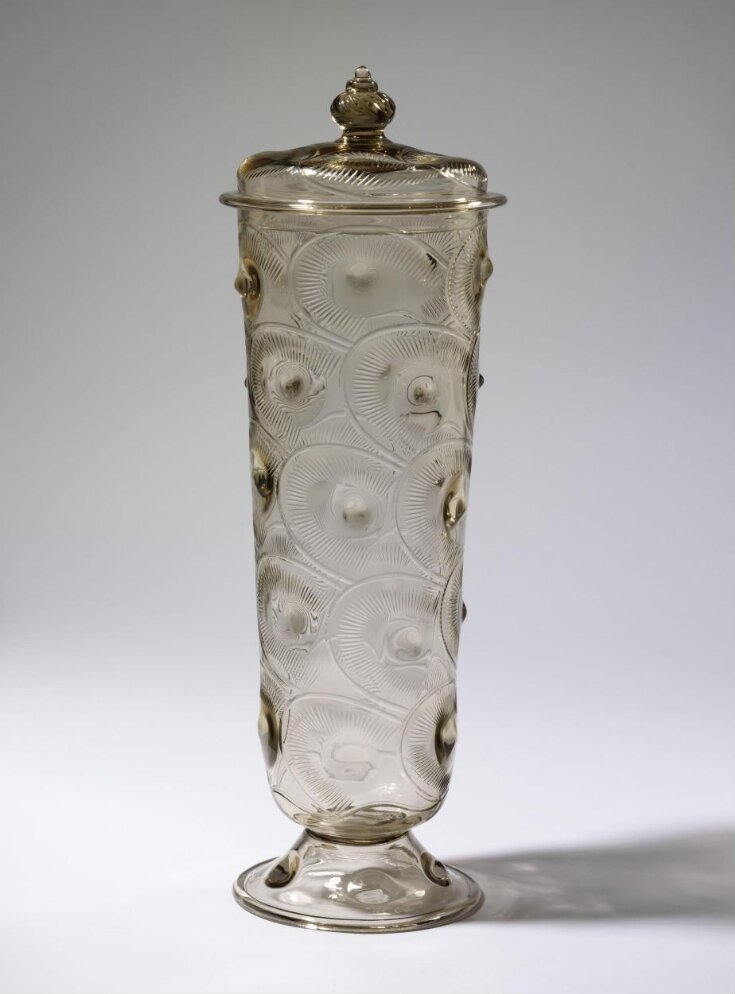

Vase and Cover
1889 (made)
| Artist/Maker | |
| Place of origin |
Clear brown-grey glass vase and cover, mould-blown and wheel-cut, with moulded decoration; design based on the peacock tail feather.
Object details
| Object type | |
| Parts | This object consists of 2 parts.
|
| Materials and techniques | mould-blown and wheel-cut glass |
| Brief description | Vase and cover, France (Paris), made by Ernest-Baptiste Leveillé glass workshop, 1889, 78-1890 |
| Physical description | Clear brown-grey glass vase and cover, mould-blown and wheel-cut, with moulded decoration; design based on the peacock tail feather. |
| Style | |
| Gallery label |
|
| Object history | Ernest-Baptiste Leveillé had a glass-making and selling business at 74 Boulevard Haussmann, and later in rue Coquillière, Paris. He was a member of the Paris 'art-glass' fraternity and a pupil (later partner) of Eugène Rousseau, one of the movement's founders. This piece was made after 1885 when Leveillé took over Rousseau's workshop. The glass was made, possibly, by either Appert Frères or at Clichy to Léveillé's design and decorated in Paris with a repeating pattern of peacock's tail feathers. The unusually simple vase was bought from Léveillé himself. Léveillé exhibited in the Universal Exhibition, Paris, in 1889 and it is possible that this vase was included or that Léveillé's exhibit encouraged the Museum to approach him privately. |
| Production | Léveillé studied and subsequently collaborated with Eugène Rousseau and like him and many of their contemporaries his first work was inspired by the Far East, particularly Japan. |
| Subject depicted | |
| Bibliographic reference | Arwas,V; Art N - Art deco, Leveille and Rousseau; Beard, G: International Modern Glass |
| Collection | |
| Accession number | 78-1890 |
About this object record
Explore the Collections contains over a million catalogue records, and over half a million images. It is a working database that includes information compiled over the life of the museum. Some of our records may contain offensive and discriminatory language, or reflect outdated ideas, practice and analysis. We are committed to addressing these issues, and to review and update our records accordingly.
You can write to us to suggest improvements to the record.
Suggest feedback
You can write to us to suggest improvements to the record.
Suggest feedback
| Record created | December 13, 1997 |
| Record URL |
Download as: JSONIIIF Manifest
