
The Music Lesson
Group
ca. 1765 (made)
ca. 1765 (made)
| Artist/Maker | |
| Place of origin |
The porcelain figures made in eighteenth-century England are very different in character from those of continental Europe. In part this arises from differences in materials, as the sharpness of detail, glittering glaze and brilliant enamels achieved at Meissen and Nymphenburg, for example, could not be realized in the English 'soft-paste' bodies (and only Derby among the English factories made biscuit porcelain in the manner of Sèvres). Moreover, unlike continental factories, those in England were purely commercial concerns and few were able to recruit modellers of the first rank. Nevertheless, with their softer forms and muted colours, and very different market and aesthetic ambitions, English porcelain figures have a definite charm and character all of their own.
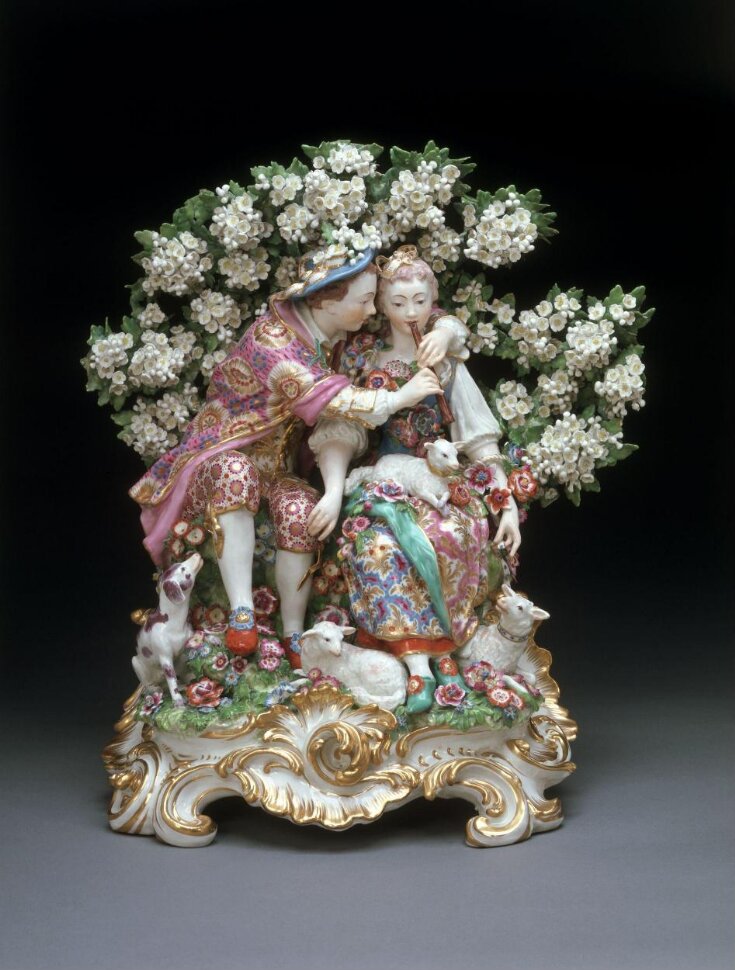
Chelsea figures are of exceptional quality. They were created by one of the few great modellers working in the English industry, Joseph Willems - who, like many of the key personnel at the factory, was from the Low Countries. Willems's figures included compositions of his own creation, accomplished copies of Meissen models and groups based on prints - as with this subject, taken from an engraving of a François Boucher painting. The group prominently features a distinctive characteristic of English ceramic figures of about 1760-1835: the profusion of hand-modelled and applied flowers and vegetation known as 'bocage' (from the French for 'grove'). Such work was carried out by 'repairers', the skilled craftsmen responsible for assembling separately moulded figure parts and sharpening up their detail, and was later a feature of inexpensive Staffordshire pottery ornaments.
Chelsea figures are of exceptional quality. They were created by one of the few great modellers working in the English industry, Joseph Willems - who, like many of the key personnel at the factory, was from the Low Countries. Willems's figures included compositions of his own creation, accomplished copies of Meissen models and groups based on prints - as with this subject, taken from an engraving of a François Boucher painting. The group prominently features a distinctive characteristic of English ceramic figures of about 1760-1835: the profusion of hand-modelled and applied flowers and vegetation known as 'bocage' (from the French for 'grove'). Such work was carried out by 'repairers', the skilled craftsmen responsible for assembling separately moulded figure parts and sharpening up their detail, and was later a feature of inexpensive Staffordshire pottery ornaments.
Object details
| Categories | |
| Object type | |
| Title | The Music Lesson (generic title) |
| Materials and techniques | Soft-paste porcelain, painted in enamels and gilded |
| Brief description | 'The Music Lesson' in soft-paste porcelain, painted in enamels and gilded, of a shepherd boy teaching a shepherdess to play the flute, made by Chelsea Porcelain factory, London, ca. 1765. |
| Physical description | Group of figures in soft-paste porcelain, painted in enamels and gilded, of a shepherd boy teaching a shepherdess to play the flute, and the figures are seated on a mound in front of a bocage consisting of a flowering hawthorn, and the boy wears a wide blue hat with a spray of hawthorn in it, a richly patterned coat and breeches, and red shoes, and by his side is a dog, and the shepherdess is dressed in a blue bodice, flowered skirt and petticoat, and green shoes, and on her lap is a lamb, and with her left hand, which is passed through the handle of a basket of flowers, she holds a ribbon attached to the neck of one or two lambs which lie at her feet, and the whole group is supported on a gilt rococo scrolled base decorated with applied flowers and foliage. |
| Dimensions |
|
| Marks and inscriptions |
|
| Credit line | Given by Lady Charlotte Schreiber |
| Object history | Modelled with alterations after a painting by François Boucher, entitled L'Agréable Leçon, and an engraving by J. E. Nilson Purchased by Lady Charlotte Schreiber from Sanders' sale, Christie's, for £364 in May 1875. This was the largest sum Lady Charlotte Schreiber paid for a piece of English porcelain. |
| Subjects depicted | |
| Summary | The porcelain figures made in eighteenth-century England are very different in character from those of continental Europe. In part this arises from differences in materials, as the sharpness of detail, glittering glaze and brilliant enamels achieved at Meissen and Nymphenburg, for example, could not be realized in the English 'soft-paste' bodies (and only Derby among the English factories made biscuit porcelain in the manner of Sèvres). Moreover, unlike continental factories, those in England were purely commercial concerns and few were able to recruit modellers of the first rank. Nevertheless, with their softer forms and muted colours, and very different market and aesthetic ambitions, English porcelain figures have a definite charm and character all of their own. Chelsea figures are of exceptional quality. They were created by one of the few great modellers working in the English industry, Joseph Willems - who, like many of the key personnel at the factory, was from the Low Countries. Willems's figures included compositions of his own creation, accomplished copies of Meissen models and groups based on prints - as with this subject, taken from an engraving of a François Boucher painting. The group prominently features a distinctive characteristic of English ceramic figures of about 1760-1835: the profusion of hand-modelled and applied flowers and vegetation known as 'bocage' (from the French for 'grove'). Such work was carried out by 'repairers', the skilled craftsmen responsible for assembling separately moulded figure parts and sharpening up their detail, and was later a feature of inexpensive Staffordshire pottery ornaments. |
| Other number | Sch. I 197 - Schreiber number |
| Collection | |
| Accession number | 414:192-1885 |
About this object record
Explore the Collections contains over a million catalogue records, and over half a million images. It is a working database that includes information compiled over the life of the museum. Some of our records may contain offensive and discriminatory language, or reflect outdated ideas, practice and analysis. We are committed to addressing these issues, and to review and update our records accordingly.
You can write to us to suggest improvements to the record.
Suggest feedback
You can write to us to suggest improvements to the record.
Suggest feedback
| Record created | December 18, 2008 |
| Record URL |
Download as: JSONIIIF Manifest
