
The Alarm
Oil Painting
1723 (painted)
1723 (painted)
| Artist/Maker | |
| Place of origin |
Jean-François de Troy (1679-1752) was born in Paris and was first taught by his father. He later attended lessons at the Académie Royale de Peinture et de Sculpture and sojourned in Italy from 1699 to 1706. He specialised in history painting and genre painting with erotically charged scenes, for which he became best known. He was one of the leading painters of the Parisian high society and was nominated, in January 1738, Director of the Académie Française in Rome where he died in 1752.
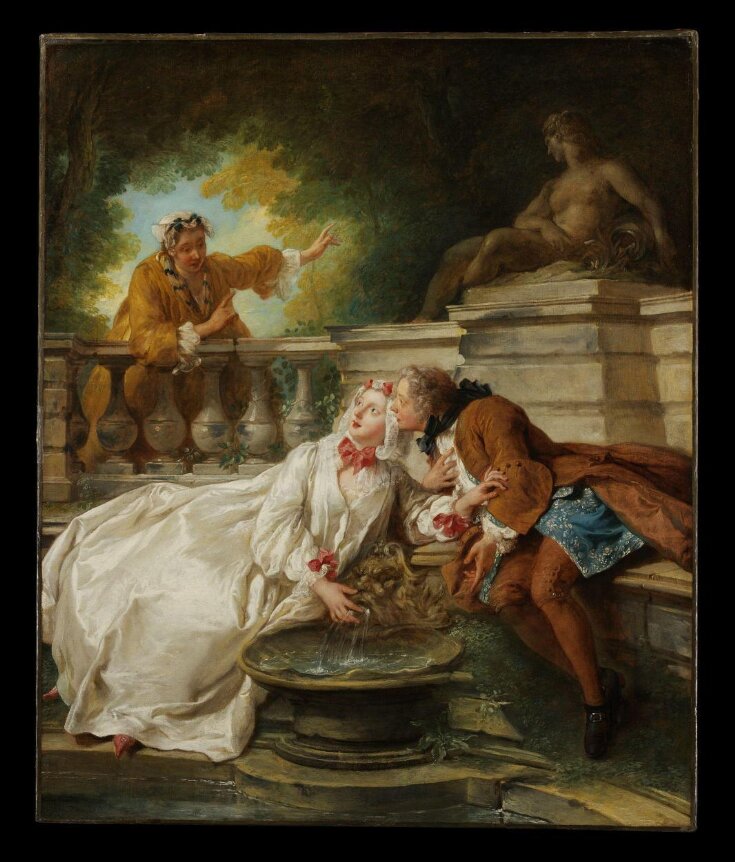
This painting is a good example of the gallant pieces fashionable in the 18th-century France. It depicts a secret rendezvous set in a romantic garden by a fountain while a maid interrupts the conservation with a dramatic gesture. This painting is one of the earliest ‘tableaux de mode’ by de Troy, a genre he is credited to be the inventor.
This painting is a good example of the gallant pieces fashionable in the 18th-century France. It depicts a secret rendezvous set in a romantic garden by a fountain while a maid interrupts the conservation with a dramatic gesture. This painting is one of the earliest ‘tableaux de mode’ by de Troy, a genre he is credited to be the inventor.
Object details
| Categories | |
| Object type | |
| Titles |
|
| Materials and techniques | oil on canvas |
| Brief description | Oil painting, 'The Alarm (La Gouvernante Fidèle)', Jean-François de Troy, French school, 1723 |
| Physical description | A couple of lover sits by a fountain with a grotesque; above a reclining classical nymph surmounts a balustrade, upon which a maid leans towards the couple with a dramatic gesture. |
| Dimensions |
|
| Styles | |
| Marks and inscriptions | 'J F DE TROY 1723' (Siigned and dated by the artist at the bottom of the fountain) |
| Gallery label |
|
| Credit line | Bequeathed by John Jones |
| Object history | Bequeathed by John Jones, 1882 Historical significance: Originally attributed to Watteau, this painting has been restored to de Troy's authorship before 1893. It is a good example of the erotically charged genre scenes for which de Troy became best known. It shows two lovers at a fountain, interrupted by a maid. They wear typical 18th-century costume and are depicted in a romantic garden. The gesture of the lady in white with one hand on the fountain grotesque's mask echoes the gesture of the sculpted nymph above and alludes to her secret rendezvous. This compositional idea is reminiscent of the art of Watteau who developed the genre of the 'fête galante' at the beginning of the 18th century. Although Watteau's 'fête galante' was pervaded with mystery and a sense of timeless feast, de Troy presents a more authentic portrayal of contemporary manners, fashions and pastimes, hence the appellation 'tableaux de modes', whose invention he has been credited with. The presence of nature plays an important role in these pictures and contributes in developing a formula repeated with success by many artists until the French Revolution. These gallant pieces intersect with the taste for a new sensuality, developed later in the century in the libertine philosophy and exemplified in such texts as Dangerous Acquaintances by Choderlos de Laclos and the Marquis de Sade's Philosophy in the Bedroom. This painting is traditionally dated 1723 (inscribed at the bottom of the fountain) but the composition was engraved in reverse by Charles-Nicolas Cochin père about ten years later and bears an inscription reading: 1727. This painting is anyhow one of the earliest 'tableaux de mode' executed by de Troy and one of the most attractive. The print is accompanied by a few verse in French, which converts this piece into a moralising picture with a warning against the consequences of concealed love: 'Fuyez Iris, fuyez: ce séjour est à craindre. Tandis que de ces eaux vous cherchez la fraîcheur, Des discours d'un amant déffendez vôtre coeur, lls allument un feu difficile à s'eteindre'. |
| Historical context | Pastoral is a genre of painting whose subject is the idealized life of shepherds and shepherdesses set in an ideally beautiful and idyllic landscape. These scenes are reminiscent of the Arcadia, the Antique Golden Age that the Roman author Virgil (1St BC) described in the Eclogues and were at the time illustrated on the Roman wall paintings. The pastoral was reborn during the Renaissance, especially in Venice, in the oeuvre of such painters as Titian (ca. 1488-1576) and Giorgione (1477-1510), and gradually evolved over the centuries. In the 17th century, Arcadian themes were illustrated in the Roman school led by the painter Claude Lorrain (1604-1682) whereas a century later, Antoine Watteau (1684-1721) and his followers forged the new genre of fêtes galantes, which appears as a derivation of the pastoral. The pastoral became the hallmark of the Rococo movement in which François Boucher's (1703-1770) elegant eroticism found his true expression. This tradition, which had become an illustration of the carefree aristocratic world, died with the French revolution and was never revived although the celebration of the timeless Mediterranean world in the oeuvre of such painter as Henri Matisse (1869-1954) may be seen as a continuing interest for the theme. |
| Subjects depicted | |
| Summary | Jean-François de Troy (1679-1752) was born in Paris and was first taught by his father. He later attended lessons at the Académie Royale de Peinture et de Sculpture and sojourned in Italy from 1699 to 1706. He specialised in history painting and genre painting with erotically charged scenes, for which he became best known. He was one of the leading painters of the Parisian high society and was nominated, in January 1738, Director of the Académie Française in Rome where he died in 1752. This painting is a good example of the gallant pieces fashionable in the 18th-century France. It depicts a secret rendezvous set in a romantic garden by a fountain while a maid interrupts the conservation with a dramatic gesture. This painting is one of the earliest ‘tableaux de mode’ by de Troy, a genre he is credited to be the inventor. |
| Bibliographic references |
|
| Collection | |
| Accession number | 518-1882 |
About this object record
Explore the Collections contains over a million catalogue records, and over half a million images. It is a working database that includes information compiled over the life of the museum. Some of our records may contain offensive and discriminatory language, or reflect outdated ideas, practice and analysis. We are committed to addressing these issues, and to review and update our records accordingly.
You can write to us to suggest improvements to the record.
Suggest feedback
You can write to us to suggest improvements to the record.
Suggest feedback
| Record created | December 15, 1999 |
| Record URL |
Download as: JSONIIIF Manifest
