
Maharaja Ranjit Singh
Painting
ca. 1835 - ca. 1840 (made)
ca. 1835 - ca. 1840 (made)
| Artist/Maker | |
| Place of origin |
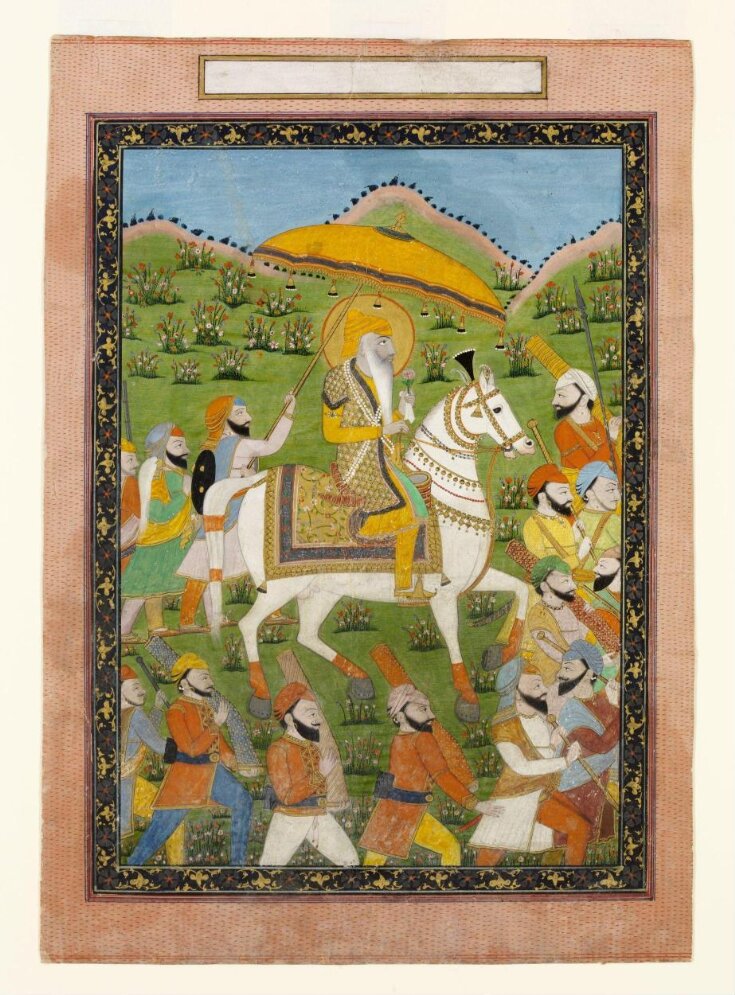
Ranjit Singh was the first Sikh maharaja of the Panjab, the region in the far north of the Indian subcontinent whose Persian name refers to the five rivers flowing across the plains. He ruled from 1801 until his death in 1839. This painting shows Ranjit Singh riding through a flower-sprinkled landscape on a white stallion that is bedecked with gold chains and turban jewels. The maharaja is dressed in saffron-coloured clothes with a brocade short coat, his only jewels being long ropes of pearls and a bazuband, or ornament for the upper arm. He is surrounded by companions, many of whom carry insignia of royalty such as weapons wrapped in cloth. Most important of these is the parasol – the ancient emblem of kings – that shades Ranjit Singh’s head.
The painting was given to the V&A in 1955 by Mrs L.M. Rivett-Carnac on behalf of the Van Cortlandt family. According to family tradition, this was one of a pair of portraits made for Ranjit Singh by his court artist and presented by him to Mrs Rivett-Carnac’s grandfather, Colonel Henry Charles Van Cortlandt, the other copy being kept by the maharaja. Van Cortlandt (1814–1888) entered Ranjit Singh’s service in 1832, and after the first Anglo-Sikh War (1845–1846) commanded Sikh detachments under the British.
The painting was given to the V&A in 1955 by Mrs L.M. Rivett-Carnac on behalf of the Van Cortlandt family. According to family tradition, this was one of a pair of portraits made for Ranjit Singh by his court artist and presented by him to Mrs Rivett-Carnac’s grandfather, Colonel Henry Charles Van Cortlandt, the other copy being kept by the maharaja. Van Cortlandt (1814–1888) entered Ranjit Singh’s service in 1832, and after the first Anglo-Sikh War (1845–1846) commanded Sikh detachments under the British.
Object details
| Categories | |
| Object type | |
| Title | Maharaja Ranjit Singh (generic title) |
| Materials and techniques | Painted in opaque watercolour on paper |
| Brief description | Painting, Maharaja Ranjit Singh, opaque watercolour on paper, Lahore, ca. 1835-1840 |
| Physical description | Painting, in opaque watercolour on paper, Maharaja Ranjit Singh (r. 1801-1839) rides through a hilly landscape on a white horse, accompanied by attendants bearing insignia of royalty. The maharaja's head is framed by a halo of light, a convention borrowed from Mughal painting. |
| Dimensions |
|
| Content description | Maharaja Ranjit Singh (r. 1801-1839) rides through a hilly landscape on a white horse, accompanied by attendants bearing insignia of royalty. The maharaja's head is framed by a halo of light. |
| Credit line | Given by Mrs L.M. Rivett-Carnac on behalf of the Van Cortlandt family |
| Object history | This portrait was said to have been presented by Maharaja Ranjit Singh to Colonel Henry Charles Van Cortlandt (1814-1888), who entered the Maharaja's service for a period of 8 years as a military commander in 1832. It was given to the museum on behalf of the Van Cortlandt family by Mrs L. M. Rivett-Carnac in 1955 Historical significance: Ranjit Singh was the first Sikh Maharaja of the Panjab. |
| Production | Sikh |
| Subjects depicted | |
| Summary | Ranjit Singh was the first Sikh maharaja of the Panjab, the region in the far north of the Indian subcontinent whose Persian name refers to the five rivers flowing across the plains. He ruled from 1801 until his death in 1839. This painting shows Ranjit Singh riding through a flower-sprinkled landscape on a white stallion that is bedecked with gold chains and turban jewels. The maharaja is dressed in saffron-coloured clothes with a brocade short coat, his only jewels being long ropes of pearls and a bazuband, or ornament for the upper arm. He is surrounded by companions, many of whom carry insignia of royalty such as weapons wrapped in cloth. Most important of these is the parasol – the ancient emblem of kings – that shades Ranjit Singh’s head. The painting was given to the V&A in 1955 by Mrs L.M. Rivett-Carnac on behalf of the Van Cortlandt family. According to family tradition, this was one of a pair of portraits made for Ranjit Singh by his court artist and presented by him to Mrs Rivett-Carnac’s grandfather, Colonel Henry Charles Van Cortlandt, the other copy being kept by the maharaja. Van Cortlandt (1814–1888) entered Ranjit Singh’s service in 1832, and after the first Anglo-Sikh War (1845–1846) commanded Sikh detachments under the British. |
| Bibliographic references |
|
| Collection | |
| Accession number | IS.282-1955 |
About this object record
Explore the Collections contains over a million catalogue records, and over half a million images. It is a working database that includes information compiled over the life of the museum. Some of our records may contain offensive and discriminatory language, or reflect outdated ideas, practice and analysis. We are committed to addressing these issues, and to review and update our records accordingly.
You can write to us to suggest improvements to the record.
Suggest feedback
You can write to us to suggest improvements to the record.
Suggest feedback
| Record created | December 15, 1999 |
| Record URL |
Download as: JSONIIIF Manifest
