Figure Group
1560-1575 (made)
| Artist/Maker | |
| Place of origin |
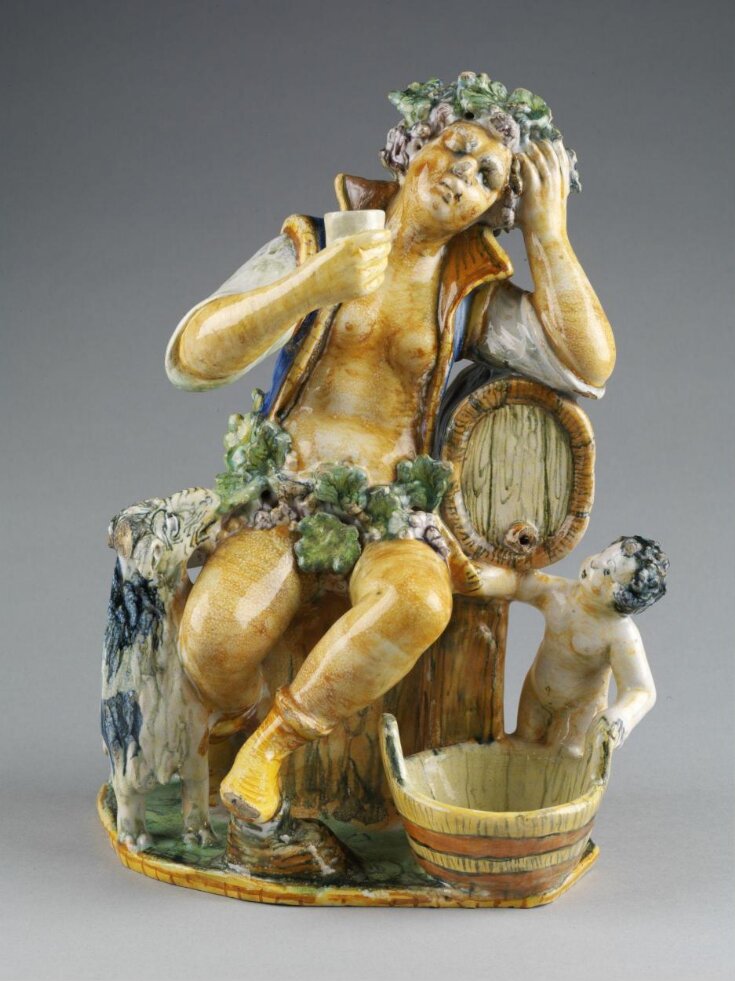
Colourful figural groups made in tin-glazed ceramic provided the opportunity to own a durable and highly finished, sculptural object at relatively low cost. Such groups were mostly objects with a practical function, such as inkwells or candlesticks. Table-fountains are more rare. This table fountain is suitably fashioned as a drunken Bacchus, resting on a wine barrel. The Bacchus figure has a hole behind the head, through which it can be filled with liquid, which then escapes through a hole in the side of the barrel as well as through his penis. He is literary pissed and pissing at the same time. Objects such as this were obviously intended to provide some entertainment for guests at dinner parties.
Object details
| Categories | |
| Object type | |
| Materials and techniques | Tin-glazed earthenware painted with enamels |
| Brief description | Figure group of Bacchus in tin-glazed earthenware painted with enamels, Fontana Workshop, Urbino, 1560-1575. |
| Physical description | Figure group, tin-glazed earthenware painted with enamels, of Bacchus siting on a tree stump and drinking wine which has come from a cask at his side on which his arm rests. He is adorned with bunches of grapes and has a child and a goat beside him. |
| Dimensions |
|
| Credit line | Presented by Lt. Col. K. Dingwall, DSO with Art Fund support |
| Historical context | Colourful figural groups made in tin-glazed ceramic provided the opportunity to own a durable and highly finished, sculptural object at relatively low cost. Such groups were mostly objects with a practical function, such as inkwells or candlesticks. Table-fountains are more rare. This table fountain is suitably fashioned as a drunken Bacchus, resting on a wine barrel. The Bacchus figure has a hole behind the head, through which it can be filled with liquid, which then escapes through a hole in the side of the barrel as well as through his penis. He is literary pissed and pissing at the same time. Objects such as this were obviously intended to provide some entertainment for guests at dinner parties. |
| Subjects depicted | |
| Summary | Colourful figural groups made in tin-glazed ceramic provided the opportunity to own a durable and highly finished, sculptural object at relatively low cost. Such groups were mostly objects with a practical function, such as inkwells or candlesticks. Table-fountains are more rare. This table fountain is suitably fashioned as a drunken Bacchus, resting on a wine barrel. The Bacchus figure has a hole behind the head, through which it can be filled with liquid, which then escapes through a hole in the side of the barrel as well as through his penis. He is literary pissed and pissing at the same time. Objects such as this were obviously intended to provide some entertainment for guests at dinner parties. |
| Bibliographic references |
|
| Collection | |
| Accession number | C.665-1920 |
About this object record
Explore the Collections contains over a million catalogue records, and over half a million images. It is a working database that includes information compiled over the life of the museum. Some of our records may contain offensive and discriminatory language, or reflect outdated ideas, practice and analysis. We are committed to addressing these issues, and to review and update our records accordingly.
You can write to us to suggest improvements to the record.
Suggest feedback
You can write to us to suggest improvements to the record.
Suggest feedback
| Record created | December 15, 1999 |
| Record URL |
Download as: JSONIIIF Manifest
