
Pillow Cover
early 17th century (made)
| Artist/Maker | |
| Place of origin |
In England in the 17th century the majority of wooden chairs and stools were not upholstered, and in more prosperous homes, decorated cushions like this were widely used both for comfort and for the attractiveness of their appearance.
Much embroidery for furnishings such as cushions would have been worked by amateurs on a ground on which the design had been drawn by a professional pattern drawer, sometimes adapting published prints. Because the design would have been drawn on the canvas in black outline only, the embroiderer could use her individual taste in the choice of colour, and to a more limited extent, stitch and type of thread.
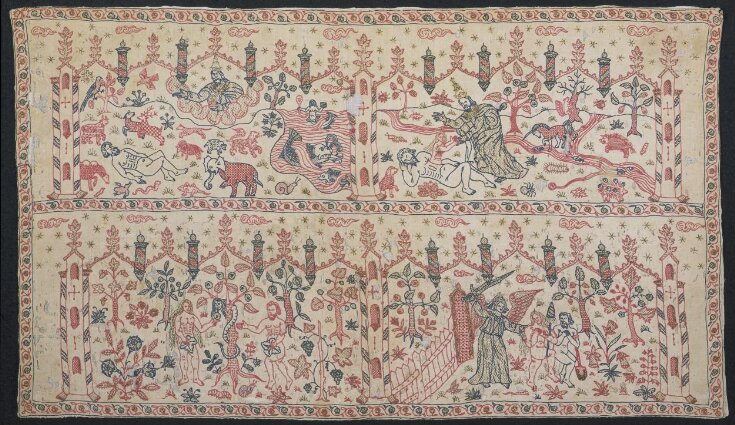
This embroidery shows four scenes from the Old Testament: God creating Adam, God creating Eve from Adam's rib, the temptation of Eve and the expulsion from the Garden of Eden. Stories from the Old Testament were popular subjects in English 17th-century domestic embroidery, many versions surviving with minor variations. Most of these were taken originally from a book of biblical stories published by Gerard de Jode in Antwerp in 1585. The illustrations from this seem to have had a wide circulation in England.
Much embroidery for furnishings such as cushions would have been worked by amateurs on a ground on which the design had been drawn by a professional pattern drawer, sometimes adapting published prints. Because the design would have been drawn on the canvas in black outline only, the embroiderer could use her individual taste in the choice of colour, and to a more limited extent, stitch and type of thread.
This embroidery shows four scenes from the Old Testament: God creating Adam, God creating Eve from Adam's rib, the temptation of Eve and the expulsion from the Garden of Eden. Stories from the Old Testament were popular subjects in English 17th-century domestic embroidery, many versions surviving with minor variations. Most of these were taken originally from a book of biblical stories published by Gerard de Jode in Antwerp in 1585. The illustrations from this seem to have had a wide circulation in England.
Object details
| Categories | |
| Object type | |
| Materials and techniques | Linen, embroidered with metal thread and silks |
| Brief description | Embroidered linen cushion cover, 1600-1629, English, depicting four Biblical scenes |
| Physical description | This long pillow cover depicts biblical scenes, including Adam and Eve in the Garden of Eden. Linen embroidered with metal thread and silks in stem, chain, back, cross and speckling stitches. |
| Dimensions |
|
| Historical context | See T.143-1962 for details of design source. |
| Subjects depicted | |
| Summary | In England in the 17th century the majority of wooden chairs and stools were not upholstered, and in more prosperous homes, decorated cushions like this were widely used both for comfort and for the attractiveness of their appearance. Much embroidery for furnishings such as cushions would have been worked by amateurs on a ground on which the design had been drawn by a professional pattern drawer, sometimes adapting published prints. Because the design would have been drawn on the canvas in black outline only, the embroiderer could use her individual taste in the choice of colour, and to a more limited extent, stitch and type of thread. This embroidery shows four scenes from the Old Testament: God creating Adam, God creating Eve from Adam's rib, the temptation of Eve and the expulsion from the Garden of Eden. Stories from the Old Testament were popular subjects in English 17th-century domestic embroidery, many versions surviving with minor variations. Most of these were taken originally from a book of biblical stories published by Gerard de Jode in Antwerp in 1585. The illustrations from this seem to have had a wide circulation in England. |
| Collection | |
| Accession number | T.115-1928 |
About this object record
Explore the Collections contains over a million catalogue records, and over half a million images. It is a working database that includes information compiled over the life of the museum. Some of our records may contain offensive and discriminatory language, or reflect outdated ideas, practice and analysis. We are committed to addressing these issues, and to review and update our records accordingly.
You can write to us to suggest improvements to the record.
Suggest feedback
You can write to us to suggest improvements to the record.
Suggest feedback
| Record created | December 15, 1999 |
| Record URL |
Download as: JSONIIIF Manifest
