Sickness and Health
Oil Painting
1843 (painted)
1843 (painted)
| Artist/Maker | |
| Place of origin |
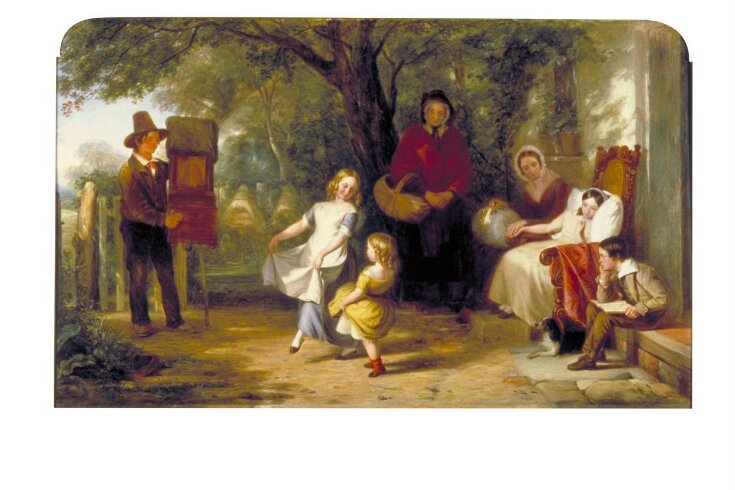
Webster exhibited this painting alongside a quotation from Wordsworth's poem 'The Three Cottage Girls': 'The cheerfulness of innocence survives to mitigate distress'. He starkly contrasts the girls dancing to organ music with the sick girl and her anxious family. A critic thought it 'a simple subject, treated with infinite grace and pathos'.
Object details
| Categories | |
| Object type | |
| Title | Sickness and Health (popular title) |
| Materials and techniques | oil on panel |
| Brief description | Oil painting entitled 'Sickness and Health' by Thomas Webster. Great Britain, 1843. |
| Physical description | This painting also originally bore a literary quotation with its title: 'the cheerfulness of innocence serves to mitigate distress' taken from Wordsworth. The sickness and death of children was common throughout the social classes in nineteenth-century England, and was a constant theme in art and literature from the 1830s. A special impetus was given by Dickens, whose death of young Paul in Dombey and Son (1847-8) and of Little Nell in The Old Curiosity Shop (1841) reached the hearts and minds of most of the reading public. Webster appeals to our emotions by contrasting the two children dancing to the music of the itinerant organ-grinder with the sick girl and her sympathetically morose brother. The picture was much admired by contemporary critics, not only for its sweetness of sentiment but for its careful handling of paint. |
| Dimensions |
|
| Styles | |
| Marks and inscriptions | 'T. Webster./1843' (Signed and dated by the artist, lower right) |
| Credit line | Given by John Sheepshanks, 1857 |
| Object history | Given by John Sheepshanks, 1857 |
| Subjects depicted | |
| Literary reference | Wordsworth: The Three Cottage Girls |
| Summary | Webster exhibited this painting alongside a quotation from Wordsworth's poem 'The Three Cottage Girls': 'The cheerfulness of innocence survives to mitigate distress'. He starkly contrasts the girls dancing to organ music with the sick girl and her anxious family. A critic thought it 'a simple subject, treated with infinite grace and pathos'. |
| Bibliographic reference | Catalogue of British Oil Paintings 1820-1860, Ronald Parkinson, Victoria and Albert Museum, London: HMSO, 1990, p. 297 |
| Collection | |
| Accession number | FA.219[O] |
About this object record
Explore the Collections contains over a million catalogue records, and over half a million images. It is a working database that includes information compiled over the life of the museum. Some of our records may contain offensive and discriminatory language, or reflect outdated ideas, practice and analysis. We are committed to addressing these issues, and to review and update our records accordingly.
You can write to us to suggest improvements to the record.
Suggest feedback
You can write to us to suggest improvements to the record.
Suggest feedback
| Record created | December 15, 1999 |
| Record URL |
Download as: JSONIIIF Manifest
