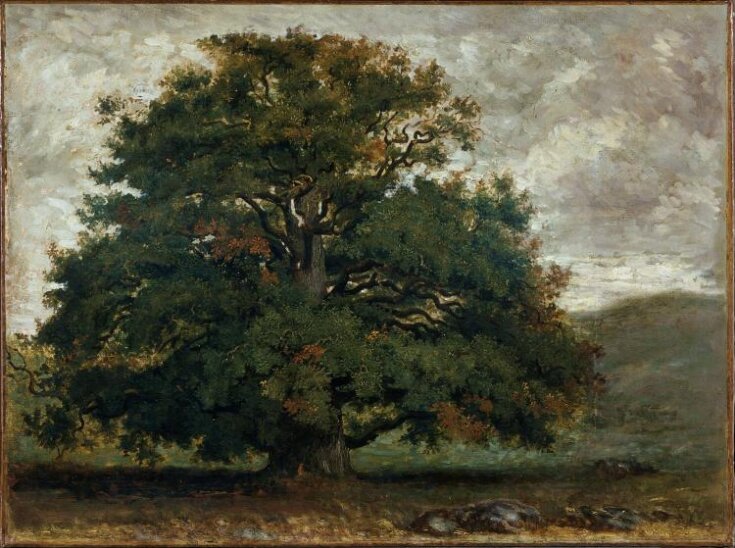

A Tree in Fontainebleau Forest
Oil Painting
1840s (painted)
1840s (painted)
| Artist/Maker | |
| Place of origin |
Théodore Rousseau (1812-1867) was born in Paris where he trained with his cousin, the landscape painter Alexandre Pau de Saint-Martin (1782-1850), and subsequently with Joseph Rémond (1795-1875). In spite of progressively emerging as the leader of the Barbizon school, Rousseau was systematically excluded from the Paris Salon between 1836 and 1841. Between the revolution of 1848 and the early 1860s, Rousseau enjoyed a short period of prosperity with official commissions and was eventually made Officer of the Légion d'honneur in 1867, a few month before he died.
This painting is a fine example of Rousseau's portrayal of trees, one of his favourite subject matters. Originally executed on paper and later laid on canvas, this painting was probably made en plein-air, directly after the motif in the forest of Fontainebleau. This artistic practice was characteristic of the painters of the School of Barbizon, of which Rousseau is considered one of the most authoritative exponents.
This painting is a fine example of Rousseau's portrayal of trees, one of his favourite subject matters. Originally executed on paper and later laid on canvas, this painting was probably made en plein-air, directly after the motif in the forest of Fontainebleau. This artistic practice was characteristic of the painters of the School of Barbizon, of which Rousseau is considered one of the most authoritative exponents.
Object details
| Categories | |
| Object type | |
| Parts | This object consists of 2 parts.
|
| Titles |
|
| Materials and techniques | oil on paper laid on canvas |
| Brief description | Oil painting, 'A Tree in Fontainebleau Forest', Théodore Rousseau, 1840s |
| Physical description | A large oak tree in the foreground, with hues of burnt ochre in the foliage, in the background a hilly landscape under a cloudy sky. |
| Dimensions |
|
| Styles | |
| Marks and inscriptions |
|
| Credit line | Bequeathed by Constantine Alexander Ionides |
| Object history | Bequeathed by Constantine Alexander Ionides, 1900. Acquired by Ionides for £500 before 1881 (cf. Ionides' personal inventory of his collection, private collection), probably from the firm Goupil and Co. Historical significance: This painting is a fine example of Rousseau's portrayal of trees, a recurrent subject matter within his production of landscape paintings. This imposing oak tree dominates the landscape in the forest of Fontainebleau and was probably depicted after the motif en plein air. The earthen and cool palette enlivened with touches of burnt ochre suggests that the picture was captured during an autumnal afternoon. Rousseau lived in the nearby village of Barbizon, which gave its name to the realist movement developed there by artists attracted by the atmospheric effects and the beautiful nature of the forest of Fontainebleau. Their art is reminiscent of John Constable and 17th-century Dutch landscape painters, whose depiction of the natural world had a strong influence on their technical approach. Constable's strongest impact in France, from 1824 when The Haywain (1821, The National Gallery, London) was shown at the Salon, up to the late 1830s coincided with the beginning of the movement later called Barbizon school. An inscription on the back stretcher reads: 'Th. Rousseau vers 1840. Etude du Dormoir', which places the painting around 1840 but as Kauffmann suggested, this painting may have been executed at a later date. A painting is the Louvre showing a group of oak trees in Apremont (Inv. RF 1447), executed c. 1850-52 and exhibited at the Exposition Universelle in 1855, shows many similarities with the present painting. It is not unlikely that the Louvre painting, representative of Rousseau's studio-reworked paintings, was inspired by the present composition. Rousseau particularly favoured depicting lone trees, demonstrating a remarkable ability to capture their individuality. The present tree even had name: it was called Le Rageur (i.e. the furious one) and this painting shows Rousseau's transitional position between Romanticism and Naturalism as he oscillates between the humanisation of nature and the truthful rendering of the countryside. |
| Historical context | 19th-century French art is marked by a succession of movements based on a more or less close relationship with nature. At the beginning of the century, Romantic artists were fascinated by nature they interpreted as a mirror of the mind. They investigated human nature and personality, the folk culture, the national and ethnic origins, the medieval era, the exotic, the remote, the mysterious and the occult. This movement was heralded in France by such painter as Eugène Delacroix (1798-1863). In its opposition to academic art and its demand for a modern style Realism continued the aims of the Romantics. They assumed that reality could be perceived without distortion or idealization, and sought after a mean to combine the perception of the individual with objectivity. This reaction in French painting against the Grand Manner is well represented by Gustave Courbet (1819-1877) who wrote a 'Manifesto of Realism', entitled Le Réalisme published in Paris in 1855. These ideas were challenged by the group of the Barbizon painters, who formed a recognizable school from the early 1830s to the 1870s and developed a free, broad and rough technique. They were mainly concerned by landscape painting and the rendering of light. The works of Narcisse Virgile Diaz de la Peña (1807-1876), Jules Dupré (1811-1889), Théodore Rousseau (1812-1867), Constant Troyon (1810-1865) and Jean-François Millet (1814-1875) anticipate somehow the plein-air landscapes of the Impressionists. |
| Subjects depicted | |
| Summary | Théodore Rousseau (1812-1867) was born in Paris where he trained with his cousin, the landscape painter Alexandre Pau de Saint-Martin (1782-1850), and subsequently with Joseph Rémond (1795-1875). In spite of progressively emerging as the leader of the Barbizon school, Rousseau was systematically excluded from the Paris Salon between 1836 and 1841. Between the revolution of 1848 and the early 1860s, Rousseau enjoyed a short period of prosperity with official commissions and was eventually made Officer of the Légion d'honneur in 1867, a few month before he died. This painting is a fine example of Rousseau's portrayal of trees, one of his favourite subject matters. Originally executed on paper and later laid on canvas, this painting was probably made en plein-air, directly after the motif in the forest of Fontainebleau. This artistic practice was characteristic of the painters of the School of Barbizon, of which Rousseau is considered one of the most authoritative exponents. |
| Bibliographic references |
|
| Collection | |
| Accession number | CAI.54 |
About this object record
Explore the Collections contains over a million catalogue records, and over half a million images. It is a working database that includes information compiled over the life of the museum. Some of our records may contain offensive and discriminatory language, or reflect outdated ideas, practice and analysis. We are committed to addressing these issues, and to review and update our records accordingly.
You can write to us to suggest improvements to the record.
Suggest feedback
You can write to us to suggest improvements to the record.
Suggest feedback
| Record created | December 15, 1999 |
| Record URL |
Download as: JSONIIIF Manifest
