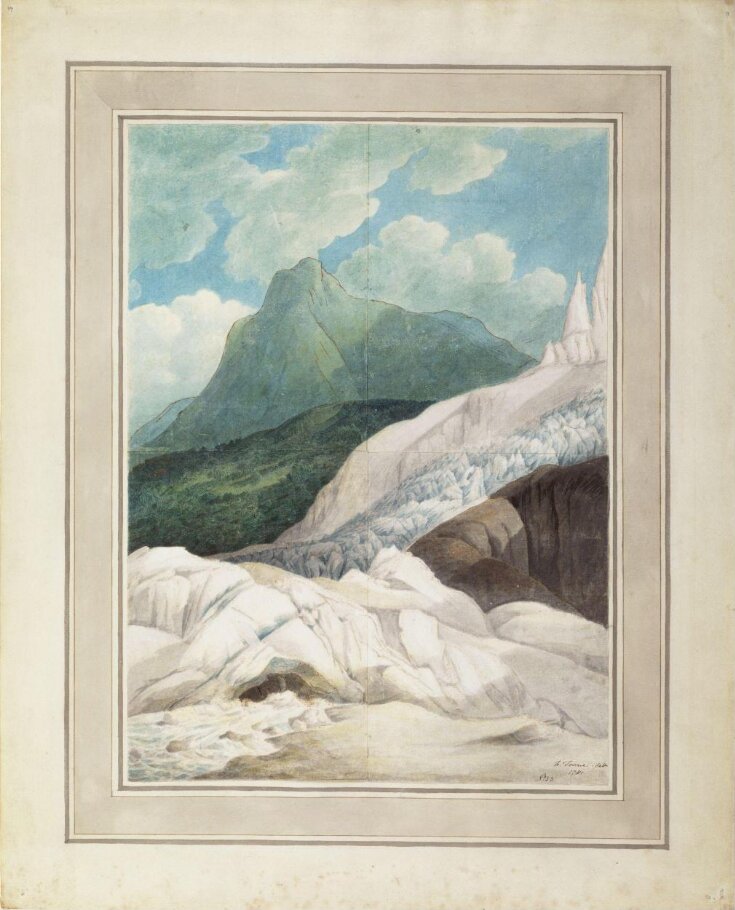

The Source of the Arveiron, with Mont Blanc in the Background
Watercolour
1781 (painted)
1781 (painted)
| Artist/Maker | |
| Place of origin |
Francis Towne (1739-1816) began his artistic career as a coach painter. He later moved on to landscape painting. His watercolours are very simple but striking. He painted this watercolour in Switzerland, where he stayed on his return to England after a trip to Italy.
Delve deeper
Discover more about this object

Object details
| Categories | |
| Object type | |
| Title | The Source of the Arveiron, with Mont Blanc in the Background (popular title) |
| Materials and techniques | Watercolour, pen and ink |
| Brief description | Watercolour entitled 'The Source of the Arveiron, with Mont Blanc in the Background' by Francis Towne. British School, 1781. |
| Physical description | View of the source of the River Arveyron in the Chamonix valley. In the background is the Aiguille de Bochard in the Mont Blanc range, and descending from the right and into the foreground is the southern end of the Mer de Glace glacier. This drawing belongs to the remarkable series of studies of Alpine scenery. Towne banishes all 'picturesque' elements such as wayside shrines and bridges and his vision is of the greatest severity; his presentation austere. He achieves the expression of his fascination with the geometry of nature by the most economical of means, reducing everything to the simplest of terms and achieving a monumentality by his skilful arrangement of light and interreacting planes. |
| Dimensions |
|
| Style | |
| Marks and inscriptions | (Signed and dated 1781.) |
| Object history | Bought from Thomas Agnew & Sons, Ltd, 43 Old Bond Street, London. |
| Subject depicted | |
| Places depicted | |
| Summary | Francis Towne (1739-1816) began his artistic career as a coach painter. He later moved on to landscape painting. His watercolours are very simple but striking. He painted this watercolour in Switzerland, where he stayed on his return to England after a trip to Italy. |
| Bibliographic references |
|
| Collection | |
| Accession number | P.20-1921 |
About this object record
Explore the Collections contains over a million catalogue records, and over half a million images. It is a working database that includes information compiled over the life of the museum. Some of our records may contain offensive and discriminatory language, or reflect outdated ideas, practice and analysis. We are committed to addressing these issues, and to review and update our records accordingly.
You can write to us to suggest improvements to the record.
Suggest feedback
You can write to us to suggest improvements to the record.
Suggest feedback
| Record created | December 15, 1999 |
| Record URL |
Download as: JSONIIIF Manifest
