
Vauxhall Gardens
Watercolour
ca. 1784 (painted)
ca. 1784 (painted)
| Artist/Maker | |
| Place of origin |
Thomas Rowlandson (1756-1827) loved to depict high and low life in England at the time. Many of his drawings and watercolours are on a comical theme.
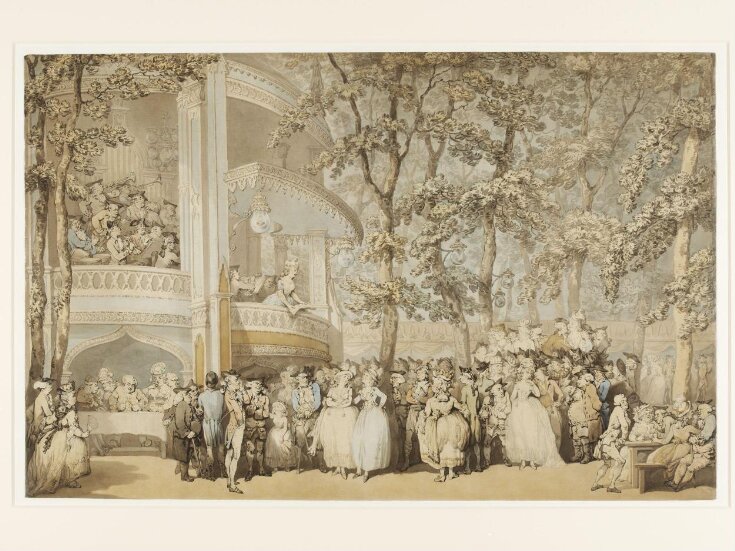
The Vauxhall gardens were a fashionable resort, just south of the Thames in London. Here visitors could eat, drink, dance, listen to music, take a stroll and enjoy the sculptures in the open air.
In this drawing it is possible to identify many well known people. They include Samuel Johnson (1709-1784), author of the famous ‘Dictionary’, the writers James Boswell (1740-1795), Mrs Thrale (1741-1821) and Oliver Goldsmith (1728-1774), and society figures - the Duchess of Devonshire (1757-1806) and her sister Lady Duncannon; the Prince of Wales (1762-1830), who became king as George IV in 1820, and his mistress, the actress Mary ‘Perdita’ Robinson (1758-1800); and Admiral Paisley.
The Vauxhall gardens were a fashionable resort, just south of the Thames in London. Here visitors could eat, drink, dance, listen to music, take a stroll and enjoy the sculptures in the open air.
In this drawing it is possible to identify many well known people. They include Samuel Johnson (1709-1784), author of the famous ‘Dictionary’, the writers James Boswell (1740-1795), Mrs Thrale (1741-1821) and Oliver Goldsmith (1728-1774), and society figures - the Duchess of Devonshire (1757-1806) and her sister Lady Duncannon; the Prince of Wales (1762-1830), who became king as George IV in 1820, and his mistress, the actress Mary ‘Perdita’ Robinson (1758-1800); and Admiral Paisley.
Object details
| Categories | |
| Object type | |
| Title | Vauxhall Gardens (generic title) |
| Materials and techniques | Pen and ink, with watercolour and graphite pencil, on paper |
| Brief description | Thomas Rowlandson (1757-1827), 'Vauxhall Gardens'. Pen and ink, with water-colour and graphite pencil, on paper. About 1784. |
| Physical description | The scene is an alfresco concert at Vauxhall with the singer Mrs Weichsel accompanied by a group of musicians entertaining the audience from the Orchestra where performances were held in fine weather. Below them are the supperboxes. The two ladies holding court under the central tree are said to be the beautiful Duchess of Devonshire and her sister Lady Duncannon, and among their entourage are plausibly identified Captain Topham, gossip writer to The World who quizzes them through a glass; Admiral Paisley with eye patch and wooden leg; to the right of the tree, James Perry, editor of The Morning Chronicle in highland dress. |
| Dimensions |
|
| Style | |
| Credit line | Purchased with Art Fund support |
| Subjects depicted | |
| Places depicted | |
| Summary | Thomas Rowlandson (1756-1827) loved to depict high and low life in England at the time. Many of his drawings and watercolours are on a comical theme. The Vauxhall gardens were a fashionable resort, just south of the Thames in London. Here visitors could eat, drink, dance, listen to music, take a stroll and enjoy the sculptures in the open air. In this drawing it is possible to identify many well known people. They include Samuel Johnson (1709-1784), author of the famous ‘Dictionary’, the writers James Boswell (1740-1795), Mrs Thrale (1741-1821) and Oliver Goldsmith (1728-1774), and society figures - the Duchess of Devonshire (1757-1806) and her sister Lady Duncannon; the Prince of Wales (1762-1830), who became king as George IV in 1820, and his mistress, the actress Mary ‘Perdita’ Robinson (1758-1800); and Admiral Paisley. |
| Associated object | 27607 (Reproduction) |
| Bibliographic references |
|
| Collection | |
| Accession number | P.13-1967 |
About this object record
Explore the Collections contains over a million catalogue records, and over half a million images. It is a working database that includes information compiled over the life of the museum. Some of our records may contain offensive and discriminatory language, or reflect outdated ideas, practice and analysis. We are committed to addressing these issues, and to review and update our records accordingly.
You can write to us to suggest improvements to the record.
Suggest feedback
You can write to us to suggest improvements to the record.
Suggest feedback
| Record created | December 15, 1999 |
| Record URL |
Download as: JSONIIIF Manifest
