Sculpture
1840-1860 (made)
| Artist/Maker | |
| Place of origin |
Object Type
The composition, probably based on figures made for a fountain, is known in a number of variants and was evidently popular as a garden decoration.
Time
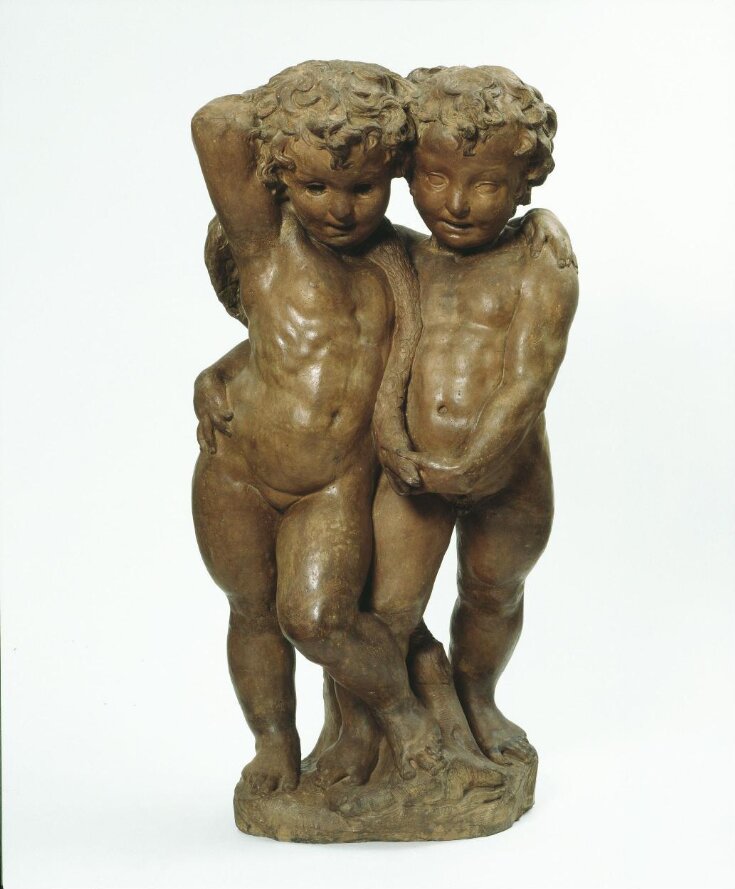
The motif of children playing with a goose is of classical origin. The group relates stylistically to figures produced around 1545 by Niccolò Tribolo and Pierino da Vinci, who were both specialists at modelling children. However, it was made by a reproductive technique, and tests indicated that the sculpture was fired less than 150 years ago, probably not long before it was acquired and sketched by Edward Burne-Jones (1833-1898). This type of image has clearly appealed to different western cultures over an extensive period.
Materials & Making
The group was made from moulded clay, which was then fired to form the more permanent terracotta. This method of production allows replicas to be made quickly and comparatively easily. Expansion of air or water during firing can cause breakage, so the clay group was first left to dry as much as possible. The even thickness of the wall of this hollow sculpture also helped to regulate water loss, further reducing the risk of breakage. Cast-lines were removed and details sharpened in the 'leather-hard' clay before firing.
The composition, probably based on figures made for a fountain, is known in a number of variants and was evidently popular as a garden decoration.
Time
The motif of children playing with a goose is of classical origin. The group relates stylistically to figures produced around 1545 by Niccolò Tribolo and Pierino da Vinci, who were both specialists at modelling children. However, it was made by a reproductive technique, and tests indicated that the sculpture was fired less than 150 years ago, probably not long before it was acquired and sketched by Edward Burne-Jones (1833-1898). This type of image has clearly appealed to different western cultures over an extensive period.
Materials & Making
The group was made from moulded clay, which was then fired to form the more permanent terracotta. This method of production allows replicas to be made quickly and comparatively easily. Expansion of air or water during firing can cause breakage, so the clay group was first left to dry as much as possible. The even thickness of the wall of this hollow sculpture also helped to regulate water loss, further reducing the risk of breakage. Cast-lines were removed and details sharpened in the 'leather-hard' clay before firing.
Object details
| Categories | |
| Object type | |
| Materials and techniques | Cast terracotta |
| Brief description | Boy and Girl with Goose |
| Physical description | Two naked figures of a boy and a girl are posed frontally standing side by side against a tree stump. A goose is supported on the girl's back. |
| Dimensions |
|
| Gallery label | British Galleries:
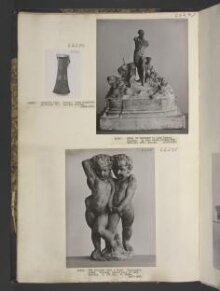
AN ARTIST'S SKETCHES IN THE MUSEUM From about 1860 the Museum was actively collecting and displaying European Medieval and Renaissance decorative arts and sculpture. This small figure group was bought in 1863 for the South Kensington Museum and thought at the time to have been made in about 1550. In the 1860s the artist Edward Burne-Jones studied works of art in museum collections to improve his drawing skills. This is his sketch of the terracotta group, made on one of his visits to the Museum.(27/03/2003) |
| Object history | Possibly based on figures by Niccolo Tribolo (probably born in Florence, Italy, 1500, probably died there in 1550) and Pierino da Vinci (born in Vinci, Italy, about 1529, died in Pisa, Italy, 1553) Probably made in Florence, Italy. |
| Historical context | The group is known in a number of variants and was evidently popular as garden decoration. The motif of children playing with a goose is of classical origin. |
| Subjects depicted | |
| Summary | Object Type The composition, probably based on figures made for a fountain, is known in a number of variants and was evidently popular as a garden decoration. Time The motif of children playing with a goose is of classical origin. The group relates stylistically to figures produced around 1545 by Niccolò Tribolo and Pierino da Vinci, who were both specialists at modelling children. However, it was made by a reproductive technique, and tests indicated that the sculpture was fired less than 150 years ago, probably not long before it was acquired and sketched by Edward Burne-Jones (1833-1898). This type of image has clearly appealed to different western cultures over an extensive period. Materials & Making The group was made from moulded clay, which was then fired to form the more permanent terracotta. This method of production allows replicas to be made quickly and comparatively easily. Expansion of air or water during firing can cause breakage, so the clay group was first left to dry as much as possible. The even thickness of the wall of this hollow sculpture also helped to regulate water loss, further reducing the risk of breakage. Cast-lines were removed and details sharpened in the 'leather-hard' clay before firing. |
| Bibliographic references |
|
| Collection | |
| Accession number | 8527-1863 |
About this object record
Explore the Collections contains over a million catalogue records, and over half a million images. It is a working database that includes information compiled over the life of the museum. Some of our records may contain offensive and discriminatory language, or reflect outdated ideas, practice and analysis. We are committed to addressing these issues, and to review and update our records accordingly.
You can write to us to suggest improvements to the record.
Suggest feedback
You can write to us to suggest improvements to the record.
Suggest feedback
| Record created | December 15, 1999 |
| Record URL |
Download as: JSONIIIF Manifest
